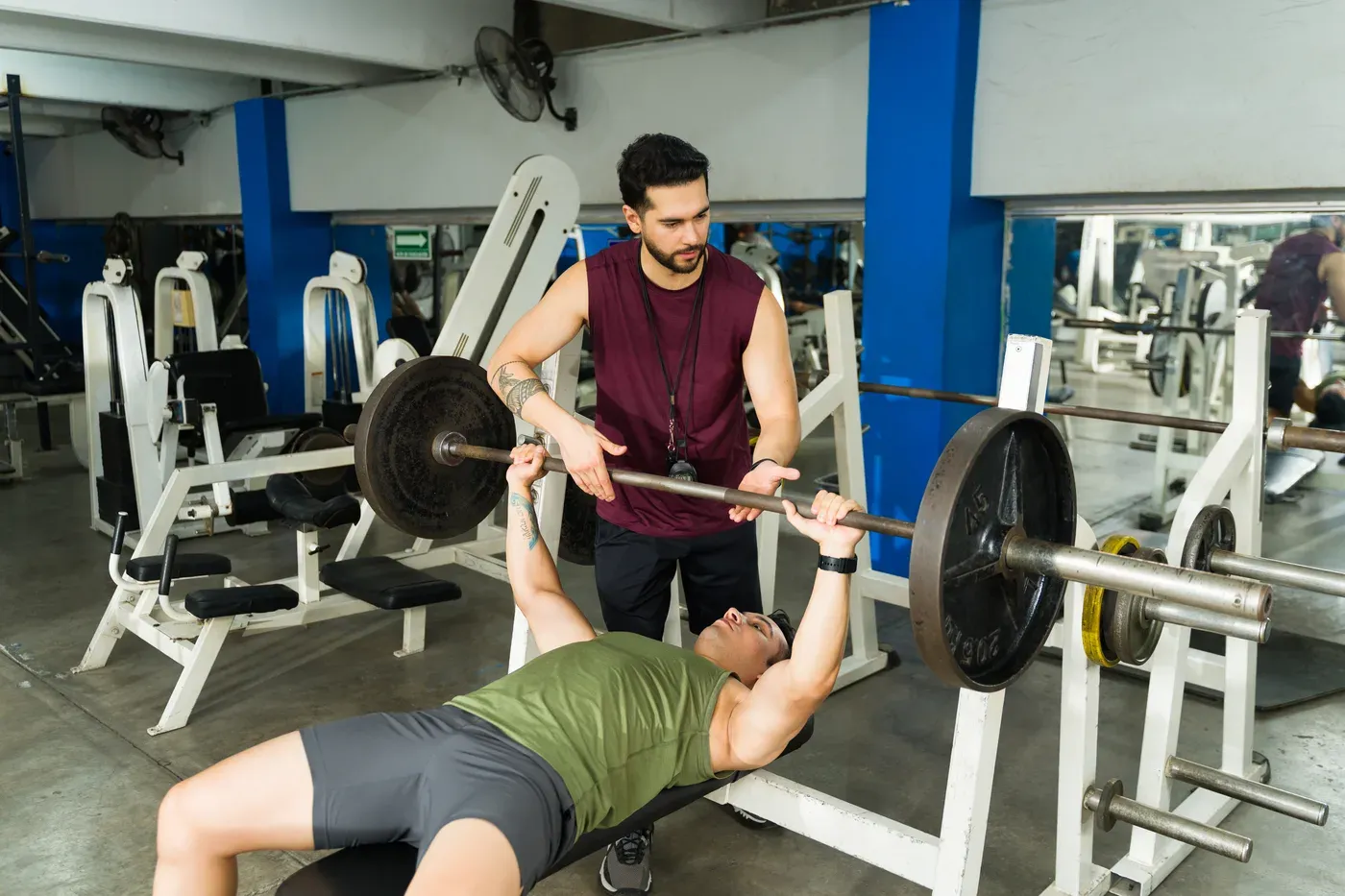
To bench press safely over 40, set the rack’s safety arms just below chest level, pin your shoulder blades back and down, grip slightly wider than your shoulders, and lower the bar to your lower chest with elbows tucked at roughly 45 to 70 degrees from your sides. Press back up over your shoulders. A slower lowering phase and lighter top sets keep the shoulders happier than chasing a one-rep max.
What it trains and why bother
The bench press builds the chest, front of the shoulders and triceps, and it’s one of the few upper-body lifts you can load heavy and track precisely over years. A stronger press carries into pushing a stalled car, getting up off the floor and holding your own in a game of pickup basketball.
The trade-off is the shoulder joint, which takes more wear in the bench than in most lifts. The fix isn’t to avoid it, it’s to press with a shoulder position that holds up.
Before the first rep
Lie down with your eyes directly under the bar. Plant your feet flat, a bit wider than hip width. Pull your shoulder blades together and down, as though pinning them into your back pockets, and keep them there the whole set. You should feel your upper back pressing into the pad and a small gap under your lower back.
Set the safety arms or pins so the bar lands on them if you sink with it on your chest. If your rack has none, use dumbbells or ask someone to spot.
Step-by-step
- Grip the bar with your thumbs wrapped around it and the bar sitting low in your palm, over the forearm bones.
- Unrack by pressing it up and bringing it over your shoulders. Arms straight, not locked hard.
- Breathe in and hold it.
- Lower the bar in a slight diagonal to the lower part of your chest, around nipple line or just below. Take about two seconds.
- Elbows travel down and slightly in, not straight out to the sides.
- Touch lightly; don’t bounce.
- Press up and slightly back toward your face so the bar finishes over your shoulders. Breathe out at the top.
Four mistakes and their fixes
- Elbows flared wide. This is the classic shoulder irritant. Think “bend the bar” to pull your elbows in.
- Shoulder blades coming apart. As you press, the shoulders roll forward off the bench. Re-set between reps and lower the weight.
- Butt lifting off the bench. Your feet are driving you up instead of steadying you. Push through your heels toward your head, not into the ceiling.
- Wrists bent back. The bar sits in your fingers and the wrist folds. Move it down to the heel of your hand.
Sets and reps
| Goal | Sets × reps | Rest | Effort |
|---|---|---|---|
| New to benching | 3 × 8–10 | 2 min | Moderate; stop with 3 reps left |
| Strength | 4–5 × 4–6 | 3 min | Hard, 1–2 reps left |
| Muscle | 3–4 × 8–12 | 90 s–2 min | Hard, 1–2 reps left |
Add 2.5 kg (5 lb) when all sets hit the top of the range with clean reps. Smaller fractional plates help once jumps start to stall.
Variations and shoulder-friendly swaps
| Option | Why choose it |
|---|---|
| Push-up | Shoulder blades move freely; easy to scale |
| Dumbbell bench press | Each arm finds its own path; easy to bail out |
| Incline dumbbell press | More upper chest, often kinder on the front of the shoulder |
| Floor press | Shorter range stops before the painful bottom position |
| Landmine press | Angled press for shoulders that hate flat pressing |
| Close-grip or pause bench | Harder: more triceps or more control off the chest |
If your shoulders ache, try a neutral-grip dumbbell press with palms facing each other before giving up on pressing.
Plans that include it
The bench press is the main push in the upper body workout, the 4-day split and the beginner strength program. If you want the sets, weights and progressions already worked out, the DIY programs handle that for you.
Questions people also ask
Is the bench press bad for shoulders after 40?
It's hard on shoulders when the elbows flare out to 90 degrees and the shoulder blades aren't set. With elbows tucked about 45 to 70 degrees from your body and a controlled touch on the lower chest, most men press comfortably.
Do I need a spotter to bench press?
You need a spotter or safety arms. Training alone, set the rack's safety arms just below chest height, or use dumbbells, which you can drop to the side.
How wide should my grip be on the bench press?
Slightly wider than shoulder width, so your forearms are vertical when the bar touches your chest. Very wide grips put more stress on the front of the shoulder.
Should I arch my back on the bench?
A small natural arch with your upper back pinned to the bench is fine and helps the shoulders. A big powerlifting arch isn't necessary unless you compete.