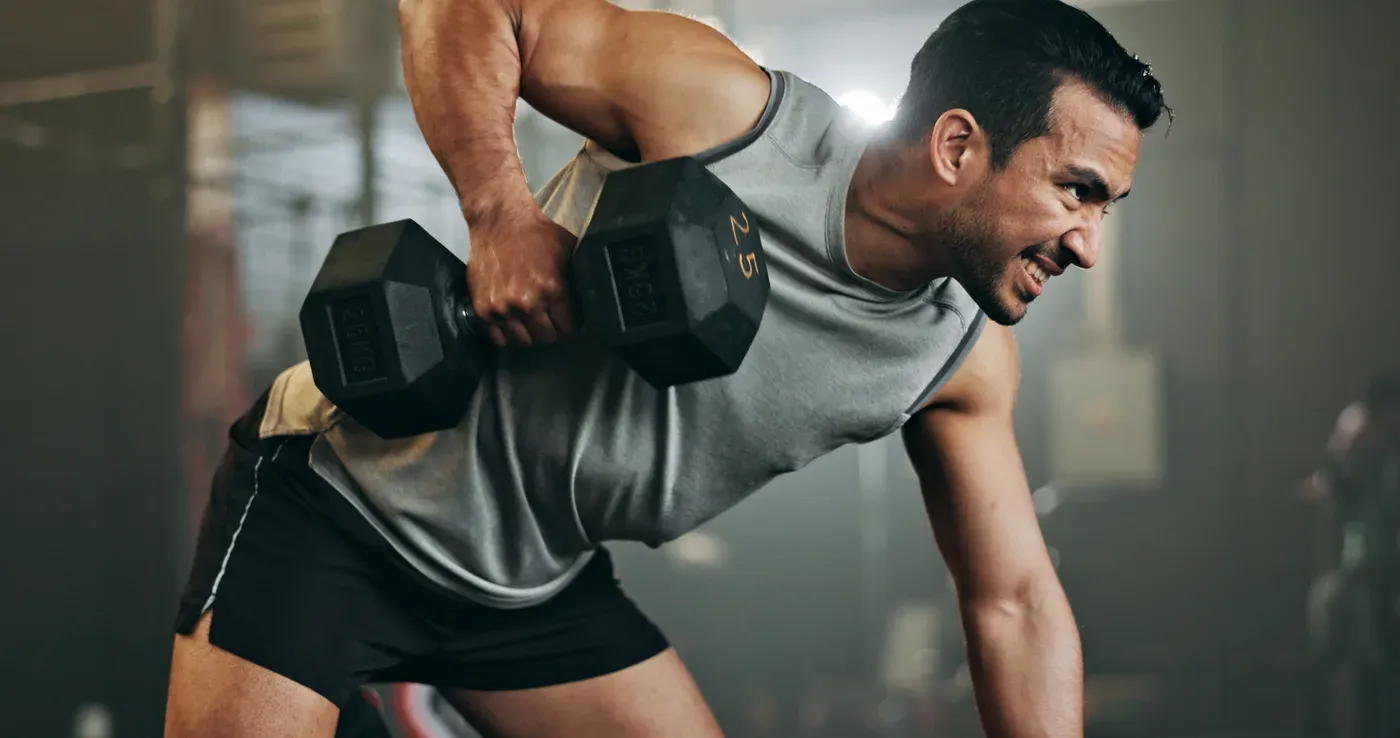
A chest-supported row is a row done lying face down on an incline bench so your chest, not your lower back, holds your body in place. To do it, set a bench to about 30 to 45 degrees, lie chest-down with a dumbbell in each hand hanging straight down, and pull the weights up to your sides by driving your elbows back. Lower slowly. Keep your chest glued to the pad on every rep.
Why choose it
Rows matter for every man who spends the day hunched forward. Bent-over barbell rows, though, ask your lower back to hold a hinged position under load for the whole set. The chest-supported row takes that out. The bench does the holding; your back muscles do the pulling. That’s why it’s the default row for many men with a history of back trouble, and why it’s a sharp tool for building the upper back even if your back is fine.
It also stops you cheating. You can’t swing a weight up when you can’t move your torso.
Setting up the bench
- Set an adjustable bench to roughly 30 to 45 degrees.
- Place two dumbbells at the front of the bench.
- Lie face down with the top of your chest just over the top edge of the pad, so your head and neck are free.
- Feet on the floor behind you, or toes on the floor with knees on the seat, depending on your height.
- Pick up the dumbbells and let them hang straight down, palms facing each other.
The row
- Pull your shoulder blades back first, without bending your elbows.
- Drive your elbows up and back past your torso.
- Stop when the dumbbells reach your lower ribs.
- Squeeze your shoulder blades together for a one-count.
- Lower slowly, letting your arms straighten fully and your shoulder blades spread apart.
- Keep your chin slightly tucked and your chest on the pad.
Mistakes and fixes
Chest lifting off the pad. You’re using your back extensors to heave. Lighter weights and a strict pause at the top.
Neck cranked up to look ahead. Look at the floor below; keep the neck in line.
Short reps. Not lowering all the way skips the stretch. Let the arms hang fully at the bottom.
Wrists curling up. The biceps take over. Keep the wrists straight and think about elbows, not hands.
Sets and reps
| Goal | Sets × reps | Rest | Notes |
|---|---|---|---|
| Starting out | 3 × 10–12 | 60–90 s | Light, focus on the squeeze |
| Strength | 4 × 6–8 | 2 min | Heavy dumbbells or machine |
| Muscle | 3–4 × 10–15 | 90 s | 1–2 s pause at the top |
Variations and swaps
| Variation | What it changes |
|---|---|
| Elbows out wide, palms down | More rear shoulder and upper back |
| Single-arm, alternating | More range and focus per side |
| Chest-supported T-bar or machine row | Easier to load heavy |
| Seal row (flat, raised bench) | Strictest version; no leg help at all |
| Dumbbell row | Adds a bit of trunk work when your back is fine |
| Seated cable row | Constant tension, seated |
For sore shoulders, keep a neutral grip and stop the elbow level with your torso. For extra upper-back work between sets, the band pull-apart fits in easily.
Workouts that use it
The chest-supported row is the main row in the lower back friendly workout and the shoulder friendly upper body workout, and it’s an option in the push pull legs plan. For a complete plan built around back-friendly choices, the DIY programs have you covered.
Questions people also ask
Why is the chest-supported row good for a bad back?
The bench holds your torso, so your lower back doesn't have to keep you bent over while you pull. You can train your upper back hard with almost no spinal load.
What angle should the bench be?
Around 30 to 45 degrees. Lower angles make it more of an upper-back exercise; steeper angles shift it toward a high row.
Dumbbells or a machine?
Both work. Dumbbells on an incline bench are available in most gyms; a chest-supported row machine or T-bar row with a pad is easier to load heavily.
Can I go heavy on chest-supported rows?
Yes, as long as your chest stays on the pad. Lifting off the pad to heave the weight defeats the purpose.