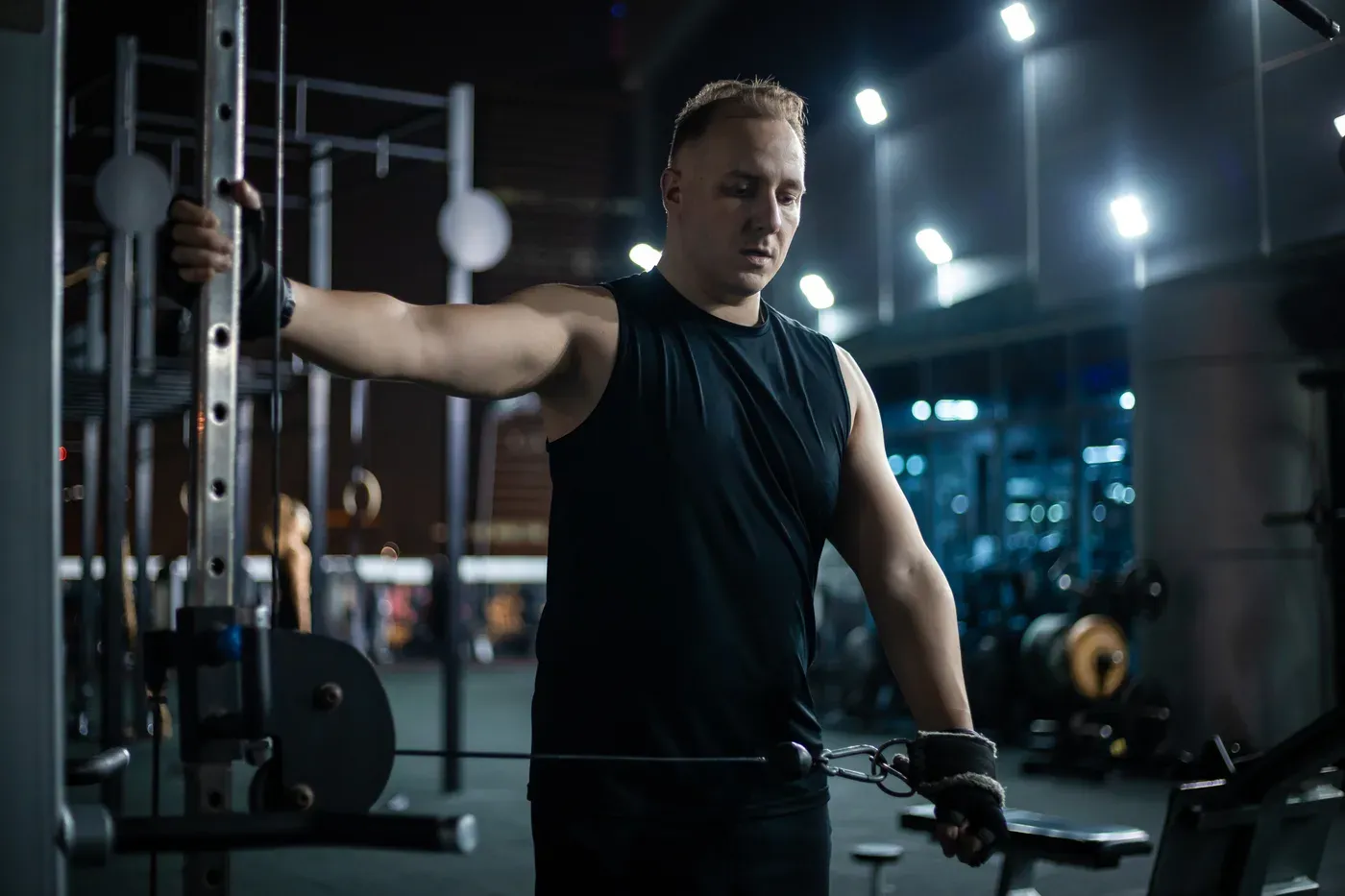
A face pull is a rope cable exercise that trains the back of the shoulders and upper back. To do it safely over 40, set the cable at about forehead height, grip the rope with thumbs pointing back toward you, step back, and pull the rope toward your face while spreading the ends apart, finishing with your hands beside your ears and elbows high. Use light weight and slow reps. It’s a shoulder-health exercise, not a strength contest.
Why it belongs in your week
Most men’s training and daily posture favour the front of the body: bench presses, push-ups, steering wheels and keyboards. The face pull works the opposite side, especially the rear delts and the muscles that rotate the shoulder outward. A shoulder that’s strong on all sides tends to tolerate pressing better.
It’s also one of the few upper-body exercises that almost never causes trouble, which makes it a good daily-driver for men with cranky shoulders.
Cable setup
- Attach a rope to a cable station set around forehead or eye height.
- Grip each end of the rope with palms facing down and thumbs toward you, or overhand with thumbs toward the cable; pick the one that feels better.
- Step back until the weight lifts off the stack and your arms are straight.
- Stand with feet hip width or in a slight split stance for balance. Lean back just slightly.
The pull
- Brace your trunk so your body stays still.
- Start by pulling your shoulder blades back.
- Pull the rope toward the bridge of your nose with elbows high, at or slightly above shoulder height.
- As the rope approaches your face, pull the ends apart so your hands finish beside your ears.
- Rotate your forearms back at the end, as if showing off your biceps.
- Hold for one second.
- Return slowly until your arms are straight and you feel the shoulders stretch forward.
Common faults
| Fault | What it looks like | Fix |
|---|---|---|
| Too heavy | Leaning back, yanking with the body | Drop the weight; your torso shouldn’t move |
| Elbows dropping | Turns into a row to the chest | Keep elbows at shoulder height or above |
| No external rotation | Hands stop in front of the face | Pull the rope apart and finish beside your ears |
| Shrugging | Shoulders creep up toward your ears | Shoulders down before each rep |
Sets and reps
| Goal | Sets × reps | Rest |
|---|---|---|
| Warm-up before pressing | 2 × 15 | 30 s |
| Shoulder health and posture | 3 × 12–15 | 60 s |
| Muscle (rear delts) | 3–4 × 15–20 | 60 s |
There’s no real strength or one-rep-max target here. Add reps and slow the tempo before adding weight.
Variations and swaps
- Easier: band face pull, or a lighter cable with a pause.
- Harder: a three-second hold at the end of each rep, or a half-kneeling version to stop you using your legs.
- Sore shoulders: pull to the chin rather than the forehead, and keep the range comfortable. Many men find face pulls feel good even when pressing doesn’t.
- No cable: the band pull-apart covers similar muscles with a cheap band.
- More upper back: the seated cable row adds heavier pulling.
Pair face pulls with an overhead press or bench session; they make good fillers between pressing sets.
Plans that include it
Face pulls show up in the shoulder friendly upper body workout, the desk posture workout and the push pull legs plan. The DIY programs place them in the right spot each week if you’d rather follow a plan.
Questions people also ask
What muscles do face pulls work?
The rear deltoids, the muscles between the shoulder blades and the small rotator cuff muscles that turn the arm outward.
How heavy should face pulls be?
Light enough to hold the end position for a full second with your elbows high. Most men go too heavy and turn it into a row.
Can I do face pulls with a resistance band?
Yes. Anchor a band at head height on a door or post and pull it the same way. It's a good option for home or travel.
Should I do face pulls before pressing?
They work well as part of a warm-up before bench or overhead pressing, or at the end of an upper-body session.