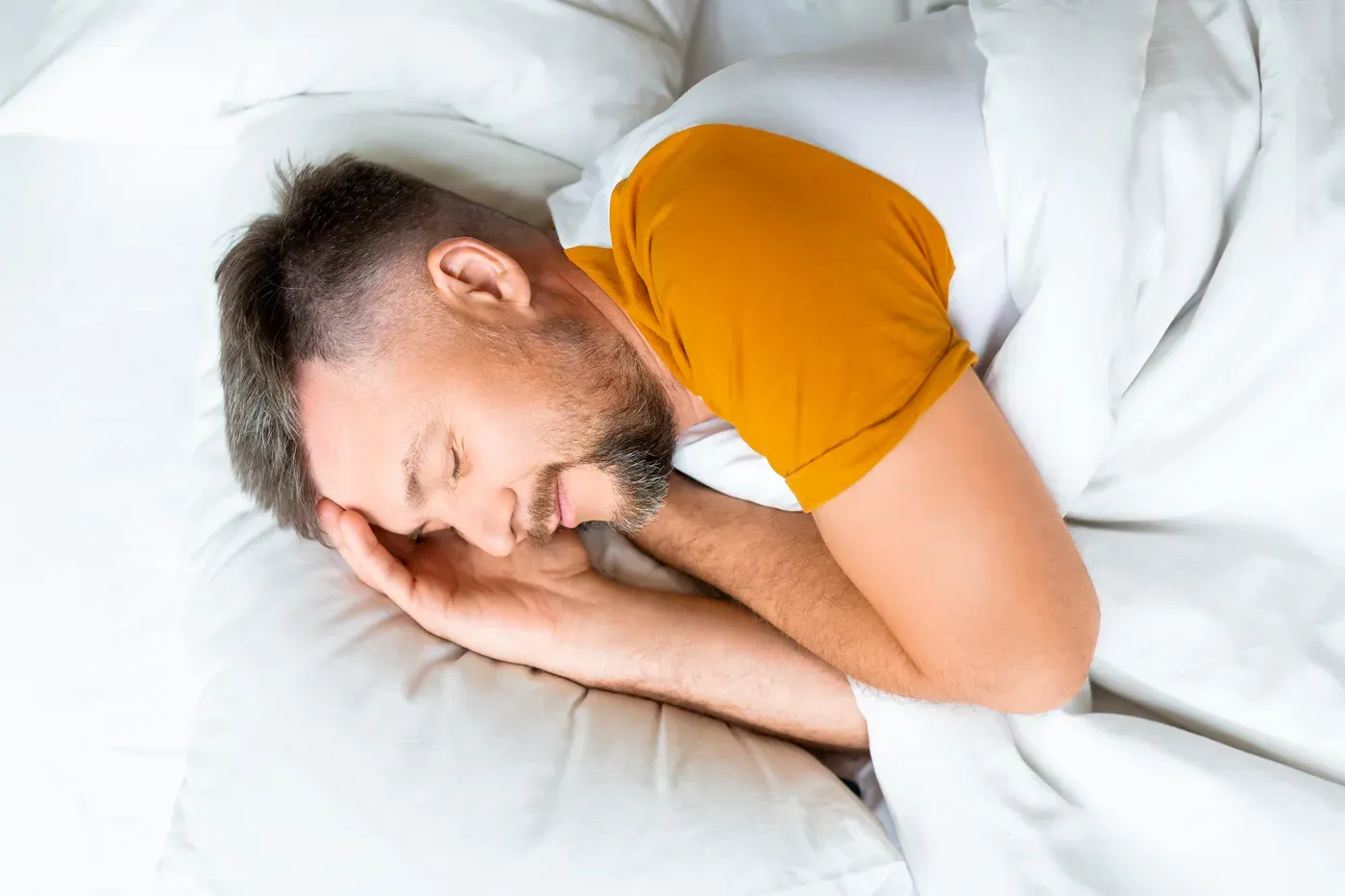
Sleep affects weight loss in men in three ways: short sleep makes you hungrier, it shifts the weight you lose away from fat and towards muscle, and it makes training harder to recover from. In one of the clearest studies, overweight adults on the same reduced-calorie diet lost less than half as much fat when they slept 5.5 hours as when they slept 8.5 hours, and lost more lean mass. If you’re dieting on six hours a night, you’re paying full price for a discounted result.
What happens to fat loss on short sleep
The key study put ten overweight, middle-aged adults (seven men, average age 41) on the same moderate calorie deficit for 14 days, twice: once with 8.5 hours in bed each night, once with 5.5 hours (Nedeltcheva et al., 2010).
| Over 14 days on the same diet | 8.5 hours in bed | 5.5 hours in bed |
|---|---|---|
| Fat lost | 1.4 kg | 0.6 kg |
| Fat-free mass lost | 1.5 kg | 2.4 kg |
| Hunger | Lower | Higher |
Total weight loss was similar. What changed was what the weight was made of. On short sleep, more of it came from fat-free mass, which includes muscle. The study was small and short, so treat the exact numbers with care, but the direction is clear and matches what men notice when they diet through a stressful, sleepless stretch.
Why you’re hungrier after a short night
Sleep loss changes the hormones that regulate appetite. In a study of 12 healthy young men, two days of restricted sleep, compared with two days of extended sleep, lowered leptin (a fullness signal) by 18%, raised ghrelin (a hunger signal) by 28%, and increased reported hunger by 24%, with the biggest jump in appetite for calorie-dense, high-carbohydrate foods (Spiegel et al., 2004).
That’s the biology behind the 3 p.m. muffin and the 10 p.m. fridge raid after a bad night. More time awake also simply means more hours to eat. If late-evening eating is your weak spot, stopping late-night snacking and an earlier bedtime are the same project.
What short sleep does to muscle
Muscle is what keeps your metabolism and your strength up as you get older, so protecting it during a diet matters. In a laboratory study, a single night without sleep reduced muscle protein synthesis by 18% the next day compared with a normal night, and raised cortisol (Lamon et al., 2021). That was total sleep deprivation in young adults, which is more extreme than a busy week, but it supports the diet study above: short sleep pushes the body away from building and holding muscle.
Practically, training on poor sleep also feels harder. You lift less, do fewer reps and are more likely to skip the session altogether.
How much sleep to aim for while losing fat
There’s no special fat-loss number. The Canadian 24-Hour Movement Guidelines recommend seven to nine hours of good-quality sleep for adults, with consistent bed and wake-up times, and that’s the target during a fat-loss phase too. Our guide to how much sleep a man over 40 needs goes into the detail.
The useful mindset: treat sleep as part of the diet. When the plan says “eat 2,200 calories and sleep seven hours”, both halves count.
A fat-loss sleep plan for busy men
- Set the wake-up time first. It’s usually fixed by work or kids. Count back seven and a half hours and make that your lights-out.
- Move training to protect sleep. If a 5 a.m. session means five hours in bed, train at lunch or after work instead. The best time to work out is the one that doesn’t cost you sleep.
- Make the last meal of the day a real one. A dinner with protein and vegetables reduces the late-night grazing that comes with being awake and tired.
- Cap caffeine by early afternoon. In a sleep-lab study, a moderate dose of caffeine taken six hours before bed still disrupted sleep (Drake et al., 2013).
- Keep alcohol off weeknights. It makes you sleepy but fragments the second half of the night.
- Dark, cool, quiet. Blackout blinds, a cool room and the phone charging outside the bedroom.
- Don’t cut harder to compensate. After a short night, keep calories at your normal target. Crash-dieting on top of short sleep is the combination that costs the most muscle.
If you can’t fix the hours
Some weeks you won’t get seven hours: a newborn, shift work, a big deadline. In those weeks, make the deficit smaller, keep protein high, keep strength training but drop a hard set or two, and keep walking. Accept a slower week rather than a worse one. If you sleep poorly even when you have the time, or snore loudly and wake unrefreshed, talk to your doctor; insomnia and sleep apnea are both treatable.
The bottom line
Sleep isn’t a soft extra in a fat-loss plan. Short sleep raises hunger, shifts weight loss towards muscle and makes training harder, so men who protect seven to nine hours usually get more fat loss from the same diet. If your sleep, stress and eating are all pulling against your training, the 12-Week Lifestyle Reset ($1,999) builds a sleep and recovery strategy into the plan alongside nutrition and phased strength training.
Questions people also ask
Does sleep really affect weight loss?
Yes. In a controlled study of people on the same calorie-reduced diet, those given 5.5 hours of sleep opportunity lost less than half as much fat as when they had 8.5 hours, and lost more lean mass. Short sleep also increases hunger.
How much sleep do I need to lose weight?
Aim for the seven to nine hours of good-quality sleep that Canadian guidelines recommend for adults. There's no special fat-loss number; the goal is to stop chronic short sleep from working against your diet.
Should I get up at 5 a.m. to work out if it cuts my sleep?
Only if you can go to bed early enough to still get about seven hours. Trading sleep for a workout every day can cost more in hunger, recovery and fat loss than the session gains.
Does sleeping more build muscle?
Sleep doesn't build muscle by itself, but short sleep works against it. Research shows sleep loss reduces muscle protein synthesis and that dieting on short sleep increases the share of weight lost from lean mass.
Sources
- Nedeltcheva et al. (2010), Insufficient sleep undermines dietary efforts to reduce adiposity, Ann Intern Med
- Spiegel et al. (2004), Sleep curtailment in healthy young men is associated with decreased leptin levels, elevated ghrelin levels, and increased hunger and appetite, Ann Intern Med
- Lamon et al. (2021), The effect of acute sleep deprivation on skeletal muscle protein synthesis and the hormonal environment, Physiol Rep
- Drake et al. (2013), Caffeine effects on sleep taken 0, 3, or 6 hours before going to bed, J Clin Sleep Med
- CSEP — Canadian 24-Hour Movement Guidelines for Adults 18–64