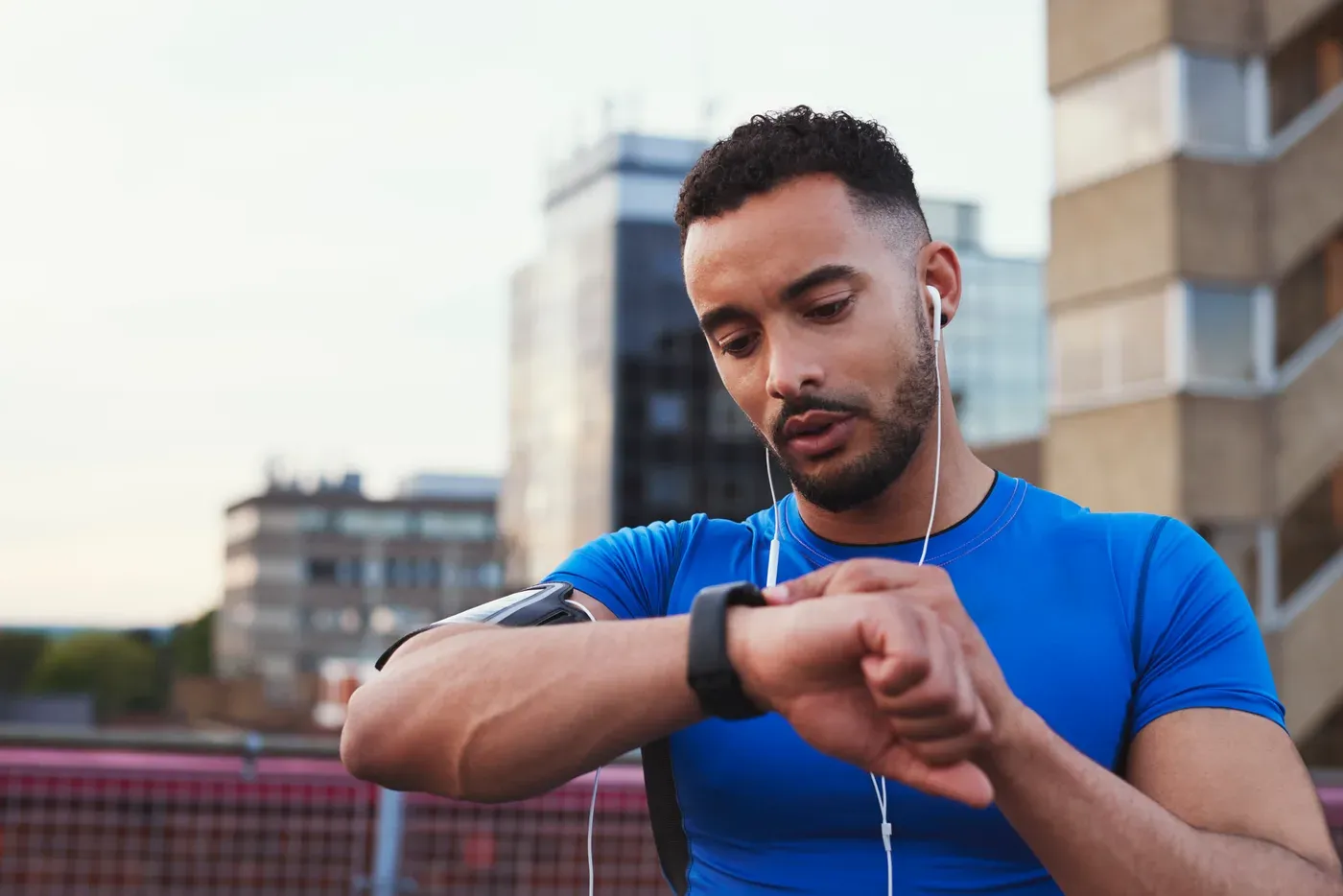
To track fitness progress properly, use five measures instead of one: a weekly average body weight, a waist measurement every two weeks, progress photos every four weeks, a training log every session, and a few health and habit markers (steps, sleep, resting heart rate). The scale on its own misleads you, especially in the first months of training, when fat loss and water or muscle gain can cancel each other out. Together, the five measures show what’s actually changing and what to adjust.
What to track and how often
| Measure | How often | How to do it | What it tells you |
|---|---|---|---|
| Body weight | Daily or weekly; use the weekly average | Same time, after the bathroom, before eating | Overall trend in body mass |
| Waist | Every 2 weeks | Top of hip bones, after a normal breath out | Fat loss around the middle |
| Photos | Every 4 weeks | Same spot, light, time and clothing; front, side, back | Visible change you stop noticing day to day |
| Training log | Every session | Exercise, weight, sets, reps, how hard it felt | Whether you’re getting stronger |
| Habits | Daily, reviewed weekly | Sessions, steps, hours in bed, drinks | Whether the plan is being followed |
| Resting heart rate | Weekly | Same morning routine, before getting up | Rising fitness, or poor recovery |
That looks like a lot, but it takes under five minutes a week once it’s a routine.
Body weight: use the average, not the reading
A single morning weigh-in can swing by a kilogram or more from salt, carbs, alcohol, sleep and bathroom timing. That’s why one reading tells you very little and why the weight fluctuations guide is worth reading if the daily number frustrates you.
Weigh yourself every morning under the same conditions, write it down, and compare this week’s average with last week’s. If you’d rather not weigh daily, weigh once a week on the same day, same conditions, and look at the trend over four weeks.
Waist: the most useful number for most men
For a man carrying weight around the middle, the waist measurement is often the clearest sign of fat loss. The Heart and Stroke Foundation describes how to measure it: find the top of your hip bones, keep the tape parallel to the floor, take two normal breaths, and measure after the second breath out, snug but not pressing into the skin. It lists over 94 cm (37 in) as increased risk for men and over 102 cm (40 in) as substantially increased risk, while noting that other factors, including ethnicity, affect what applies to you.
Measure every two weeks in the same spot. Changes smaller than about half a centimetre are noise. The waist-to-height ratio calculator is another way to put the number in context.
Photos: the measure you’ll thank yourself for
Day-to-day change is invisible in a mirror you look into every morning. Photos taken four weeks apart under the same conditions often show what you can’t see. Rules that make them useful:
- Same place, same lighting, same time of day.
- Same clothing (or none), standing relaxed, not flexed.
- Front, side and back, phone at chest height.
- Store them somewhere private and compare month to month, not week to week.
The training log: proof you’re getting fitter
Your log is the one measure that improves every week, even in weeks when weight and waist don’t. Record the exercise, the weight, sets and reps, and a quick effort rating out of 10 for the last set. Look for:
| What you see in the log | What it means |
|---|---|
| Weights or reps rising most weeks | The program is working |
| Same numbers for 3+ weeks | Time to change the progression, or recover better |
| Numbers falling, sessions feeling much harder | Under-recovered: check sleep, stress and food |
Habits and health markers
Count the things that cause progress: strength sessions, daily steps, hours in bed and drinks per week. The Canadian 24-Hour Movement Guidelines give easy benchmarks: at least 150 minutes of moderate to vigorous activity and two strength sessions a week, and seven to nine hours of sleep.
A falling resting heart rate over months is a sign of improving fitness. A morning heart rate well above your normal for several days, together with poor sleep and flat sessions, usually means you need more recovery. Blood pressure, cholesterol and blood sugar belong to your doctor’s checks, not your weekly log, but they’re worth noting when you get them.
If you want a more exact body-composition number occasionally, the guide to measuring body fat compares DEXA, bioimpedance scales and tape methods.
How to read it all together
Look at the measures as a set once a month:
- Waist down, weight flat, lifts up: fat loss with some muscle gain. Keep going.
- Weight down, lifts down, always tired: the deficit is too aggressive. Eat a bit more, especially protein.
- Everything flat, habits under 80%: the plan isn’t the problem; the schedule is.
- Everything flat, habits on track: adjust the plan, usually calories or training progression.
Pair the tracking with clear 12-week targets; the guide to setting fitness goals that stick shows how. If you’d rather send the numbers to a coach who reads them and adjusts your training and food each month, that’s the core of monthly 1:1 coaching ($499 a month): progress tracking, regular check-ins and ongoing adjustments.
Questions people also ask
How often should I weigh myself?
Either daily, using the weekly average, or once a week at the same time and conditions. Daily weigh-ins give a more reliable trend because single readings swing with water, salt and sleep.
Why is my weight not going down but my waist is?
You're probably losing fat while holding more water in trained muscles, or gaining a little muscle. A shrinking waist with a stable scale in the first months of training is usually good news.
Are smart scales accurate for body fat?
Home body-fat scales are useful for trends at best and can be off by several percentage points on a given day. Use the waist measurement and photos as your main body-composition check.
What's the best app to track workouts?
The one you'll actually open. A notes app, a spreadsheet or a dedicated training app all work. What matters is recording the exercise, weight, sets and reps every session.