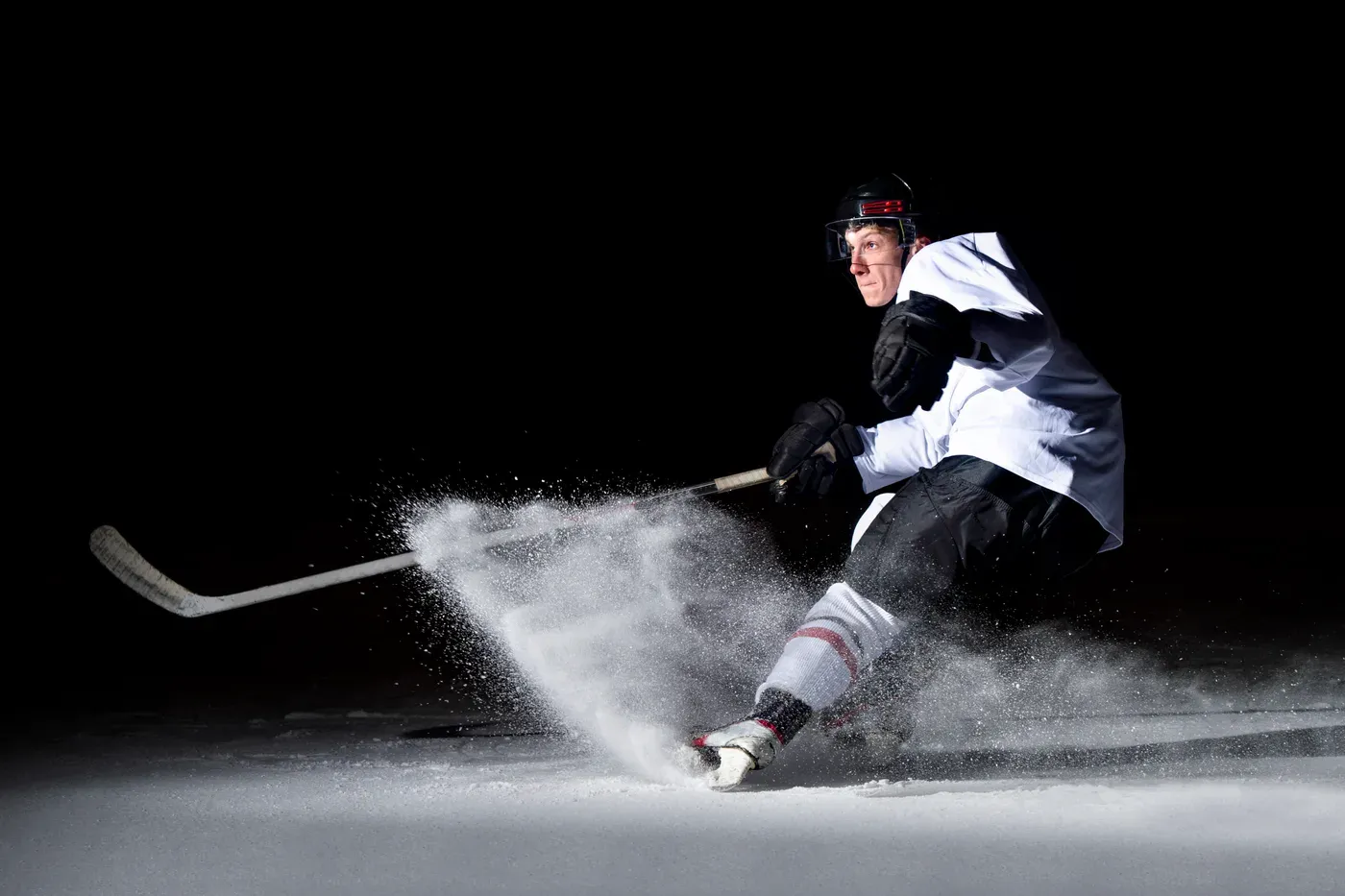
Men’s league hockey needs repeat sprint fitness, not distance running. Each shift is a short, hard burst followed by a few minutes on the bench, so the best conditioning is interval work that copies that pattern, alongside strength training for the legs, hips and groin. Start four to six weeks before the season with two interval sessions and two strength sessions a week, then drop to one or two short sessions a week once games begin.
What a rec league game demands
Rec hockey is stop-start. You skate hard for well under a minute, coast, battle along the boards, then sit for a few minutes while the other lines go. How many shifts you get depends on how many players show up, and a short bench means more of them with less rest.
That pattern asks for three things:
- Repeat sprint ability: going hard on your 12th shift almost as well as your first.
- Leg and hip strength and power: for the first three strides, stops, and battles along the boards.
- Groin and hip resilience: skating’s wide stride loads the adductors and hip flexors heavily.
Long, slow jogs don’t prepare you for any of these very well. Power, the quality behind acceleration, also declines earlier with age than strength (Reid & Fielding, 2012), which is why older players feel a step slower even when they’re not out of breath.
Protect your groin
Adductor (groin) strains are a classic hockey injury. In a study of an NHL team, a preseason adductor-strengthening program was followed by 3 adductor strains over two seasons, compared with 11 in the two seasons before the program (Tyler et al., 2002). That’s a small study in professionals, not proof for a 44-year-old in a Thursday night league, but adductor work is cheap insurance.
| Groin exercise | Sets × reps | Progression |
|---|---|---|
| Copenhagen plank (short lever, knee on bench) | 3 × 15–20 s per side | Move support to the ankle |
| Side lunge | 3 × 8 per side | Hold a dumbbell |
| Cable or band hip adduction | 2 × 12–15 per side | Slow lowering |
| Lateral band walk | 2 × 15 steps each way | Thicker band |
The six-week preseason plan
Four sessions a week. Leave a day between the two strength sessions.
| Weeks | Strength (2×) | Intervals (2×) |
|---|---|---|
| 1–2 | Goblet squat, Romanian deadlift, split squat, push-up, row, Copenhagen plank: 3 × 8–10 | Bike or rower: 8 × 30 s hard, 90 s easy |
| 3–4 | Add trap bar deadlift 4 × 5, lateral lunge, single-leg RDL; keep groin work | 10 × 40 s hard, 2 min easy |
| 5–6 | Add power: lateral bounds 3 × 5 per side, medicine ball rotational throw 3 × 5 | 8–10 × 45 s hard, 2:30 easy; one session can be on the ice |
Interval tips:
- Copy your shifts. Work periods of 30 to 45 seconds with two to three minutes of rest mimic a real game.
- Bike over running if your knees or Achilles complain; the bike also matches the bent-knee position of skating.
- Stop the session if your hard efforts fall apart; quality matters more than finishing the set count.
In-season routine
Once games start, the goal is to keep what you built:
| Day | Session |
|---|---|
| Game day | Warm-up only |
| Day after | Walk, mobility, groin work (light) |
| Two days after | Full-body strength, 30–40 min, shorter sets |
| Midweek | Optional 15–20 min bike intervals |
Keep heavy leg work at least two days before game night.
The dressing room warm-up
Late ice at a cold arena is the worst time to go from sitting to sprinting. Before you put your skates on:
- Brisk march or light jog in the hallway, 2 minutes
- Leg swings, front and side, 10 each
- Side lunges, 8 per side
- Bodyweight squats, 10
- Hip openers (lunge with rotation), 5 per side
- Two or three hard strides in warm-up laps before the puck drops
Recovery after late games
GTA rec ice often runs late into the evening. Adrenaline, a cold drink in the dressing room and a drive home make for poor sleep. Have water and a protein-rich snack after the game, keep the beer to one or two if you’re having any, and get to bed as soon as you’re home. Sleep loss from one game night costs more of your next week’s training than the game itself.
Beyond the season
Strength training reduces sports injuries substantially in trials across a range of sports (Lauersen et al., 2018). Keeping two strength sessions going in the off-season means the next preseason is about sharpening, not rescuing. If you also ski in the winter, the ski season prep guide overlaps nicely with this plan.
The bottom line
Train like your game: short, hard efforts with recovery, strong legs and hips, and adductors that can take a wide stride. Six weeks of preseason work and a lighter in-season routine will make the third period feel like the first. If you want a 12-week block built around your season, with an assessment and regular check-ins, look at the 12-Week Body Transformation. For more on fast, low-risk movements, see power exercises for men over 40.
Questions people also ask
How do I get in shape for beer league hockey?
Start four to six weeks before the season with two strength sessions and two interval sessions a week. Intervals should mimic shifts: 30 to 45 seconds hard, then two to three minutes easy.
Why do I get so winded on my first shift?
Usually no warm-up. Cold muscles and a heart rate jumping from rest to maximum make the first shift miserable. Five to ten minutes of easy movement in the dressing room and a few hard strides in warm-up help a lot.
How do I prevent groin pulls in hockey?
Strengthen your adductors before and during the season with exercises like Copenhagen planks and side lunges, and warm up properly. A study in NHL players found a preseason adductor program cut adductor strains substantially.
Should I lift weights during the hockey season?
Yes, one or two shorter sessions a week. Keep heavy leg work at least two days away from game night, and cut volume rather than stopping completely.
Is it OK to play hockey late at night?
Late ice times are common in rec leagues. The late adrenaline can wreck sleep, so keep post-game drinks moderate, eat a light meal, and protect the next night's sleep.
Sources
- Tyler et al. (2002), The effectiveness of a preseason exercise program to prevent adductor muscle strains in professional ice hockey players, Am J Sports Med
- Lauersen et al. (2018), Strength training as superior, dose-dependent and safe prevention of acute and overuse sports injuries, Br J Sports Med
- Reid & Fielding (2012), Skeletal muscle power: a critical determinant of physical functioning in older adults, Exerc Sport Sci Rev