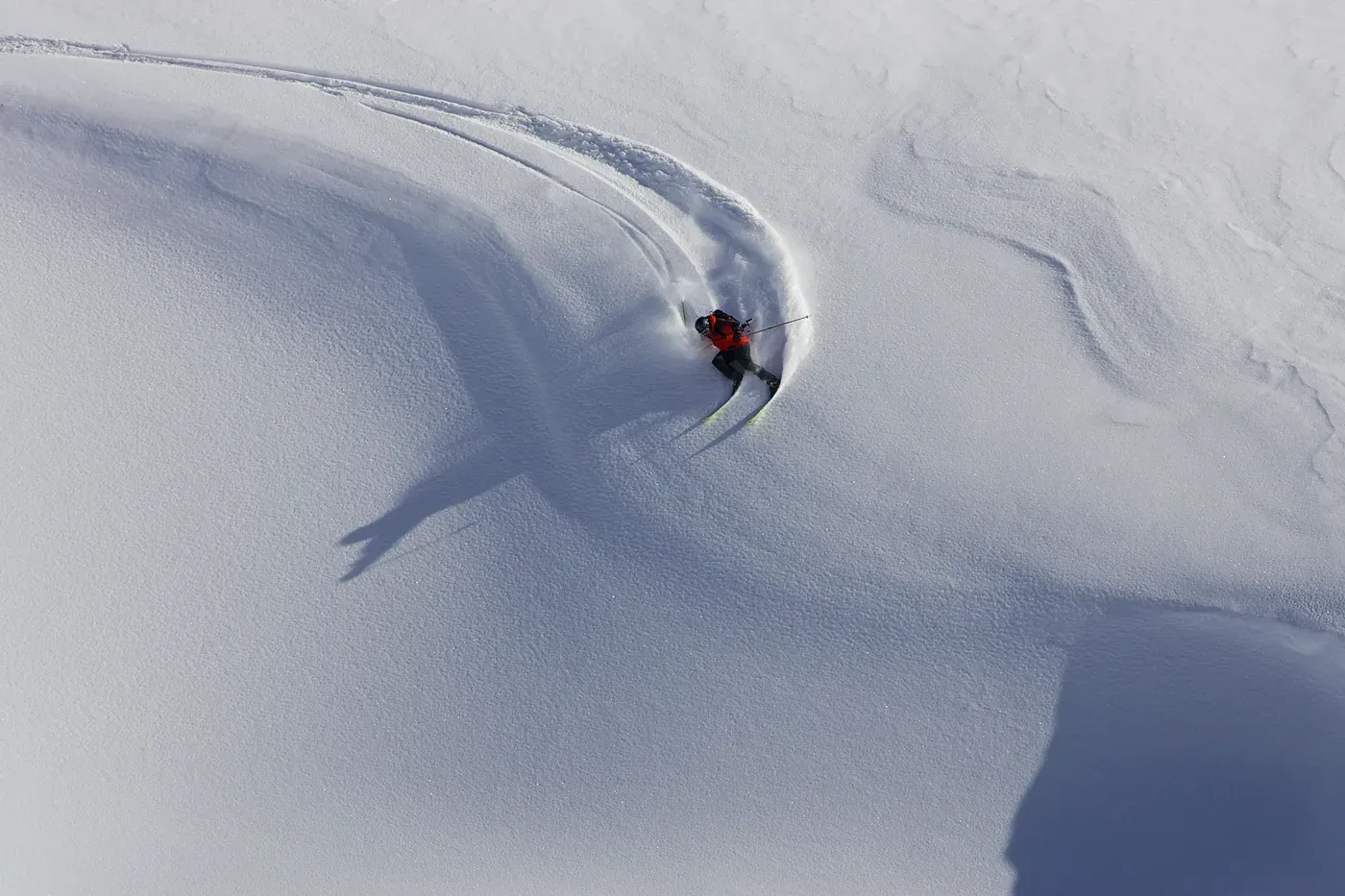
Ski fitness training for men over 40 should build three things: quad strength that holds up through long turns, single-leg control that keeps your knees tracking safely, and leg endurance for full days on the hill. Start six to eight weeks before your first trip with two or three strength sessions a week that use slow lowering, wall sits and single-leg work, plus one or two interval sessions. By your first day you’ll ski longer before your thighs burn and finish the last run in control.
What skiing asks of your body
Alpine skiing is a mix of systems. A review of the research on ski racing found that it involves many physiological systems working together, none more important than the others, and that technical ability is the biggest factor in performance (Turnbull et al., 2009). For a recreational skier, that translates into:
- Quad strength and endurance: you spend most of a run in a bent-knee position, controlling forces through your legs.
- Controlled lowering (eccentric strength): much of the work happens as your muscles resist and absorb, rather than push.
- Single-leg balance and knee control: weight shifts from ski to ski on every turn.
- Hip and trunk stability: to stay centred over your skis on uneven snow.
- Quick reactions: to catch an edge or ride out a bump, which relies on power, a quality that fades earlier with age than strength (Reid & Fielding, 2012).
- Aerobic fitness: for recovering on chairlifts and lasting a full day, especially at altitude out west.
Most men over 40 who ski a few weekends a winter have the skill. What gives out is the legs, usually by early afternoon. That’s when technique gets sloppy.
The 8-week ski fitness plan
Three sessions a week: two strength, one conditioning. If you only have two, combine conditioning into the end of a strength session.
Strength sessions
| Weeks | Session A | Session B |
|---|---|---|
| 1–2 | Goblet squat 3 × 10 (3-second lowering), step-up 3 × 8/side, Romanian deadlift 3 × 10, wall sit 3 × 30 s, side plank 2 × 20 s | Split squat 3 × 8/side (slow lowering), lateral lunge 3 × 8/side, hip thrust 3 × 10, single-leg balance 3 × 30 s/side |
| 3–4 | Squat 3 × 8 (heavier), step-down 3 × 8/side, Romanian deadlift 3 × 8, wall sit 3 × 45 s, Pallof press 3 × 10/side | Rear-foot-elevated split squat 3 × 8/side, lateral lunge 3 × 10/side, single-leg RDL 3 × 8/side, Copenhagen plank 2 × 15 s/side |
| 5–6 | Squat 4 × 6, lateral bounds 3 × 5/side, step-down 3 × 10/side, wall sit 3 × 60 s | Split squat 4 × 6/side, skater hops 3 × 6/side, single-leg RDL 3 × 8/side, side plank 3 × 30 s |
| 7–8 | Squat 3 × 6, lateral bounds 3 × 6/side, wall sit 2 × 90 s, Pallof press 3 × 10 | Split squat 3 × 8/side, side-to-side line hops 3 × 20 s, single-leg balance on a pad 3 × 30 s |
Notes:
- Slow lowering builds the control skiing needs. Take 3 seconds on the way down.
- Jumps and hops start only in week 5, low and controlled. Land softly with knees over toes. Skip them if your knees object.
- The split squat is the backbone of the plan; see the split squat guide for setup and joint-friendly versions.
Conditioning session
| Weeks | Session |
|---|---|
| 1–2 | Bike or rower: 6 × 45 s hard, 90 s easy |
| 3–4 | 8 × 45 s hard, 75 s easy |
| 5–8 | 8 × 60 s hard, 60 s easy, or a long hilly hike on a weekend |
Interval lengths roughly match a long run down the hill followed by a lift ride. For the bigger aerobic picture, the hiking trip training guide has a base-building approach that also works well before a western ski trip.
Why it matters more after 40
Strength training substantially reduced sports injuries in a meta-analysis of prevention trials, and more training was linked to more protection (Lauersen et al., 2018). Those trials weren’t in skiers specifically, but stronger legs that control the knee are what you rely on when you catch an edge late in the day.
A few practical habits help too:
- Ski your legs, not the clock. Tired legs make for sloppy turns and slow reactions. Take the last run when your legs say so, not when the lifts close.
- Warm up on the first run. A green or easy blue run before anything steep, after a few minutes of leg swings and squats in the lodge.
- Check your bindings at a ski shop before the season, especially if your weight has changed.
- Eat and drink at lunch. Long cold days burn more than you think.
Ontario versus a western trip
| Trip | What it asks for | Training tweak |
|---|---|---|
| Ontario hills (Blue Mountain, Horseshoe, Mount St. Louis Moonstone) | Short runs, lots of lift rides, often icy | Focus on quad strength and edge control; shorter intervals |
| Quebec (Tremblant, Mont-Sainte-Anne) | Longer runs, colder temperatures | Longer wall sits and intervals |
| Western Canada or US | Long runs, altitude, deep snow | Add aerobic base (hikes, longer bike rides) and longer intervals |
The bottom line
Eight weeks of leg strength, single-leg control and intervals is the difference between skiing until 3 p.m. in control and quitting at lunch with burning thighs. Start in early November and keep one session a week going through the season. If you want a 12-week block built around your ski trips, with an initial assessment and regular check-ins, look at the 12-Week Body Transformation. For a sport with similar leg demands, see conditioning for men’s league hockey.
Questions people also ask
When should I start training for ski season?
Six to eight weeks before your first ski day. For a January trip or a Christmas start at Blue Mountain or in Quebec, that means early to mid-November.
What are the best exercises for skiing?
Squats and split squats with slow lowering, wall sits, step-downs, lateral lunges, single-leg Romanian deadlifts, and side-to-side hops once you have a strength base. Add some intervals for leg endurance.
Why do my thighs burn so quickly when skiing?
Skiing holds your quads in a bent-knee position under load for long stretches, much of it with the muscle lengthening under control. Training with slow lowering and wall sits builds the specific endurance.
How do I protect my knees skiing over 40?
Build quad and hamstring strength, practise single-leg control so your knee tracks over your foot, ski within your ability, and stop when you're tired. Make sure your bindings are set for your weight, height, age and ability at a ski shop.
Sources
- Turnbull et al. (2009), Physiology of alpine skiing, Scand J Med Sci Sports
- Lauersen et al. (2018), Strength training as superior, dose-dependent and safe prevention of acute and overuse sports injuries, Br J Sports Med
- Reid & Fielding (2012), Skeletal muscle power: a critical determinant of physical functioning in older adults, Exerc Sport Sci Rev