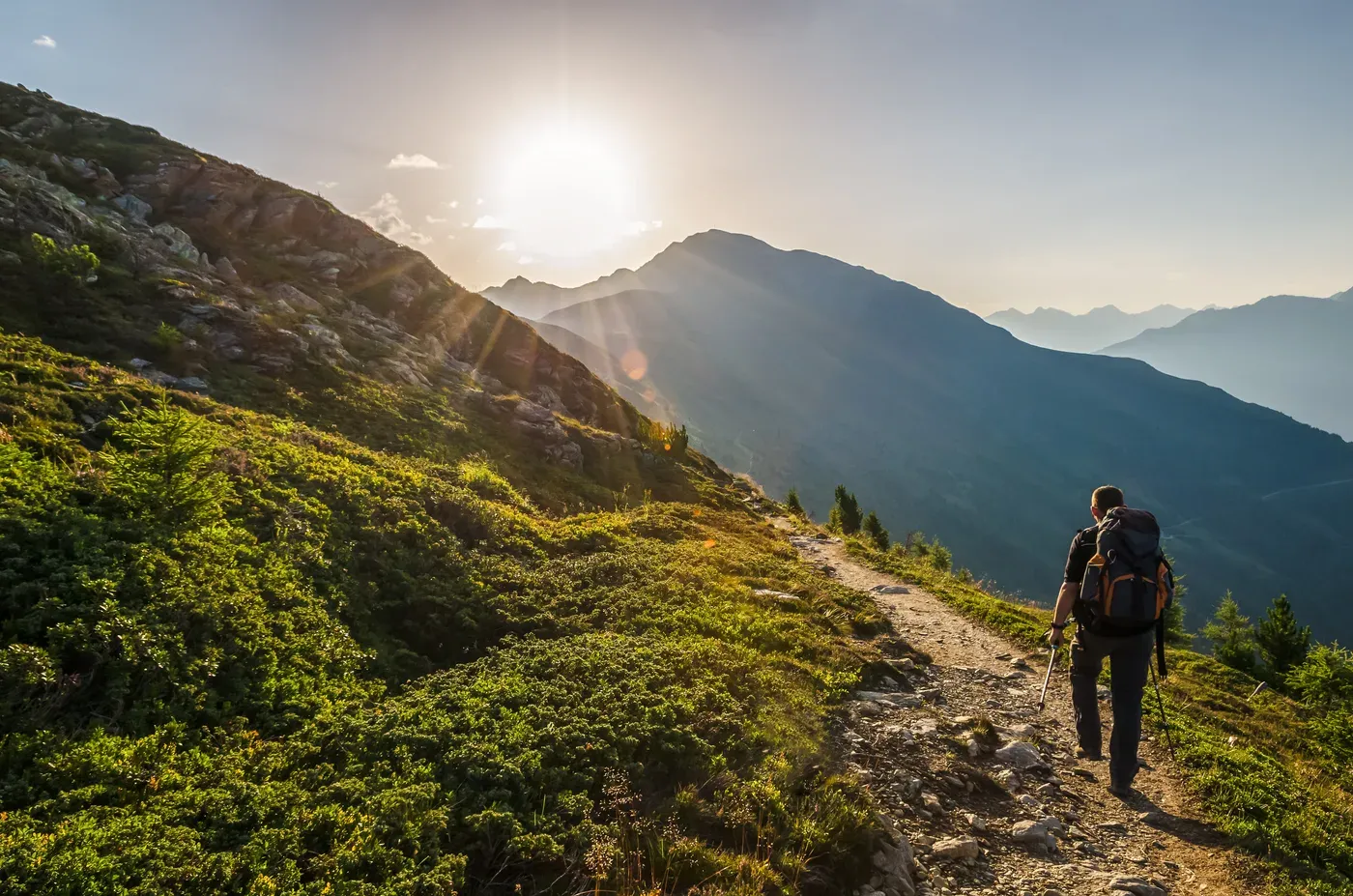
To train for a hiking trip, build up to back-to-back long hikes carrying the pack you’ll use, add stair or hill work for the climbs, and strengthen your legs to control the descents, which is where knees usually complain. Twelve weeks is enough for most men over 40: three or four sessions a week, including one long weekend hike that grows toward the length and elevation of your trip’s hardest day.
Start from your trip’s hardest day
Every trip has one day that decides whether you enjoy it. Work out:
| Question | Why it matters |
|---|---|
| Longest day (km and hours) | Sets your long-hike target |
| Biggest climb and descent (metres) | Sets how much stair and hill work you need |
| Pack weight | Daypack (5–8 kg) and multi-day pack (12–20 kg) are very different training loads |
| Back-to-back days | Multi-day trips need you to recover overnight |
| Altitude | High-altitude trips feel harder at the same pace; leave more margin |
Your training goal: by week 10 or 11, complete a training hike at about 70 to 80% of your hardest day’s distance and climbing, with your trip pack, and feel fine the next morning.
Why descents are the hard part after 40
Climbing tires your lungs. Descending tires your knees and quads, because the muscles work to brake every step. That’s why many hikers over 40 have sore knees on the way down and sore thighs for days after.
Two things help:
- Train the lowering. Slow step-downs and split squats with a slow lowering phase prepare your quads for the braking work.
- Use trekking poles. In a lab study of downhill walking, hiking poles reduced ground reaction force, knee joint moment and knee joint compressive and shear forces by 12 to 25% (Schwameder et al., 1999). The study was small, but the effect was consistent.
The 12-week hiking plan
| Weeks | Long hike (weekend) | Midweek conditioning | Strength (2×) |
|---|---|---|---|
| 1–2 | 2–3 h, light daypack | 2 × 30–40 min brisk walk or incline treadmill | Step-up, split squat, Romanian deadlift, row, side plank: 3 × 10 |
| 3–4 | 3–4 h, pack at about half trip weight | 1 × stair session (20 min) + 1 × 40 min walk | Add slow step-downs 3 × 8/side, calf raises 3 × 15 |
| 5–6 | 4–5 h, pack at about 75% trip weight | 1 × stairs (25–30 min) + 1 × 45 min incline walk with pack | Heavier: goblet squat 3 × 8, split squat 3 × 8/side, step-down 3 × 10/side |
| 7–8 | 5–6 h with full pack; try two days back to back | 1 × stairs (30 min, with pack) + 1 × easy 45 min | Maintain; add single-leg RDL 3 × 8/side |
| 9–10 | Biggest training hike: 70–80% of your hardest trip day, full pack | 1 × stairs + 1 × easy | Maintain at slightly lower volume |
| 11 | 3–4 h moderate | 1 × easy stairs | One session, lighter |
| 12 | 1–2 h easy, test gear | Easy walking | Light or none; travel and rest |
Stair sessions: walk up steadily, walk down carefully, repeat. Add your pack once your knees are comfortable without it.
Training for a mountain trip from Toronto
Toronto doesn’t have mountains, but it has enough to train with:
- Stairs: long outdoor staircases and the stairwells of your condo or office tower. The Toronto stair workouts guide lists good options.
- Ravines and trails: the Don Valley, Humber River trails and the Rouge for long weekend hikes. See Toronto hiking trails for fitness.
- Escarpment day trips: sections of the Bruce Trail near Hamilton, Milton and the Niagara Escarpment for real climbs and descents.
- Incline treadmill: set the maximum incline, wear your pack, and walk for 30 to 45 minutes.
The strength sessions that protect knees and back
| Exercise | Sets × reps | Why |
|---|---|---|
| Step-up (knee-height box) | 3 × 8–10 per side | Climbing strength |
| Slow step-down (3-second lowering) | 3 × 8–10 per side | Controls descents |
| Split squat | 3 × 8 per side | Single-leg strength and balance |
| Romanian deadlift | 3 × 8–10 | Hamstrings and back for carrying a pack |
| Calf raise | 3 × 15 | Ankles and calves for uneven ground |
| Farmer’s carry | 3 × 40 m | Trunk and grip under load |
| Side plank | 2 × 30 s per side | Trunk stability with a pack |
In injury-prevention trials, strength training substantially lowered injury risk, with more training linked to more protection (Lauersen et al., 2018).
Gear and habits that matter as much as fitness
- Break in your boots on training hikes; never take new boots on the trip.
- Train with the actual pack, packed to trip weight, by week 7.
- Practise eating and drinking on the move during long hikes.
- Start slowly each day. The first hour should feel easy.
The bottom line
The best hiking fitness comes from hiking with a pack on hills, supported by leg strength for the descents and a steadily growing long hike. Twelve weeks gets most men over 40 ready for a big trip. If you’d like a 12-week block built around your departure date, with an assessment at the start and check-ins to adjust it, look at the 12-Week Body Transformation. Heading for a ski trip instead? The ski season prep guide has a similar leg-focused plan.
Questions people also ask
How far in advance should I train for a hiking trip?
Twelve weeks is ideal for a multi-day or mountain trip if you're starting from moderate fitness. Eight weeks can work for a single big day hike if you already walk regularly.
What is the best exercise for hiking?
Hiking with a loaded pack on hills. In the gym, step-ups and slow step-downs are the closest match, because they train both climbing and controlling the descent.
Do trekking poles really help your knees?
In a lab study of downhill walking, using poles reduced knee joint forces by 12 to 25 percent. They're worth using on long descents, especially with a heavy pack.
How do I train for hiking if I live in Toronto with no mountains?
Use stairs, ravine trails, the Scarborough Bluffs area and the Bruce Trail on weekends, plus incline treadmill walking with a pack. Stair climbing is the best local substitute for sustained climbs.
Sources
- Schwameder et al. (1999), Knee joint forces during downhill walking with hiking poles, J Sports Sci
- Lauersen et al. (2018), Strength training as superior, dose-dependent and safe prevention of acute and overuse sports injuries, Br J Sports Med
- CSEP — Canadian 24-Hour Movement Guidelines for Adults 18–64