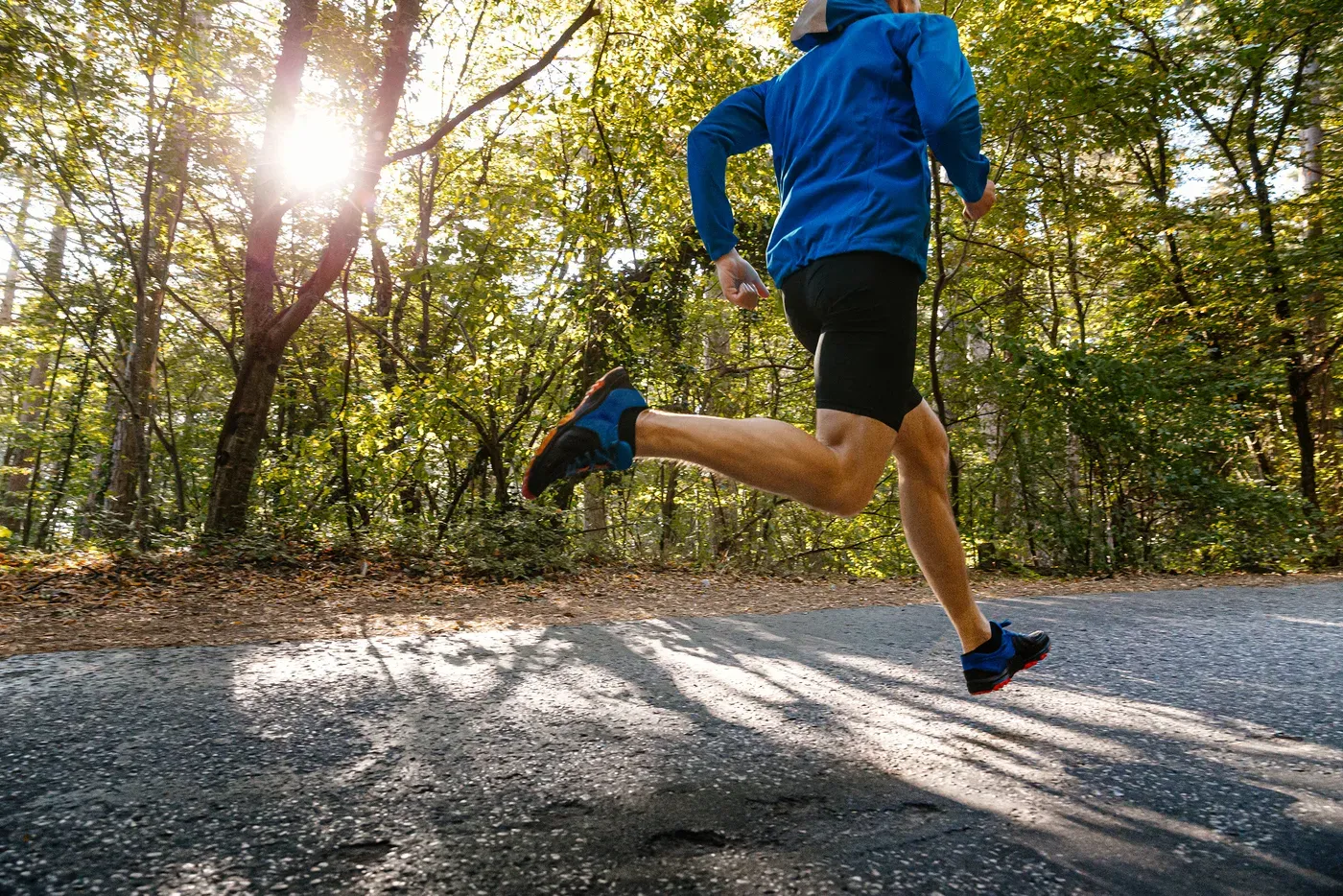
To train for a first half marathon over 40, give yourself 16 weeks, starting from the point where you can run 30 minutes without stopping. Run three or four times a week, mostly at an easy conversational pace, with one long run that builds from about 8 km to 18 km, plus two short strength sessions. Build gradually, take a lighter week every fourth week, and taper for the last two weeks. The goal for a first race is to reach the start line healthy and finish strong.
Pick your race and count back
Two big Toronto races include a half marathon, and they fall at opposite ends of the running year:
| Race | Date | Training block | What to know |
|---|---|---|---|
| Toronto Marathon (half) | Sunday, May 2, 2027 | Mid-January to early May | Most training runs happen in winter: ice, cold and short days |
| TCS Toronto Waterfront Marathon (half) | October 17, 2027 | Late June to mid-October | Long runs in summer heat and humidity |
Dates from the Toronto Marathon and TCS Toronto Waterfront Marathon websites; confirm the details before registering.
A May race means a January start, so read the guide to winter running in Toronto before you commit. An October race means summer long runs, so start early in the morning and carry water.
Before you start the plan
You’re ready if you can:
- run 30 minutes continuously at an easy pace;
- run three times a week without pain the next day;
- answer “no” to the health questions on Canada’s Get Active Questionnaire, or have your doctor’s go-ahead (CSEP).
If you can’t run 30 minutes yet, start with how to start running at 40 and come back in eight weeks.
On joints: a meta-analysis found recreational runners had lower rates of hip and knee arthritis than sedentary people (3.5% versus 10.2%) (Alentorn-Geli et al., 2017). Half marathon training is well within recreational volume.
The 16-week half marathon plan
Three runs a week plus an optional fourth. Easy = conversational pace. “Tempo” = comfortably hard, you can speak a few words.
| Week | Run 1 (easy) | Run 2 (quality) | Long run | Optional run 4 |
|---|---|---|---|---|
| 1 | 30 min | 30 min with 4 × 1 min faster | 8 km | — |
| 2 | 30 min | 35 min with 5 × 1 min faster | 9 km | 20 min easy |
| 3 | 35 min | 35 min with 10 min tempo | 10 km | 20 min easy |
| 4 (lighter) | 30 min | 30 min easy | 8 km | — |
| 5 | 35 min | 40 min with 12 min tempo | 11 km | 25 min easy |
| 6 | 40 min | 40 min with 5 × 3 min faster | 12 km | 25 min easy |
| 7 | 40 min | 45 min with 15 min tempo | 13 km | 25 min easy |
| 8 (lighter) | 30 min | 35 min easy | 10 km | — |
| 9 | 40 min | 45 min with 6 × 3 min faster | 14 km | 30 min easy |
| 10 | 45 min | 45 min with 20 min tempo | 15 km | 30 min easy |
| 11 | 45 min | 50 min with 4 × 5 min at race effort | 16 km | 30 min easy |
| 12 (lighter) | 35 min | 40 min easy | 12 km | — |
| 13 | 45 min | 50 min with 25 min tempo | 17 km | 30 min easy |
| 14 | 45 min | 50 min with 3 × 8 min at race effort | 18 km | 30 min easy |
| 15 (taper) | 35 min | 35 min with 10 min at race effort | 12 km | — |
| 16 (race) | 25 min easy | 20 min easy with 4 short strides | Race: 21.1 km | — |
Rules:
- Long runs are easy. Slow enough to talk the whole way. Walk breaks are allowed.
- Repeat a week rather than push through a niggle that changes how you run.
- Practise race fuel on long runs over 14 km: water, and whatever gel or snack you plan to use on race day.
Strength work for runners over 40
In a meta-analysis of injury-prevention trials, strength training cut sports injury risk by more than half, with more training linked to more protection (Lauersen et al., 2018). Two 25-minute sessions a week, never the day before your long run:
| Exercise | Sets × reps |
|---|---|
| Split squat or reverse lunge | 3 × 8 per side |
| Single-leg Romanian deadlift | 3 × 8 per side |
| Slow calf raises (straight and bent knee) | 3 × 12–15 each |
| Step-down from a low box | 2 × 10 per side |
| Side plank | 2 × 30 s per side |
Cut to one session a week during the taper.
Race-week checklist
- Nothing new: shoes, shorts, breakfast and gels all tested on long runs.
- Sleep well on the Friday; the night before is often restless and that’s fine.
- Eat a familiar, carb-heavy dinner and an early, familiar breakfast.
- Start slower than you think. The first 5 km should feel too easy.
- Walk through water stations if it helps you drink.
The bottom line
A first half marathon at 40-plus is a 16-week project: easy running most of the time, one long run that grows slowly, two short strength sessions and planned lighter weeks. Pick the Toronto race that matches the season you’d rather train in. If you’d like your running, strength, nutrition and recovery planned and adjusted month by month as the long runs grow, look at monthly 1:1 coaching. If cycling is part of your week as cross-training, see strength training for cyclists over 40.
Questions people also ask
How long does it take to train for a half marathon at 40?
About 16 weeks if you can already run 30 minutes continuously. If you can't, spend 8 weeks building to that first, then start the half marathon plan.
How many days a week should I run for a half marathon?
Three or four runs a week works well for most men over 40, plus one or two short strength sessions. More days only help if your joints and recovery keep up.
What is a good half marathon time for a 45-year-old first-timer?
Finishing healthy is the goal for a first race. Many first-timers aim to run the whole way at a comfortable pace and walk briefly through water stations. Set a time goal for your second race.
Should I walk during a half marathon?
Planned short walks, such as 30 seconds every 2 km or through each water station, are a legitimate strategy and help many first-timers finish stronger.
Sources
- Toronto Marathon — race information (marathon, half marathon, 10K, 5K)
- TCS Toronto Waterfront Marathon — race information
- Lauersen et al. (2018), Strength training as superior, dose-dependent and safe prevention of acute and overuse sports injuries, Br J Sports Med
- Alentorn-Geli et al. (2017), The association of recreational and competitive running with hip and knee osteoarthritis, J Orthop Sports Phys Ther
- CSEP — Get Active Questionnaire (pre-screening for physical activity)