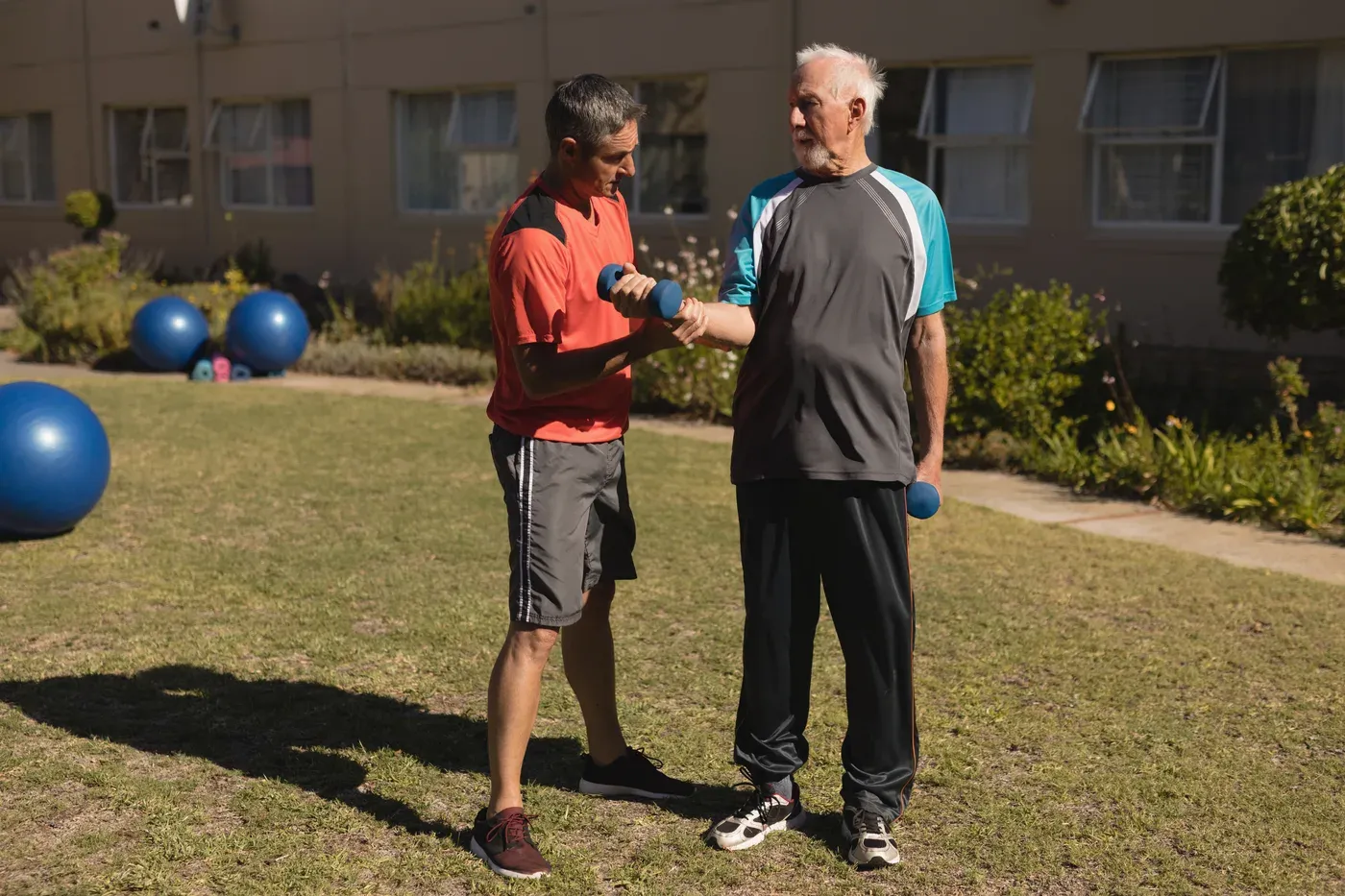
Yes, for most beginners over 35 a personal trainer is worth it for a limited time: roughly the first 6 to 12 weeks. That’s how long it usually takes to learn five basic movement patterns safely, find your starting weights and build a routine you’ll keep. After that, many beginners can continue on a written program with occasional check-ins. The mistake isn’t hiring a trainer as a beginner; it’s hiring one with no plan for when you’ll stop needing them.
What a beginner is really paying for
A beginner doesn’t need a trainer for motivation speeches or exotic exercises. You’re paying for three things you can’t easily get alone:
- Technique on the movements that carry load. Squatting and hinging badly under a barbell is how backs get tweaked.
- The right starting weights. Too light and nothing happens; too heavy and you get hurt or discouraged.
- A routine that sticks. Fixed appointments carry you through the first weeks, when quitting is most likely.
There’s evidence that supervision helps with the second point in particular. In a 12-week study, men training under supervision selected heavier loads and made bigger strength gains than men doing the same program unsupervised (Mazzetti et al., 2000). The men in that study were moderately trained; for genuine beginners, picking appropriate loads is even harder.
The beginner syllabus: five patterns to learn
Think of your first block with a trainer as a short course with a defined syllabus. By the end, you should be able to do each of these with confident technique:
| Pattern | Example exercises | You’ve got it when |
|---|---|---|
| Squat | Goblet squat, leg press, box squat | You can sit back and down with a neutral back and knees tracking over toes |
| Hinge | Romanian deadlift, trap-bar deadlift, hip thrust | You can push your hips back with a flat back and feel it in your hamstrings, not your lower back |
| Push | Push-up, dumbbell bench press, landmine press | Shoulders stay comfortable and you control the lowering |
| Pull | Seated row, lat pulldown, chest-supported row | You pull with your back, not just your arms |
| Carry and brace | Farmer’s carry, dead bug, plank | You can hold a braced trunk while moving |
These cover the muscle-strengthening work Canada’s movement guidelines recommend at least twice a week (CSEP). Everything else in a beginner program is a variation on them.
How many sessions to buy
Rather than buying a big package up front, think in stages:
- Weeks 1 to 4: two sessions a week if you can. This is the learning phase. Each session should cover the main patterns and leave you with a written plan for any solo session.
- Weeks 5 to 8: one session a week. Train once or twice more on your own. Use sessions to check technique as weights rise.
- Weeks 9 to 12: every week or two. By now you should be running the plan mostly yourself.
That’s roughly 12 to 16 sessions in total, which is a very different purchase from a 50-pack. If you’re not progressing to more independence by week 8, ask why.
Cheaper routes for beginners on a budget
If ongoing sessions don’t fit your budget, these combinations cover the biggest beginner risks:
| Route | What it involves | Trade-off |
|---|---|---|
| A few technique sessions + a written program | Two to four sessions to learn the patterns, then a beginner plan on your own | Less accountability |
| Online coaching with video review | You film your sets; a coach gives feedback weekly | Slower technique correction |
| Small-group or semi-private training | Share a trainer with one to three others | Less individual attention |
| A self-guided beginner program | A structured plan with demos and progression | No feedback at all |
When a beginner can skip the trainer
You might not need one if you played sports and lifted when you were younger, you’re comfortable learning from video and filming yourself, you have no injuries, and you’ve stuck with structured plans before. In that case, read about starting to lift at 40 and pick a beginner program.
If the gym itself is the obstacle
Plenty of men over 35 put off starting because walking into a gym feels awkward. A trainer helps here more than most people admit: you have somewhere to be, someone to follow, and a plan before you arrive. Ask about quieter times, or start with sessions in a smaller studio. The guide to gym anxiety over 40 has more practical fixes.
Starting this month
Decide on a 12-week learning block with a clear end. Book two sessions a week for the first month if possible, and make sure you leave every session knowing what to do on your own. If you’d rather have a coach build that block around your schedule, Weekly 1:1 Coaching starts from $99 a week, and the level of support can drop as you become independent. The guide to your first personal training session explains what to bring and expect.
Questions people also ask
How many sessions does a beginner need with a personal trainer?
Often 8 to 12 sessions over six to twelve weeks is enough to learn the main movement patterns and set up a routine, provided you also train on your own in between. Some men need fewer, some need more.
Can a complete beginner learn to lift from YouTube?
You can learn a lot, but you can't see yourself from the side. Video plus filming your own sets helps; a few sessions with a coach checking your squat and hinge is the safer shortcut for men over 35.
Should a beginner start with machines or free weights?
Either works. Machines are easier to learn and useful if you're nervous; free weights teach balance and transfer well to daily life. A good trainer will usually mix both and move you toward free weights as you gain confidence.
I'm overweight and out of shape. Is a trainer a good idea?
Often a very good idea, because the right starting point matters more when you're deconditioned. Complete a health screen first, and check with your doctor if it flags anything.