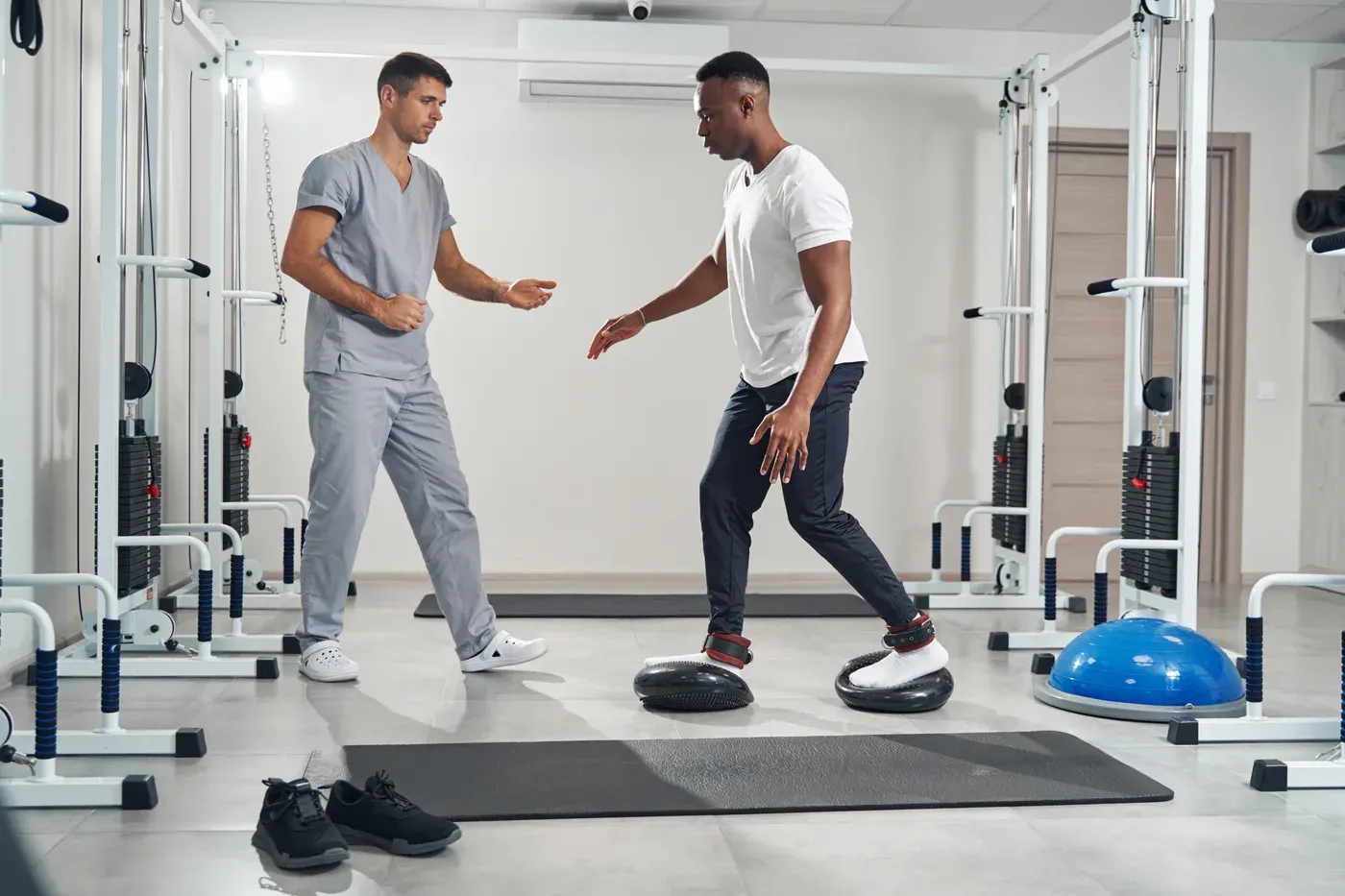
In Ontario, a Registered Kinesiologist (R.Kin) is a regulated health professional with at least a four-year kinesiology degree who has passed a provincial exam; a personal trainer is not regulated and holds a voluntary certification at most. That difference matters in two practical ways: some extended health benefit plans cover kinesiology services but not personal training, and a kinesiologist is trained to use exercise for injury recovery and chronic disease management. For general strength and fat loss in a healthy man, a good trainer or coach is usually enough.
The key differences
| Registered Kinesiologist (R.Kin) | Personal trainer | |
|---|---|---|
| Regulated in Ontario? | Yes, by the College of Kinesiologists of Ontario | No |
| Protected title | “Kinesiologist”, “Registered Kinesiologist”, “R.Kin” | None |
| Minimum education | Kinesiology degree of at least four years (or similar) | Depends on the certification; some require none |
| Entry exam | College’s entry-to-practice exam | Certification body’s exam, if certified |
| Registration number on invoices | Yes | No equivalent |
| Covered by OHIP? | No | No |
| Covered by extended health benefits? | Some plans | Generally not |
| Typical focus | Injury prevention and recovery, chronic disease management, return to work, performance | Fitness, strength, body composition, habits |
Sources for the R.Kin column: COKO FAQs and About regulation.
What “Registered Kinesiologist” means in Ontario
Kinesiology became a regulated profession in Ontario under the Kinesiology Act, 2007. Registered Kinesiologists are one of 27 regulated health professions in the province, and according to the College they’re regulated only in Ontario (COKO).
To register, a person must have a kinesiology degree of at least four years (or a similar degree such as physical education or human kinetics), submit a criminal record check and pass the College’s exam. Only registrants can call themselves a kinesiologist or use R.Kin; the older “certified kinesiologist” label can no longer be used in Ontario (COKO).
The College defines the scope of practice as the assessment of human movement and performance and its rehabilitation and management to maintain, rehabilitate or enhance movement and performance (COKO). In practice, kinesiologists work in hospitals, family health teams, rehab clinics and fitness clubs, among other settings.
The benefits-coverage angle
This is the main reason many Ontario men search this question. The facts:
- OHIP doesn’t cover kinesiology services. Some extended health insurance plans do; ask your insurer (COKO).
- Personal training generally isn’t covered by health benefits, because the trainer isn’t a regulated health professional.
- Tax: the Canada Revenue Agency lists kinesiologists in Ontario as authorized medical practitioners for the medical expense tax credit (CRA), and the College notes you may be able to submit out-of-pocket kinesiology expenses on your return.
Check the details before you book: your plan’s annual limit for kinesiology, whether it needs a doctor’s referral, and whether the receipt must show the R.Kin’s registration number. Insurers treat these differently. The full picture, including health spending accounts, is in the guide to whether personal training is covered by insurance in Canada.
A caution: claim only services that genuinely fit your plan’s terms. Using benefits to pay for general fitness sessions labelled as something else can create problems with your insurer.
Which one should you hire?
| Your situation | Better fit |
|---|---|
| Healthy, want to get stronger and leaner | Personal trainer or coach |
| Managing a chronic condition (type 2 diabetes, heart disease, arthritis) with exercise | Registered kinesiologist, often alongside your doctor |
| Recovering from injury after physio discharge | Kinesiologist, or a trainer who follows the physio’s notes |
| Your benefits cover kinesiology and you’d otherwise pay out of pocket | Kinesiologist may cost you less |
| You want nutrition coaching and weekly accountability as well | A coach who covers both, or a kinesiologist who offers it |
Even if your plan covers kinesiology, check the annual maximum; depending on the plan, it may only fund a handful of sessions a year. Many men use covered sessions for assessment and specific needs, then train on their own or with a coach for the rest.
What to check before hiring either
For a kinesiologist, search the College’s public register and ask for their registration number. For a personal trainer, ask which body certified them and confirm it; the certifications guide explains what each one requires. For both, ask how they’d handle your specific history, and whether they’ll coordinate with your doctor or physiotherapist if needed.
Deciding this week
Pull up your benefits booklet and search for “kinesiology”. If you’re covered and dealing with an injury or a chronic condition, a Registered Kinesiologist is worth a call. If you’re healthy and your goal is strength, fat loss and consistency, a coach is the more direct route; Weekly 1:1 Coaching starts from $99 a week, in person in Toronto or online. If an injury is involved, read the trainer vs physiotherapist comparison first.
Questions people also ask
Can a personal trainer also be a kinesiologist?
Yes. Some people hold a personal training certification and are also registered with the College of Kinesiologists of Ontario. If they're registered, they can use the R.Kin designation and give you a registration number, and their kinesiology services may be claimable on your benefits.
Is a kinesiology degree the same as being a kinesiologist?
No. In Ontario, a degree is only one requirement. To use the title, a person must also pass the College's entry-to-practice exam and be registered. Check the public register if you're unsure.
Will my benefits cover a kinesiologist?
Some extended health plans do and some don't, and coverage limits vary. Call your insurer or check your plan booklet for "kinesiology" or "registered kinesiologist" before you book.
Do I need a referral to see a kinesiologist?
Kinesiologists work on both a referral and non-referral basis, according to the College. Your benefits plan may still require a referral for reimbursement, so check its terms.
Are kinesiologists regulated outside Ontario?
According to the College of Kinesiologists of Ontario, Registered Kinesiologists are regulated only in Ontario. In other provinces, the title and what it means can differ.