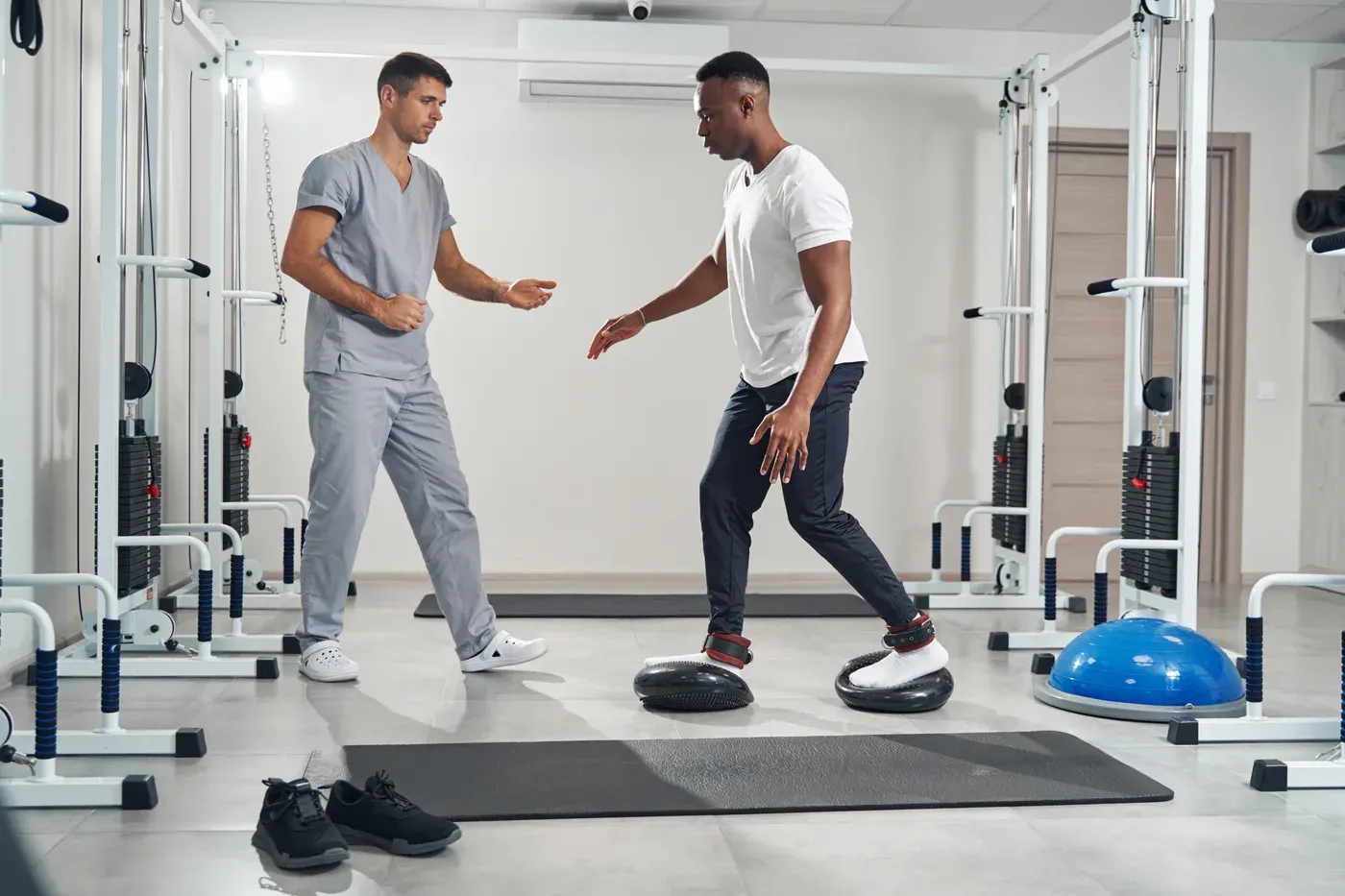
A personal trainer assesses your fitness and health history, writes an exercise program for your goal, teaches you to perform the exercises safely, increases the challenge as you get stronger and keeps you showing up. Good trainers also work on the hours outside the gym: your training on solo days, your eating and your recovery. They don’t diagnose or treat injuries or medical conditions; that’s the job of regulated health professionals.
The five parts of the job
Strip away the gym-floor theatre and a trainer’s job has five parts:
| Part | What it involves | What you should see |
|---|---|---|
| Assess | Health screening, history, movement checks, starting strength | Questions before any hard exercise |
| Program | Choosing exercises, sets, reps, rest and weekly structure | A written plan, not improvised sessions |
| Teach | Cueing technique, demonstrating, correcting | You can do the main lifts without reminders after a few weeks |
| Progress | Adding load, reps or difficulty on a schedule; changing what stalls | Your numbers moving, recorded in a log |
| Hold accountable | Fixed appointments, check-ins, noticing missed sessions | Someone asks when you skip |
CSEP describes its certified personal trainers’ work this way: using an evidence-informed approach to assess a client’s physical activity, fitness and sedentary behaviour, then building a tailored physical activity, fitness and lifestyle plan (CSEP). Most good trainers, whatever their certification, follow the same arc.
What happens inside a session
A typical 60-minute session for a man over 35 looks roughly like this:
- Check-in (5 minutes). How you slept, anything sore, how your solo sessions went.
- Warm-up (10 minutes). General movement, then lighter sets of the first lift.
- Main lifts (30 minutes). Two or three compound exercises, such as a squat or leg press, a hinge, a press and a row. This is where coaching attention matters most.
- Accessory work (10 minutes). Smaller exercises for weak points: core, upper back, single-leg work.
- Wrap-up (5 minutes). Log the numbers, agree what you’ll do before the next session.
The trainer’s value is concentrated in step 3. If the main lifts are rushed so there’s time for a long circuit, you’re getting less coaching than it looks like.
What happens between sessions
This is the part most buyers never see, and it’s where results are decided. A trainer who coaches well between sessions will:
- Write the plan for your solo days, with weights based on what you did in session.
- Review your log and adjust the next session based on it.
- Answer questions by message, such as “my gym has no trap bar, what instead?”
- Coach the basics of eating: protein, portion strategies, how to handle business dinners and weekends.
- Plan around your calendar: travel weeks, holidays, a newborn.
Some trainers sell only the hour and do none of this. That’s a legitimate product, but it’s a different one. People often call the fuller version “coaching”, which is how FITWITHIM’s options are structured.
What a personal trainer can’t do
Personal trainers aren’t one of Ontario’s regulated health professions, which include physiotherapists, kinesiologists and dietitians (COKO). That sets limits worth knowing:
- They can’t diagnose. Pain that persists, swelling, numbness or symptoms like chest pain need a doctor or physiotherapist.
- They can’t treat injuries. They can train around an injury once a health professional has assessed it, which is useful, but rehab is a separate job. The guide to personal trainers vs physiotherapists explains how the two work together.
- They shouldn’t provide medical nutrition therapy. General guidance is fine; managing a medical condition through diet is not.
- Even certified trainers have a defined scope. CSEP, for instance, doesn’t sanction its certified personal trainers to run maximal-effort fitness tests or design programs using loads above 90% of a predicted one-rep max (CSEP).
If you need exercise as part of managing a chronic condition, a registered kinesiologist may be the better fit, and their services are sometimes covered by extended health benefits.
Signs a trainer is doing the job well
After six to eight weeks, you should be able to say yes to most of these:
- You have a written program and know why each exercise is in it.
- Your main lifts are heavier or smoother than when you started.
- You train on your own between sessions, and someone looks at what you did.
- Your eating has changed in at least one concrete way.
- You’d notice, and so would your trainer, if you skipped a week.
Deciding whether you need one
Look at the five parts of the job and ask which ones you can’t do yourself. If it’s only programming, a written plan might be enough. If it’s teaching and accountability, a trainer earns their fee. If it’s the week as a whole, look for coaching rather than sessions. The guide on what happens in a first session shows what the start looks like, and you can compare FITWITHIM’s coaching options to see which parts each one covers.
Questions people also ask
What's the difference between a personal trainer and a coach?
The terms overlap and neither is legally protected. In practice, "trainer" often means someone you see for sessions, while "coach" often means someone who also handles nutrition, habits and check-ins across the week. Ask what's included rather than relying on the label.
Can a personal trainer give me a meal plan?
A trainer can give general healthy-eating guidance, such as protein targets and practical strategies. Detailed nutrition therapy for a medical condition like diabetes or kidney disease belongs with a doctor or registered dietitian.
Do personal trainers need a licence in Ontario?
No licence is required to work as a personal trainer. Certification is voluntary and comes from private bodies such as CSEP, canfitpro, NSCA or ACE. Physiotherapists and kinesiologists, by contrast, must be registered with their regulatory college.
What does a personal trainer do in a 30-minute session?
Usually a shortened warm-up and two or three main lifts, with less time for conversation. Thirty-minute sessions work well once you know the plan and only need supervision on your heaviest work.