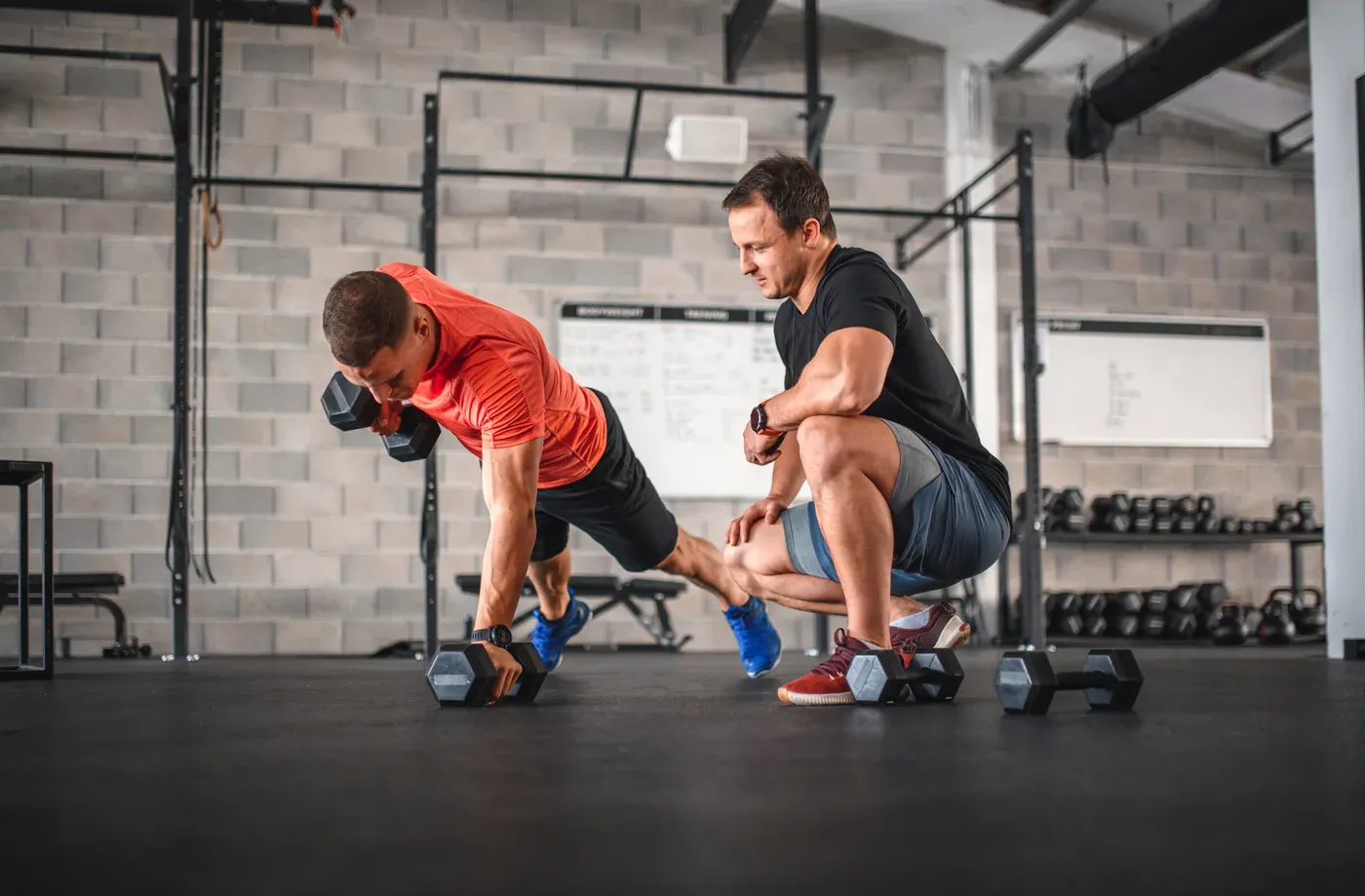
Semi-private personal training is one trainer working with a small group, usually two to four people, in the same session. The cost per person is lower than one-to-one training, you still get more attention than in a class, and training with others helps you show up. The trade-off is less individual coaching time, so it suits men who already know the basic lifts or are training with a partner on similar goals.
How a semi-private session runs
There are two common models, and it’s worth knowing which one you’re buying:
| Model | How it works | Best for |
|---|---|---|
| Individual programs, shared time | Each person follows their own plan; the trainer rotates between you | Mixed goals or experience levels |
| One shared workout | Everyone does the same session, scaled where needed | Partners with similar goals and ability |
In both, a typical hour includes a group warm-up, main lifts where the trainer checks each person’s technique in turn, and accessory or conditioning work you can do with less supervision.
A sample semi-private hour for three people
| Minutes | Person A | Person B | Person C |
|---|---|---|---|
| 0–10 | Group warm-up | Group warm-up | Group warm-up |
| 10–25 | Squat, coached | Rows on their own | Bike intervals |
| 25–40 | Rows on their own | Deadlift, coached | Push-ups and carries |
| 40–55 | Carries and core | Bike intervals | Bench press, coached |
| 55–60 | Log and next steps | Log and next steps | Log and next steps |
Each person gets about 15 minutes of close coaching on their most important lift and works independently the rest of the time.
What it costs compared with one-to-one
Semi-private sessions are priced either per person or per session split between participants. The total for the trainer’s hour is usually higher than a one-to-one session, but each person pays less.
Toronto Metropolitan University’s recreation centre is one of the few Toronto providers that publishes its rates. It offers semi-private training, and its member rates for group sessions run from $89 a session on a 5-pack to $59 on a 50-pack, compared with $59 to $44 for individual sessions (TMU Recreation). Check with any provider whether a quoted group price is per person or for the whole group.
For one-to-one prices across the city, see the Toronto personal trainer cost guide.
Who semi-private training suits
| Good fit | Poor fit |
|---|---|
| You know the main lifts and need structure and accountability | You’ve never lifted and need detailed technique teaching |
| You’re training with a partner, spouse or friend with a similar schedule | Your schedule changes week to week |
| You like a bit of company and friendly competition | You’re working around an injury that needs careful attention |
| Budget rules out regular one-to-one sessions | You want a program built entirely around you, including food |
Advantages and drawbacks
Advantages:
- Lower cost per person than one-to-one.
- Built-in accountability: someone else is expecting you.
- More coaching than a group class.
- Rest periods are natural, as the trainer works with others.
Drawbacks:
- Less technique attention on each set.
- Scheduling around several people’s calendars.
- If your partners drop out, the price per person may rise or the group may fold.
- Programs may drift toward the group average rather than your specific goal.
What to check before you join
- Group size cap. Two to four is genuinely semi-private; eight is a class.
- Individual or shared programs. Which model is it?
- Pricing basis. Per person or per group, and what happens if someone leaves?
- Matching. How does the trainer group people? Similar ability helps.
- Missed sessions. If you miss, does the group still train and do you still pay?
- Between-session support. Will you get a plan for the days you train alone?
The packages guide covers expiry and refund terms, which apply to semi-private packs too.
Making semi-private training work
Agree with your training partner on a fixed day and time before you buy. Treat the semi-private session as the anchor of your week and add one or two sessions on your own; the guide to seeing a trainer once a week shows how. If you find you need more individual attention than a shared session gives, one-to-one coaching may suit you better.
Choosing your setup
If you have a partner and similar goals, semi-private training is one of the best-value ways to get coached. If your needs are individual, such as fat loss with nutrition coaching, an old injury or an unpredictable schedule, one-to-one support will fit better. FITWITHIM’s coaching is one-to-one: Weekly 1:1 Coaching starts from $99 a week, with the level of support set at a free consultation. If you’re weighing a group format more broadly, compare personal training with group classes.
Questions people also ask
How many people are in a semi-private training session?
Usually two to four, sometimes up to six. Beyond that it starts to function like a small group class, with much less individual attention.
Can I do semi-private training with my wife or a friend?
Yes, and it's one of the most common setups. It works best when you have similar schedules and can train at the same time. Your programs don't have to be identical; a good trainer can run different plans side by side.
Is semi-private training good for beginners?
It can be if the group is small and the trainer has time to teach you the main lifts. A complete beginner may benefit from a few one-to-one sessions first, then move into a small group.
Do all people in a semi-private session follow the same workout?
Not necessarily. In well-run semi-private training, each person has their own program and the trainer moves between them. In others, everyone follows one plan. Ask which model you're buying.