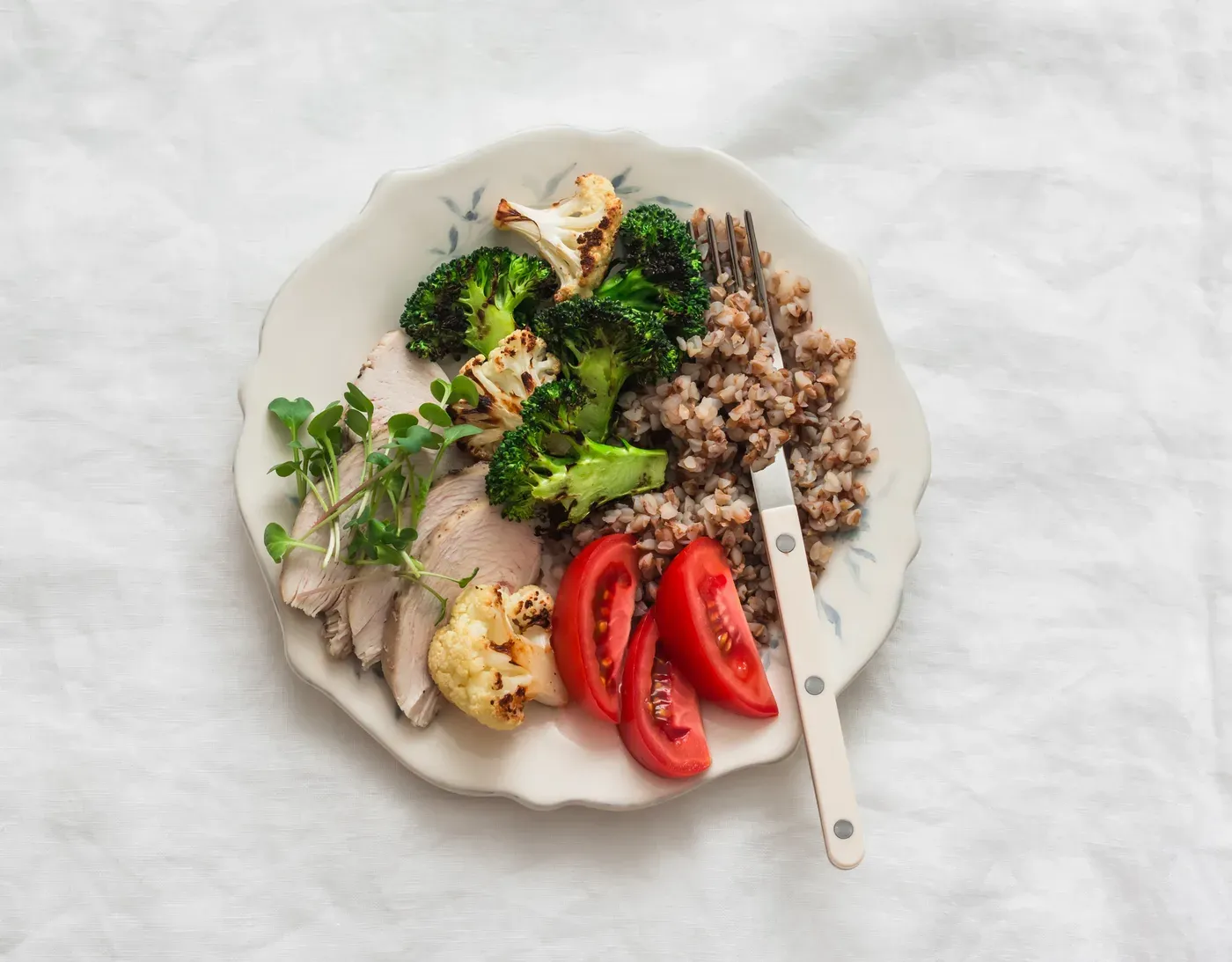
A man over 40 who does any strength training needs about 1.6 grams of protein per kilogram of body weight a day, and up to 2.2 g/kg while losing fat. For a 90 kg (198 lb) man that’s roughly 145 to 200 grams a day. The official RDA of 0.8 g/kg is the minimum to avoid deficiency in sedentary adults, not the amount that best protects muscle as you age.
The three numbers you’ll see, and what each one means
Protein advice sounds contradictory because people quote different numbers for different purposes. Here’s what each one is for:
| Figure | Source | What it’s for |
|---|---|---|
| 0.8 g/kg a day (56 g for a reference man) | Health Canada RDA | Enough to meet basic needs of almost all healthy adults. A floor. |
| 1.4 to 2.0 g/kg a day | ISSN position stand | Building and maintaining muscle for most people who exercise |
| About 1.6 g/kg a day | Morton et al., 2018 | Point beyond which extra protein added no further muscle gain, on average, in 49 trials |
The Morton meta-analysis is the most useful for a man who lifts. Across 1,863 participants, protein supplementation increased strength and muscle gains from training, but intakes above about 1.62 g/kg a day added nothing more to fat-free mass on average. Their upper confidence limit sat around 2.2 g/kg, which is why many coaches use 1.6 as the target and 2.2 as the ceiling.
Health Canada’s acceptable range for protein is 10 to 35% of calories, so even 2.0 g/kg sits comfortably inside the official limits for most men.
Your daily target by body weight
Multiply your weight in kilograms (pounds divided by 2.2) by the g/kg figure that fits your situation:
| Body weight | RDA floor (0.8 g/kg) | Target (1.6 g/kg) | Fat-loss upper end (2.2 g/kg) |
|---|---|---|---|
| 70 kg (154 lb) | 56 g | 112 g | 154 g |
| 80 kg (176 lb) | 64 g | 128 g | 176 g |
| 90 kg (198 lb) | 72 g | 144 g | 198 g |
| 100 kg (220 lb) | 80 g | 160 g | 220 g |
| 110 kg (243 lb) | 88 g | 176 g | 242 g |
If you’re well above a healthy weight, base the target on your goal weight instead. A 120 kg man aiming for 100 kg can use 160 g, not 192 g. The protein calculator does this maths for you.
Why the per-meal amount changes after 40
Older muscle needs a bigger single dose to switch on muscle building. A Canadian analysis from the University of Toronto and McMaster found that muscle protein synthesis plateaued at about 0.24 g/kg per meal in men around 22, but needed about 0.40 g/kg in men around 71 (Moore et al., 2015). Men in their 40s and 50s sit between those groups, so the safer assumption is the higher figure.
For a 90 kg man, 0.4 g/kg is about 36 grams per meal. That’s the practical reason a coffee and a muffin for breakfast, or a salad with a few strips of chicken at lunch, leaves you short: those meals carry 5 to 15 grams. Three meals of 35 to 45 grams plus one protein snack gets most men to their daily number without trying hard.
How much more you need while losing fat
When you eat below maintenance, your body is more willing to break down muscle for energy. Higher protein pushes back. In a four-week trial with a deep calorie deficit and hard training, young men eating 2.4 g/kg a day gained about 1.2 kg of lean mass and lost more fat than men eating 1.2 g/kg (Longland et al., 2016).
That was an aggressive study in young men, so don’t copy the 2.4 figure. The takeaway for a man over 40 is simpler: when you cut calories, keep protein near the top of the range (around 2.0 g/kg of goal weight) rather than letting it fall with everything else.
Is high protein safe for your kidneys?
For healthy men, intakes in the 1.6 to 2.2 g/kg range are well within what the research above studied without harm. The exception is anyone with chronic kidney disease or reduced kidney function. In that case, your protein target is a medical decision for your doctor or a registered dietitian, not a coaching one.
If you’ve had recent bloodwork, your family doctor can tell you in one sentence whether your kidney numbers are normal.
Hitting the number in real life
Knowing the target is the easy part. Eating it every day takes a system, and that’s what the high-protein eating guide covers: a weekly batch-cook of two proteins, two carbs and two vegetables, so most meals take minutes to assemble. If breakfast is your gap, the high-protein breakfast ideas list options with 30 grams or more.
This week, write down everything you eat for three days and total the protein. If you land well below the table above, close the gap one meal at a time, starting with whichever meal is lowest. If you want your target set from your weight, training and goal, then checked against your food log each month, monthly 1:1 coaching does exactly that.
Questions people also ask
How much protein does a 50-year-old man need?
The same g/kg ranges apply, with a stronger case for the upper half. Older muscle needs a bigger dose per meal to respond fully, so aim for at least 1.6 g/kg a day and about 0.4 g/kg at each main meal.
Is 150 grams of protein a day too much for a man over 40?
For a healthy man who weighs 80 to 100 kg, 150 g a day is within the 1.4 to 2.0 g/kg range the International Society of Sports Nutrition calls sufficient for most exercising people. It's not excessive unless you have kidney disease.
Should I calculate protein from my current weight or goal weight?
If you carry a lot of extra fat, use your goal weight or a realistic target weight. Calculating from 125 kg when your muscle mass is that of a 95 kg man inflates the number without adding benefit.
Does protein timing matter as much as the daily total?
No. The daily total matters most. Spreading it over three or four meals is a useful second step, especially after 40, but it won't rescue a day that's 60 g short.
Sources
- Health Canada — Dietary reference intakes: reference values for macronutrients
- Jäger et al. (2017), ISSN position stand: protein and exercise, J Int Soc Sports Nutr
- Morton et al. (2018), Protein supplementation and resistance training-induced gains in muscle mass and strength: meta-analysis, Br J Sports Med
- Moore et al. (2015), Protein ingestion to stimulate myofibrillar protein synthesis requires greater relative protein intakes in healthy older versus younger men, J Gerontol A
- Longland et al. (2016), Higher compared with lower dietary protein during an energy deficit, Am J Clin Nutr