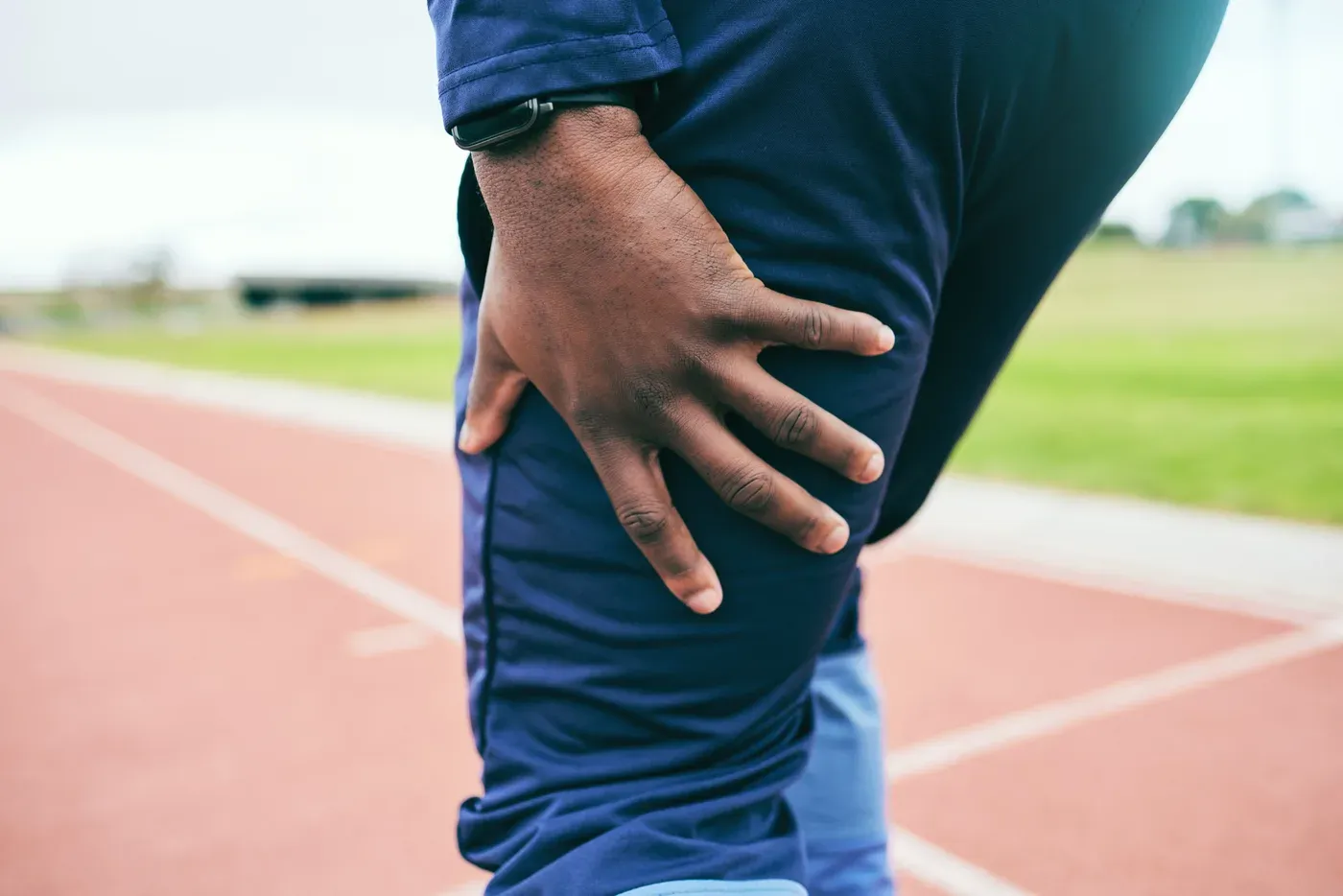
Muscle soreness and injury feel different in four ways: where, when, what kind and which direction it’s heading. Normal soreness is a dull, spread-out ache in the muscles you trained, which shows up the day after, peaks over the next day or so, eases as you move, and fades within a few days. Injury pain is more often sharp or localised, can sit in or around a joint, often starts during the lift, changes how you move, and doesn’t steadily improve. When you’re unsure, treat it as an injury until someone qualified has checked it.
The quick comparison
| Normal muscle soreness | Possible injury | |
|---|---|---|
| Starts | Hours later, usually next day | During the set, often at a specific moment |
| Where | In the muscle belly, spread out, often both sides | One spot; in or near a joint; one side |
| Feels like | Dull, tender, stiff | Sharp, stabbing, burning, or a pop |
| With movement | Eases as you warm up | Gets worse, or stops you moving normally |
| Swelling or bruising | No | Possible |
| Trend | Better each day; gone in a few days | Not improving, or worse after a week |
| Range of motion | A bit stiff | Clearly limited, or the joint feels unstable |
One or two features in the right-hand column don’t prove an injury, but they’re reasons to stop training that area and keep an eye on it.
What delayed-onset muscle soreness is
Delayed-onset muscle soreness (DOMS) is the tenderness you feel after a new or harder workout. A review of the research describes it as most common when people return to training after a period of reduced activity and when they try unfamiliar exercises, and found that exercises emphasising the lowering phase (eccentric work, like the way down in a squat or a Romanian deadlift) cause it most (Cheung et al., 2003). Symptoms can range from mild tenderness to severe pain, and DOMS can temporarily reduce range of motion and strength.
That’s why the first two weeks back at the gym after years off are the sorest, and why the first month back at the gym is built around easy sessions.
The same review found:
- Exercise was the most effective way to relieve the pain, but only temporarily.
- Stretching, cryotherapy, ultrasound and some other popular treatments had no effect on soreness.
- Training on consecutive days should be lighter and shorter for one to two days after a very sore session, or focus on less affected muscles.
Signs that point to an injury
Stop training the affected area and get it looked at if:
- You felt a sudden sharp pain or a pop during a lift.
- The pain is in a joint rather than the muscle, or in a tendon near a joint.
- There’s swelling, bruising or a visible change in shape.
- You can’t move the area through its normal range, or it feels unstable.
- Pain is getting worse rather than better after two or three days.
- You’re limping, or changing how you move to avoid it.
The NHS guidance on sprains and strains recommends urgent help if an injury is very painful or getting worse, has a lot of swelling or bruising, you can’t put weight on it or walk more than a few steps, or it feels very stiff and difficult to move. It advises emergency care if you heard a crack, the area has changed shape or points at an odd angle, it’s numb or tingling, or the skin looks blue, grey or cold.
The middle ground: tweaks and niggles
Many gym aches sit between the two: a tight spot in the lower back after deadlifts, a cranky elbow after a week of extra chin-ups. Treat these as early warnings. Reduce the load or swap the exercise for a week, keep training everything else, and watch the trend. If it’s clearly better within a week, ease back in. If not, get it assessed. Joint-specific guidance is in achy joints when training over 40.
What to do when you’re very sore
- Move. A walk or an easy bike session eases soreness for a while.
- Train something else. Upper body the day after a very sore leg day.
- Don’t repeat the hard session on the same muscles until the worst has passed.
- Eat and sleep. Protein and a full night’s sleep support recovery; see muscle recovery after 40.
- Progress more gradually next time. Very heavy soreness means you did too much new work at once.
Rarely, extreme muscle pain and weakness after an unusually hard session, especially with dark or cola-coloured urine, can be a sign of rhabdomyolysis, a breakdown of muscle tissue. MedlinePlus lists severe exertion among its causes and dark, red or cola-coloured urine among its symptoms. It’s uncommon, but it needs urgent medical care; it’s the one form of “soreness” not to sleep off.
The bottom line
Soreness is dull, spread out, delayed and improving. Injury is sharp, localised, immediate and not improving. When in doubt, treat it as an injury, train around it and get it checked. If you think you’ve hurt something, the guide to returning to training after an injury shows the staged way back. A coach who sets sensible progressions makes both much less likely; weekly 1:1 coaching starts from $99 a week, in person in Toronto or online.
Questions people also ask
How long does muscle soreness last after working out?
Delayed-onset muscle soreness typically appears the day after training, is worst over the next day or two, and fades within a few days. Soreness that's getting worse after three or four days, or isn't improving after a week, should be checked.
Should I work out when I'm sore?
Light activity often eases soreness, but the relief is temporary. Train other muscle groups, or do a lighter session for the sore area, rather than repeating a hard session on very sore muscles.
Is it a pulled muscle or just soreness?
A strain usually happens at a specific moment, with a sudden sharp pain, often in one spot on one side, and sometimes swelling or bruising. Soreness builds gradually after the workout and tends to be spread across the muscles you trained.
Does stretching prevent soreness?
Not much. A review of treatments found stretching had no effect on relieving delayed-onset muscle soreness. Gradual progression is the best prevention.