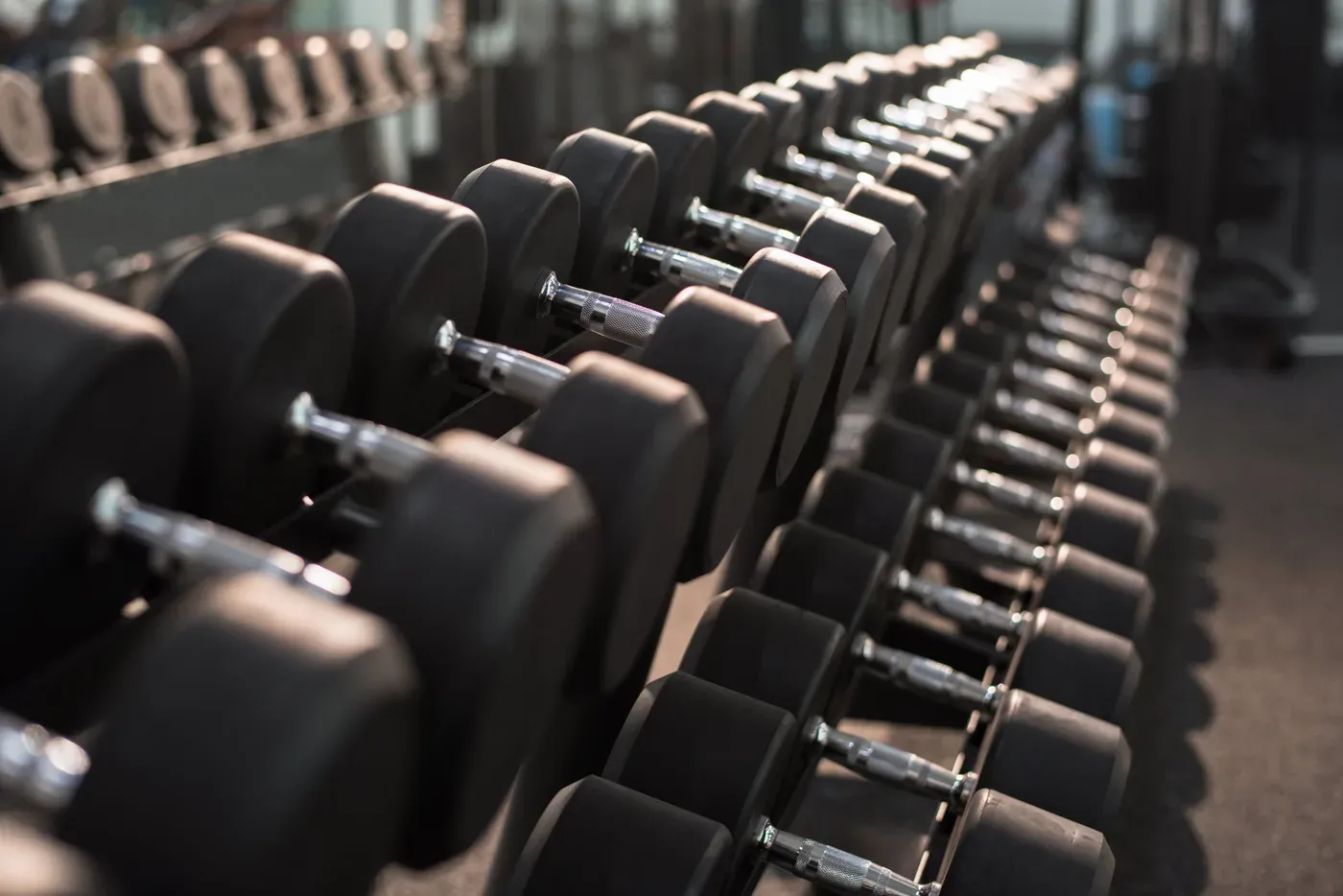
For men over 40, free weights and machines build similar strength and muscle. A 2023 meta-analysis of 13 studies found no difference in direct comparisons of strength, muscle growth or jump performance. The real differences are practical: machines need less skill and protect joints that dislike balancing a load, while free weights train coordination and carry over better to lifting things in real life. Most men do best with both.
What the research says
The most complete comparison pooled 13 studies with 1,016 participants aged 18 to 60, each lasting at least six weeks (Haugen et al., 2023). The findings:
- Muscle growth: no difference between free weights and machines.
- Strength, measured head to head: no overall difference.
- Specificity: people got better at the type of equipment they trained on. Free-weight training improved free-weight strength tests more; machine training tended to improve machine tests more.
The conclusion is simple: pick based on your goals, your joints and what you’ll actually stick with.
When machines suit men over 40 better
| Situation | Why machines help |
|---|---|
| New to lifting, or back after years off | Fixed path means you can train hard on day one while learning technique elsewhere |
| Sore lower back | Leg press, chest-supported row and seated machines take the spine out of the lift |
| Cranky shoulder | Machine presses let you choose a comfortable path and stop safely |
| Training alone with heavy loads | No spotter needed; easy to end a set (see should men over 40 lift heavy) |
| Building muscle in specific areas | Easier to isolate and push close to failure safely |
When free weights earn their place
| Situation | Why free weights help |
|---|---|
| Real-life strength | Carrying, lifting from the floor and loading the car all involve balancing a free load |
| Balance and coordination | Single-leg work, carries and dumbbell presses train stability machines don’t |
| Training at home or in hotels | A pair of dumbbells or a kettlebell travels; machines don’t |
| One side weaker than the other | Dumbbells stop the strong side from carrying the weak one |
| Sports and active hobbies | Golf, hockey and skiing need force produced while balancing |
How to combine them after 40
The American College of Sports Medicine recommends sequencing multi-joint exercises before single-joint ones and larger muscle groups before smaller ones (ACSM, 2009). A practical structure:
- Start with one main free-weight lift, done while you’re fresh: goblet squat, trap bar deadlift, dumbbell press.
- Follow with machines or cables for extra volume: leg press, chest-supported row, cable press. This is where most of the weekly sets in a hypertrophy plan for men over 40 can come from.
- Finish with a carry or single-leg exercise for balance and grip.
Joint-friendly swaps
| If this hurts | Try this instead |
|---|---|
| Barbell back squat | Leg press or goblet squat (see leg press vs squat) |
| Barbell bench press | Dumbbell or machine press with a neutral grip |
| Bent-over barbell row | Chest-supported row or seated cable row |
| Barbell overhead press | Landmine press or seated dumbbell press |
| Conventional deadlift | Trap bar deadlift or Romanian deadlift with dumbbells |
A sample session using both
- Trap bar deadlift 3 × 5–6 (free weight)
- Leg press 3 × 10–12 (machine)
- Dumbbell bench press 3 × 8–10 (free weight)
- Chest-supported machine row 3 × 10–12 (machine)
- Cable face pull 2 × 15 (cable)
- Suitcase carry 3 × 30 m per side (free weight)
Making the most of a crowded Toronto gym
Equipment choice is also about what’s free at 6 p.m. on a Monday. Busy condo gyms and downtown clubs often have one squat rack and a line for it. Build your plan with a backup for every main lift: if the rack is taken, do goblet squats or leg press; if the bench is taken, use dumbbells on any flat bench or the chest press machine. Write both options in your log so you don’t waste 15 minutes waiting.
Home gyms push the other way. A pair of adjustable dumbbells, a bench and a pull-up bar cover most needs without any machines at all, and resistance bands can stand in for cables. Whichever setting you train in, the rules don’t change: train each muscle hard, twice a week, and add weight or reps over time.
The bottom line
The equipment matters less than training hard, consistently and progressively. Use machines to take load off sore joints and add safe volume; use free weights to build the balanced, real-world strength you need for sport and daily life. If you’re just getting started, read how to start lifting weights at 40. If you’d like a coach to choose exercises around your specific joints and check your form, weekly 1:1 coaching starts from $99 a week.
Questions people also ask
Are machines safer than free weights for older men?
Machines guide the path and make it easy to stop a set, which lowers the skill needed. That makes them a good starting point. But free weights done with good technique are safe too, and they train balance and coordination machines don't.
Can I build muscle with only machines?
Yes. Direct comparisons found no difference in muscle growth between free-weight and machine training. A machine-only program can build plenty of muscle if it covers every major muscle group.
Are free weights better for functional strength?
Strength is specific to how you train it. Free-weight training improved free-weight test results more, and machine training tended to improve machine tests more. If your goal involves lifting real objects, free weights carry over more directly.
What about cables?
Cables sit between the two: they guide less than machines but give smooth, adjustable resistance. They're excellent for joint-friendly rows, presses, face pulls and arm work.