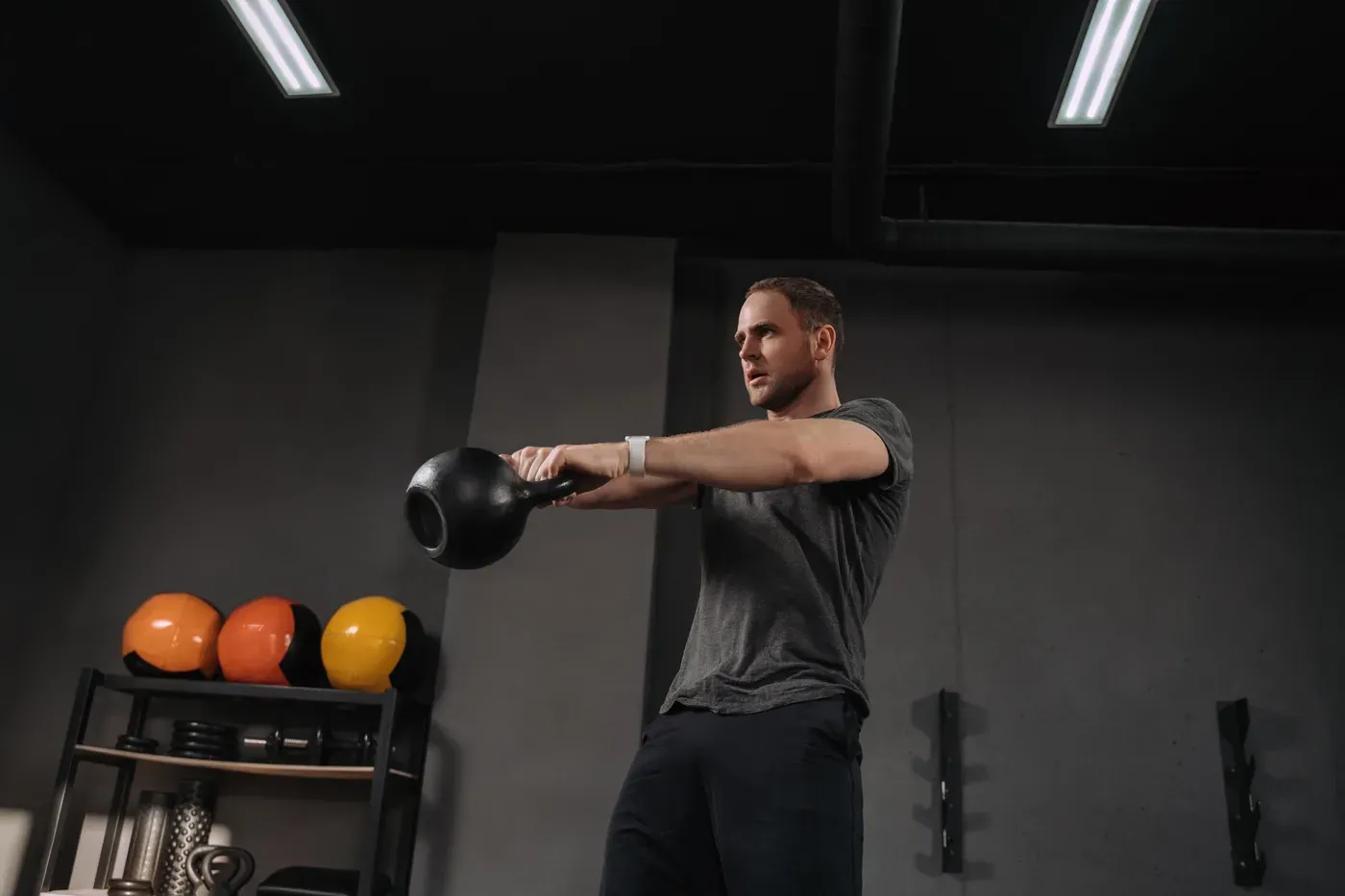
A kettlebell swing is safe over 40 when it’s a hinge driven by the hips, not a squat and not an arm lift. Hike the bell back between your thighs like a football snap, then stand up hard by snapping your hips forward so the bell floats to chest height. Let it fall back, hinge to meet it, and repeat. Your arms are just ropes. If your lower back feels it more than your glutes, stop and fix the hinge before adding more swings.
What the swing does
The swing trains the glutes and hamstrings to produce force fast, which is a quality that fades with age if you don’t use it. It also builds grip, tests your trunk and gets your heart rate up, all with one bell and two square metres of floor. For a busy man training at home, few exercises deliver more per minute.
The catch is speed. A slow hinge forgives small errors; a fast one repeated 20 times does not. That’s why the hip hinge must be solid first.
Setup
Place the kettlebell on the floor about a foot (30 cm) in front of you. Feet a bit wider than hip width, toes slightly out. Hinge down and grip the handle with both hands, tilting the bell toward you so it’s ready to hike. Your back is flat, your hips are higher than your knees, and your shoulders are above your hips.
How to swing, step by step
- Hike the bell back high between your thighs, forearms brushing your inner thighs.
- As the bell reaches the end of the backswing, snap your hips forward and stand tall.
- Squeeze your glutes and brace your abs at the top, as if bracing for a punch. Breathe out sharply.
- The bell floats to about chest height. Arms stay straight but relaxed.
- Let the bell fall. Wait until your forearms are about to touch your hips, then hinge back.
- Guide the bell back between your legs and snap again.
- To finish, hike it back one last time and park it on the floor in front of you.
Four errors and the fixes
Squatting the swing. Knees bend deeply and the bell travels down toward the floor. Keep your shins near vertical; the movement is hips back, not hips down.
Lifting with the arms. The shoulders do the work and the bell rises slowly. Think of throwing the bell forward with your hips; the arms only hold on.
Hyperextending at the top. Leaning back to finish compresses the lower back. Finish like a standing plank: glutes tight, ribs down.
Hinging too early. You start bending before the bell gets close, so it pulls you forward. Wait for the bell; let it come to you.
Sets, reps and weights
| Goal | Sets × reps | Rest | Bell |
|---|---|---|---|
| Learning | 5 × 5 hike-and-park singles | 60 s | 12–16 kg |
| Power and strength | 6–10 × 5–10 | 60–90 s | Heavy enough to need a hard snap |
| Conditioning | 10 rounds of 15 s on, 45 s off | As listed | Moderate |
Count quality, not volume. When the snap slows or form slips, end the set.
Easier, harder and back-friendly variations
- Easier: kettlebell deadlift, then hike-and-park singles, then sets of five.
- Harder: heavier bell, single-arm swings, or hand-to-hand swings for grip and rotation control.
- Sore lower back: go back to the kettlebell deadlift or a glute bridge until the back settles.
- Sore shoulders: keep the swing low, to about belly button height.
- Next skill: the Turkish get-up is the slow, controlled counterpart to the fast swing.
Workouts with swings
Swings are central in the kettlebell workout, and they show up as conditioning in the joint friendly HIIT workout and the fat loss workout. For a schedule that builds swing volume safely, look at the DIY programs.
Questions people also ask
What weight kettlebell should a man over 40 start with?
For most men, 12 to 16 kg (about 26 to 35 lb) to learn the swing. Once the pattern is solid, 20 to 24 kg (44 to 53 lb) is a common working weight.
How high should the kettlebell go?
To about chest height in a Russian-style swing. Swinging overhead adds shoulder and back stress with little extra benefit for most men.
Do kettlebell swings count as cardio?
They push your heart rate up quickly, so they work well as conditioning. They're also strength work for the hips and grip, which a treadmill isn't.
Why do I feel swings in my lower back?
Usually you're squatting the bell, lifting it with your arms, or leaning back at the top. Re-learn the hinge with the bell on the floor and practise the hike and park.