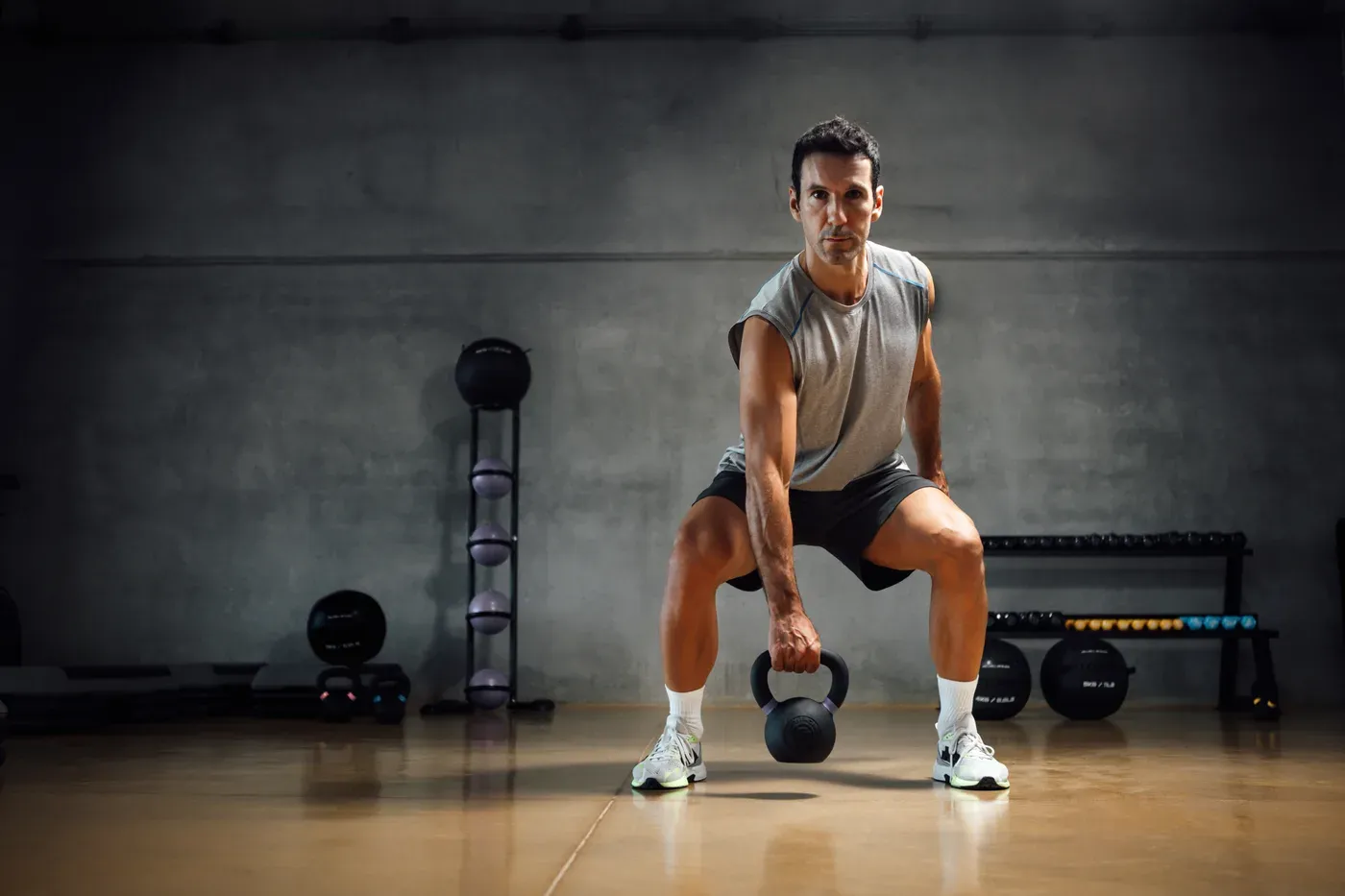
A hip hinge is how you bend forward with your hips doing the work and your back staying straight. To learn it safely over 40, hold a dowel along your spine touching your head, upper back and tailbone, soften your knees, then push your hips back until you feel your hamstrings stretch, keeping all three contact points on the stick. Stand up by driving your hips forward. Once that’s smooth, you’re ready to add a kettlebell or dumbbells.
Why the hinge comes first
Every deadlift, kettlebell swing and Romanian deadlift is a loaded hinge. If the hinge is missing, the lower back fills in, and that’s where most gym back tweaks in men over 40 start. The hinge also carries straight into daily life: picking up a laundry basket, moving a box in the garage, lifting a toddler.
Many men who sit all day have lost the feel for it. The hips forget how to move separately from the spine. The drills below rebuild that in a few short sessions.
Three drills to learn it
Wall touch
Stand with your back to a wall, heels about a foot (30 cm) away. Soften your knees. Push your hips back until your backside touches the wall, keeping your shins nearly vertical. Stand up and squeeze your glutes. Step a little further from the wall as it gets easy.
Dowel along the spine
Hold a broomstick or dowel behind you, one hand at the back of your neck and one at your lower back. The stick touches your head, between your shoulder blades and your tailbone. Hinge forward. If any contact point comes off, your back moved instead of your hips.
Hands down the thighs
Stand tall with your hands on the front of your thighs. Slide them down toward your knees by pushing your hips back. Stop as soon as your hands reach the top of your kneecaps or your hamstrings say stop, whichever comes first.
Cues to keep
- Feet hip width, weight in the middle of the foot.
- Knees soft, not straight and not squatting.
- Hips travel back first, as if pointing your backside at the wall behind you.
- Chest tips forward as a result, never before.
- Neck stays long; eyes go to the floor a few feet ahead.
- Stand by squeezing your glutes and pushing your hips through.
Mistakes to watch for
- Turning it into a squat. Knees bend too much and shins tip forward. Keep shins close to vertical.
- Rounding from the upper back. The stick leaves your head or shoulder blades. Stop sooner.
- Overextending at the top. Leaning back past straight compresses your lower back. Finish standing tall, glutes tight.
- Going too deep. Hamstrings are the limit. Range comes with practice, not effort.
When to load it, and how much
| Stage | Exercise | Sets × reps | Move on when |
|---|---|---|---|
| 1 | Dowel or wall hinge | 3 × 10 | No loss of contact points for two sessions |
| 2 | Kettlebell or dumbbell deadlift from a box | 3 × 8 | The weight feels light and the back stays flat |
| 3 | Dumbbell Romanian deadlift | 3 × 10 | You can control 3 × 10 with a pause |
| 4 | Trap bar deadlift or kettlebell swing | 3 × 5–8 | Your program says so |
Easier and joint-friendly options
- Easier: a glute bridge trains the hip extension without any forward bend at all.
- Sore back: keep the range short, practise the dowel drill daily without load, and get any lasting pain checked.
- Tight hamstrings: bend the knees a little more and accept a shorter range for now.
Where you’ll use it
The hinge pattern runs through the lower back friendly workout, the kettlebell workout and the beginner gym workout. Practise the dowel drill as part of your warm-up for a few weeks. If you want the steps from drill to loaded lift laid out for you, the DIY programs cover the full progression.
Questions people also ask
What is a hip hinge?
It's bending forward by folding at the hips while your spine stays long and fairly still. Your hips move back, your knees bend a little, and your chest tips toward the floor.
Is a hip hinge the same as bending over?
Not quite. Bending over often means rounding the back. A hinge keeps the back neutral and puts the work into the hips, hamstrings and glutes.
How long does it take to learn the hip hinge?
Many people get the feel in one or two sessions with the dowel drill. Making it automatic under load takes a few weeks of practice.
Can hinging help a sore back?
Learning to bend from the hips instead of the spine can make lifting things feel better, but it's not a treatment. If your back hurts, get it assessed by a physiotherapist and train around their advice.