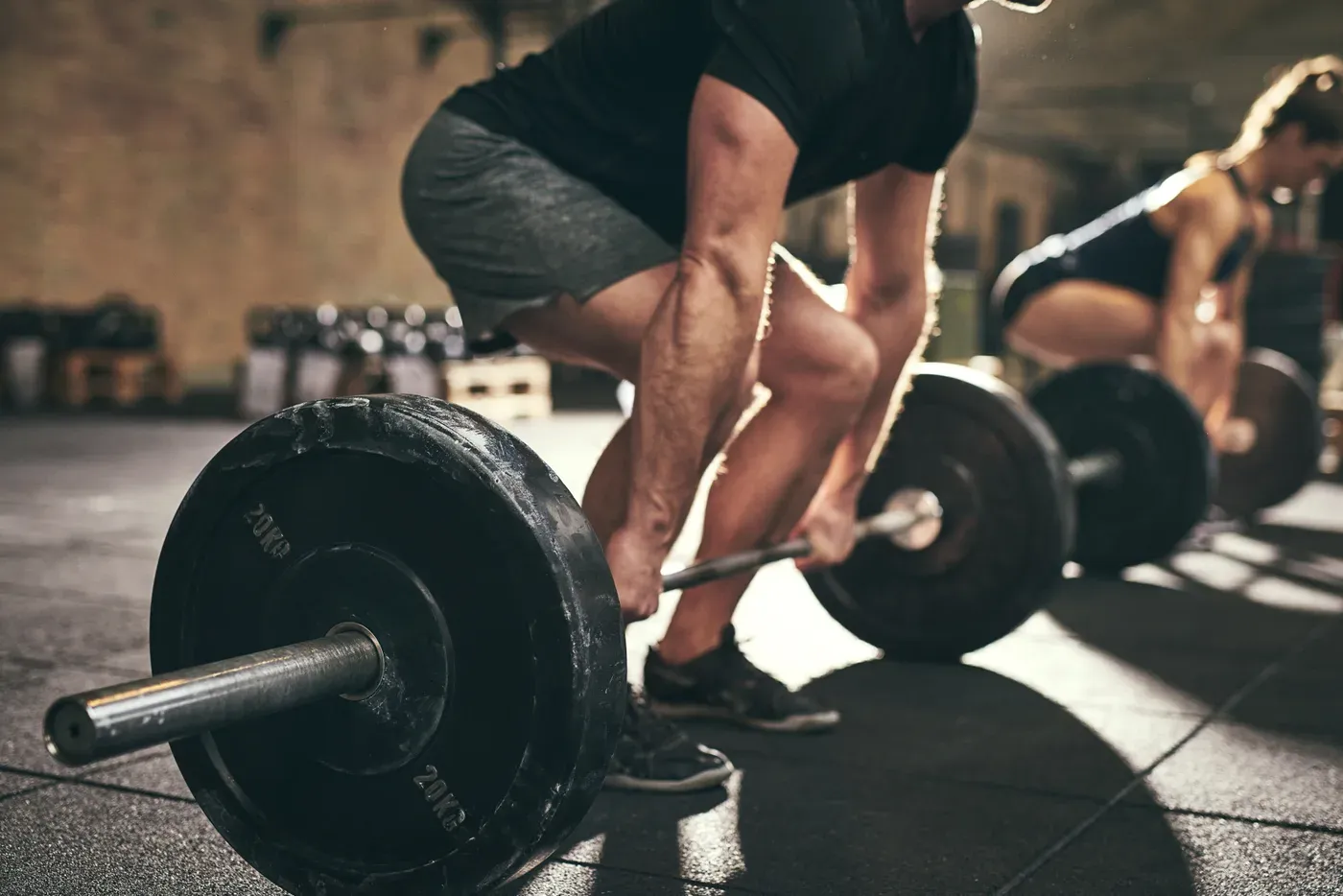
The trap bar deadlift is the safest way for most men over 40 to pull heavy weight from the floor. Stand in the centre of the hexagonal bar, hinge down and grip the handles, set your back flat and your shins near vertical, then push the floor away until you’re standing tall. Because the load sits beside you instead of in front, your back stays more upright than in a straight-bar deadlift.
Why choose the trap bar
A heavy deadlift builds the whole posterior chain: glutes, hamstrings, back extensors, upper back and grip. The trap bar delivers most of that with fewer ways to get hurt. There’s no bar to drag over your knees, the neutral grip is kinder to the elbows and biceps, and the raised handles on most bars cut the range for stiff hips.
It’s also simple to coach yourself. If you’ve ever lifted a heavy suitcase off the floor correctly, you already know the shape.
Setup
- Load the bar on the floor and step into the middle. The handles should line up with the middle of your feet, not your toes or heels.
- Feet hip width, toes straight or slightly out.
- Choose the handle height: high for learning or for stiff hips, low for full range.
- Look at the floor about two metres ahead; this keeps your neck neutral.
How to perform it
- Push your hips back and bend your knees until your hands reach the handles. Grip them in the centre so the bar balances.
- Pull your shoulders down away from your ears, as if tucking your armpits into your pockets.
- Breathe into your belly and brace before the bar moves.
- Squeeze the handles and take the slack out: pull until the bar is almost leaving the floor and you feel tight from feet to hands.
- Push the floor away with your legs. Hips and shoulders rise together.
- Finish standing tall, glutes squeezed. Don’t shrug or lean back.
- Reverse it: hips back first, then knees, and set the bar down under control. Reset your brace before every rep.
Common faults and how to correct them
Turning it into a squat. Hips drop too low and the bar ends up pressed off the toes. Raise your hips a few centimetres at setup until your shoulders sit just in front of the handles.
Jerking the bar off the floor. A yank snaps the back into a rounded position. Pull slack out first, then accelerate.
Rounding the upper back on heavy sets. Back off 10 percent, and add rows and carries so your upper back can hold position.
Dropping the lowering phase. Free-falling the bar costs you half the training effect. Lower over about two seconds.
Programming the lift
| Goal | Sets × reps | Rest | Notes |
|---|---|---|---|
| Starting out | 3 × 6 | 2 min | High handles, technique first |
| Strength | 3–5 × 3–5 | 3 min | 1–2 reps in reserve |
| Muscle | 3 × 8 | 2 min | Lower slowly; consider straps |
One heavy pulling session a week is enough for most men over 40. A second, lighter day can use RDLs or a single-leg hinge.
Variations and swaps
- Easier: high handles, a lighter load with a two-second pause at the knee, or a kettlebell deadlift.
- Harder: low handles, a deficit from a small platform, or a rack pull above the knee for overload at the top.
- Sore back: keep the high handles, cap your sets at five reps, and let the Romanian deadlift or a hip thrust fill in on bad days.
- Sore knees: the trap bar’s extra knee bend can bother some knees; raise the hips at setup to make it more hinge, less squat.
- Grip: if your hands fail first, finish with a farmer’s carry using the same bar.
Programs that use it
You’ll find the trap bar deadlift as the main pull in the workout plan for men over 40, the 2-day-a-week workout and the lower back friendly workout, where it replaces the straight bar. If you want a ready-made plan with the weekly jumps worked out, browse the DIY programs.
Questions people also ask
Is the trap bar deadlift easier on the back than a straight bar?
For most people, yes. Standing inside the bar keeps the weight in line with your body, so your torso can stay more upright and the lower back works less than in a conventional barbell deadlift.
Should I use the high or low handles?
Start with the high handles if your hips are stiff or you're new. They shorten the pull. Move to the low handles once you can reach them with a flat back.
Is a trap bar deadlift a squat or a deadlift?
It sits between the two. You still hinge at the hips and pull from the floor, but your knees bend more than in a straight-bar deadlift, so your quads share the work.
How much does a trap bar weigh?
It varies by model, commonly somewhere around 20 to 30 kg (45 to 65 lb). Check the bar or ask the gym staff before you count your plates.