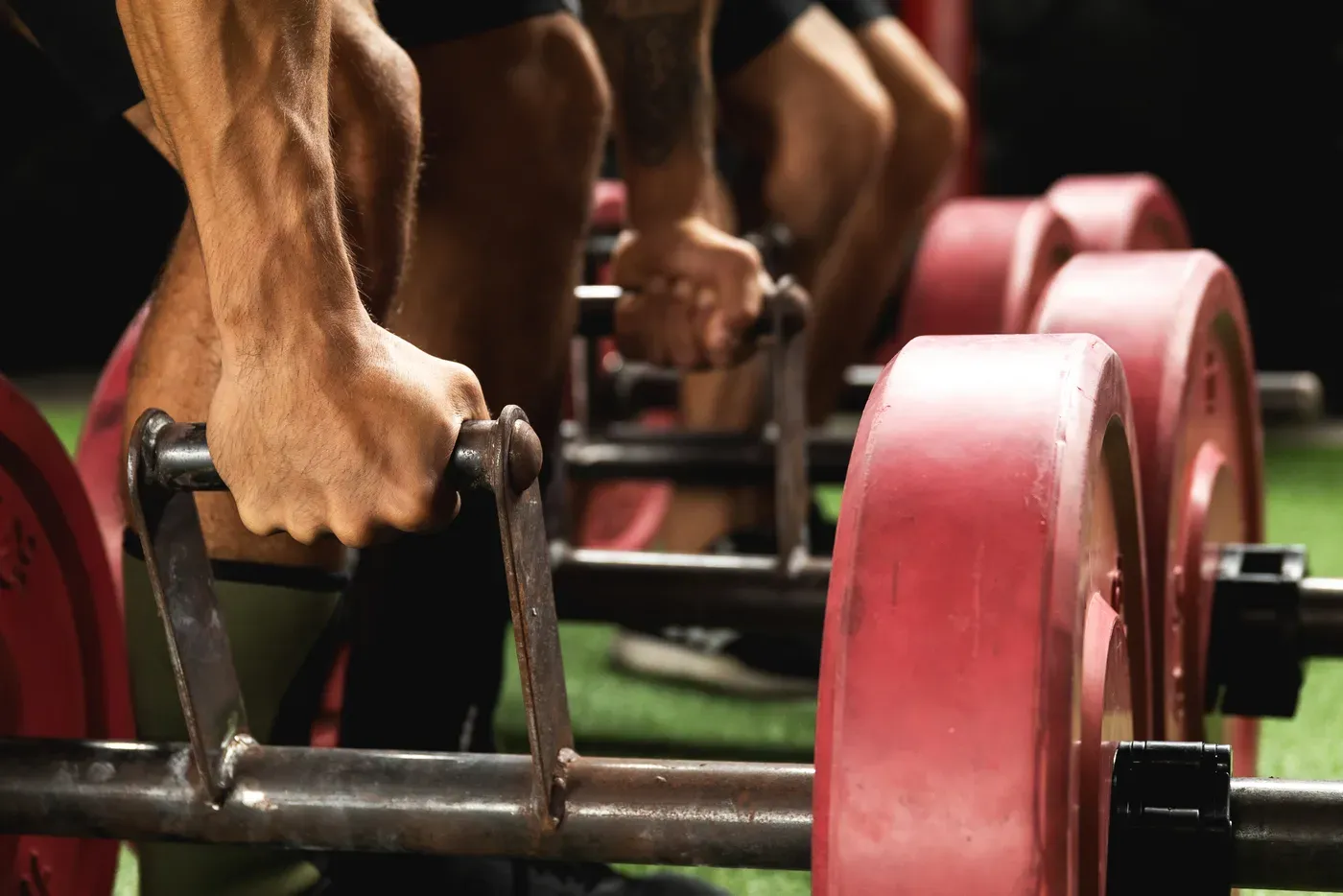
A farmer’s carry is picking up a heavy weight in each hand and walking with it. To do it safely over 40, deadlift the weights up with a flat back, stand tall with your shoulders down and ribs stacked over your hips, then walk with short, controlled steps for 20 to 40 metres. Set the weights down the same way you picked them up. Start lighter than you think and add weight once your posture holds the whole trip.
Why carries are worth the floor space
The carry trains your grip, forearms, traps, upper back and the muscles around your trunk and hips, all while you walk. It’s about as close to real life as gym training gets: bags from the car, a case of water, a bag of salt for the front steps in January.
Grip strength also has a well-documented link to health. In the PURE study of nearly 140,000 adults aged 35 to 70 across 17 countries, lower grip strength was associated with a higher risk of death from any cause and from cardiovascular disease (Leong et al., 2015). That’s an association, not proof that carries add years, but grip is a cheap thing to keep strong.
Picking the weights up
- Place two dumbbells or kettlebells beside your feet, handles parallel to your feet.
- Hinge down with hips back and a flat back, as you would for a deadlift. Don’t reach down by rounding over.
- Grip the handles in the centre so they balance.
- Brace and stand up by driving through your legs.
How to walk it
- Stand fully tall: ears over shoulders, shoulders over hips.
- Pull your shoulders slightly down and back. Don’t shrug the weights up.
- Squeeze the handles hard, as though trying to crush them.
- Walk with short, quick, heel-to-toe steps, feet roughly hip width.
- Breathe in short breaths behind a braced midsection; don’t hold your breath for the whole walk.
- To turn, take small steps around in a wide arc rather than pivoting on one foot.
- Stop, then hinge to set the weights down beside your feet.
Mistakes and fixes
| Mistake | Fix |
|---|---|
| Leaning forward or back | Lighter weights; eyes straight ahead, not at your feet |
| Long strides that make the weights swing | Shorter, quicker steps |
| Shoulders rolling forward | Imagine your shoulder blades in your back pockets |
| Dropping the weights from waist height | Always hinge them down to the floor |
Distances, loads and sets
| Goal | Load (total, both hands) | Distance or time | Sets |
|---|---|---|---|
| Beginner | About 1/3 body weight | 20 m or 30 s | 3 |
| Strength | 1/2 to 3/4 body weight or more | 15–20 m | 3–4 |
| Work capacity | About 1/3 body weight | 40–60 m or 45–60 s | 3 |
For an 85 kg (190 lb) man, a beginner load might be two 14 kg (30 lb) dumbbells. Rest 60 to 90 seconds between trips.
Easier, harder and joint-friendly variations
- Easier: lighter weights and shorter trips, or a single goblet-held kettlebell at the chest.
- Harder: heavier loads on a trap bar, thicker handles, or uneven loads.
- One side at a time: the suitcase carry adds an anti-lean challenge for the obliques.
- Sore lower back: keep the load moderate and trips short; many men find carries feel better than bending lifts.
- Sore elbows or hands: use a trap bar for a neutral grip, or straps on very heavy days.
- No room to walk: stand still and hold for time, or use a sled push for a similar full-body effort.
Programs that use carries
Farmer’s carries finish sessions in the kettlebell workout, the military workout and the fat loss workout. They also fit well after a trap bar deadlift, using the same bar. The DIY programs slot them in for you with loads that rise each week.
Questions people also ask
How heavy should a farmer's carry be?
Start with a total load around a third of your body weight split between both hands, and build toward half your body weight or more. If your posture breaks or your steps get choppy, it's too heavy.
How far should I walk?
Twenty to forty metres per trip, or 30 to 45 seconds, is a good range. Longer walks with lighter weights train endurance; shorter, heavier trips train strength.
Does the farmer's carry work the abs?
Yes. Your trunk muscles work hard to keep you upright and steady while you walk, especially when the load is heavy.
Can I do farmer's carries with kettlebells?
Yes. Kettlebells, dumbbells, a trap bar or purpose-made handles all work. A trap bar lets you go heaviest because the load is balanced.