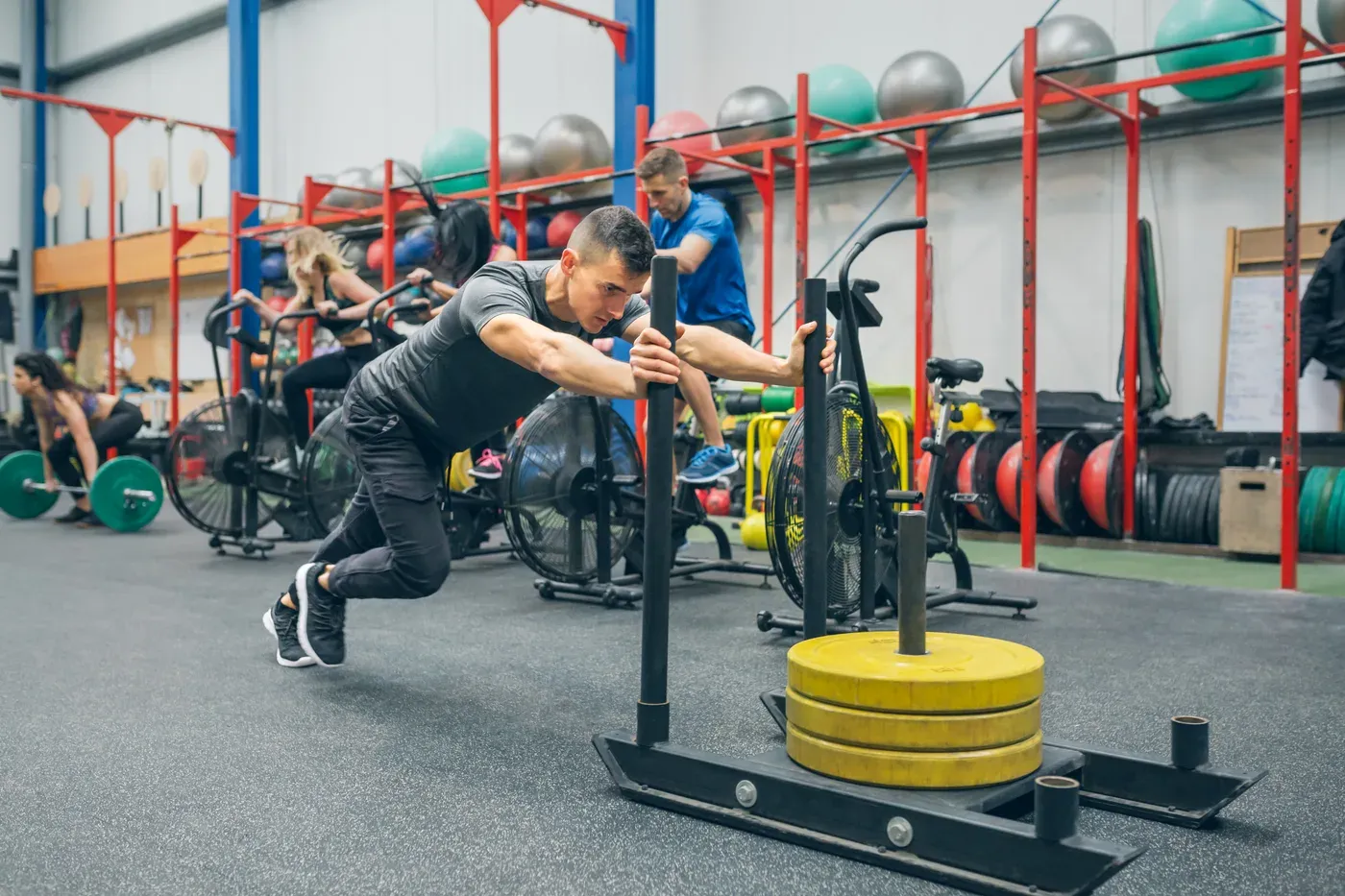
A sled push is driving a weighted sled across turf or a smooth floor with your arms extended and your legs doing the work. To do it safely, grip the uprights, lean your body to about 45 degrees with a straight line from head to back heel, and push with short, powerful steps, landing on the balls of your feet. Push for 10 to 20 metres, rest, and repeat. Because there’s no impact and almost no lowering phase, it’s one of the most joint-friendly conditioning tools in the gym.
Why the sled is a gift after 40
The sled lets you work very hard without the knee and back stress that running, jumping and heavy squats can bring. It trains the quads, glutes, calves and trunk, and it drives your heart rate up quickly. Since there’s almost no eccentric phase, you recover fast; muscle soreness the next day is usually minimal.
It’s also hard to do badly. The sled punishes poor posture by not moving, not by injuring you.
Setup
- Load the sled. On turf, start lighter than you think; friction varies a lot.
- Choose high handles (arms straight, more upright) for speed or low handles (deeper lean) for heavier pushes.
- Grip the handles with arms straight or slightly bent.
- Step back until your body forms a straight line at roughly 45 degrees.
How to push it
- Brace your trunk so your body stays rigid from head to heels.
- Drive one knee forward and push the ground back with the ball of your foot.
- Take short, quick steps, pushing through the full foot.
- Keep your hips low and your back flat, not arched or rounded.
- Keep your arms locked in position; they transfer force, they don’t push separately.
- Look a few feet ahead of the sled, not up.
- Walk the sled back the other way or turn it around for the next set.
Mistakes and fixes
Standing too upright. You push into the sled instead of driving it forward. Lean in until your body is at a diagonal.
Long strides. Big steps lose power and tension. Shorter, faster steps keep it moving.
Hips sagging or piking up. Your trunk is giving out. Use less weight or a shorter distance.
Pushing on the heels. You’ll stall. Stay on the balls of the feet.
Sets and distances
| Goal | Load | Distance | Sets | Rest |
|---|---|---|---|---|
| Beginner | Light | 10–15 m | 4–6 | 60–90 s |
| Strength | Heavy, slow steps | 10 m | 5–6 | 2 min |
| Conditioning | Moderate, brisk | 20 m | 6–10 | 60 s |
| Finisher | Light to moderate | 15 m | 3–5 back-to-back with carries | 90 s |
If you don’t have a turf lane, many gyms have sleds that run on the floor or on a track. Adjust the weight accordingly.
Easier, harder and joint-friendly options
| Option | Purpose |
|---|---|
| High-handle sled push, light | Easier, more upright, faster |
| Low-handle sled push, heavy | Harder; more leg drive |
| Sled pull walking backward | Strong quad work, very knee-friendly |
| Sled drag with a harness | Glute and hamstring emphasis |
| Hill walking with a pack | No sled, similar effort |
For sore knees, a backward sled drag is often the most comfortable leg work available. For shoulders that dislike straight-arm pressure, use the high handles. If you have no sled access, the assault bike gives similar conditioning, and the farmer’s carry gives a similar full-body effort. Step-ups build leg drive at home.
Workouts that use it
The sled push appears in the joint friendly HIIT workout, the fat loss workout and the military workout. For a plan that mixes sled work with your strength days, browse the DIY programs.
Questions people also ask
Is the sled push good for bad knees?
Usually, yes. There's no lowering phase and no impact, so the knees take far less stress than in squats or jumps for a similar effort. Choose a load that lets you keep moving smoothly.
How heavy should a sled push be?
For conditioning, light enough to keep a steady jog-walk pace. For strength, heavy enough that each step is slow and powerful. Floor surfaces vary a lot, so judge by speed, not by plates.
Does the sled push work the legs or the whole body?
Mainly the quads, glutes and calves, but your trunk, shoulders and arms work to transfer force into the sled.
Why don't I get sore from sled pushes?
Sleds involve almost no lowering, or eccentric, work, which is what causes most muscle soreness. That's part of why they're easy to recover from.