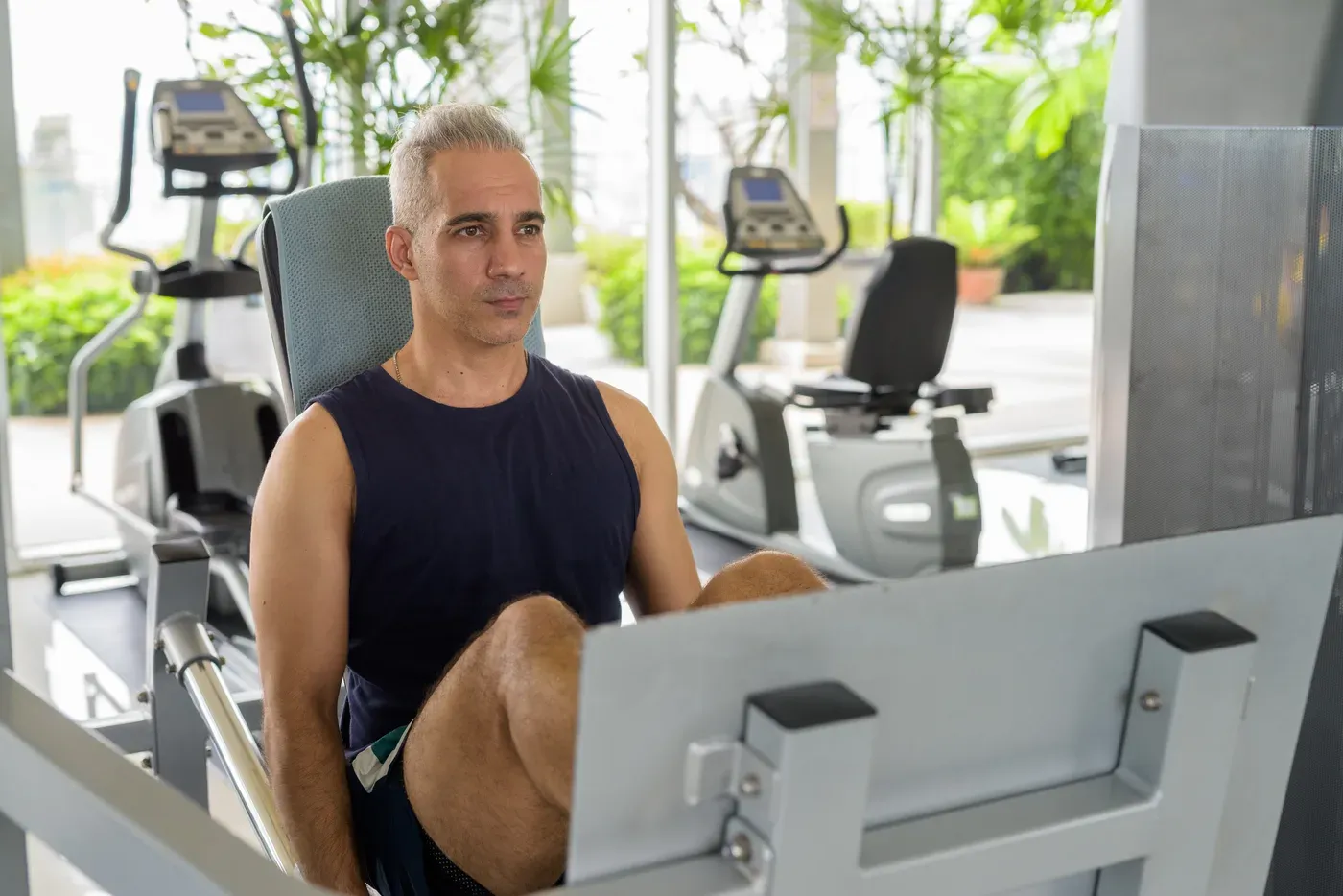
A beginner gym workout for a man over 40 should be two or three full-body sessions a week, mostly on machines at first, with weights light enough that every rep looks the same. This plan starts with two machine-based visits a week, adds a third visit in week 4, and swaps in free weights one movement at a time so that by week 8 you’re squatting, pressing and rowing with dumbbells. The aim of the first two months is to learn the movements and build the habit, not to see how much you can lift.
Before your first session
Spend ten minutes on these and the first visit will feel far less awkward.
- Screen yourself. Fill in the CSEP Get Active Questionnaire. If it flags anything, such as chest pain, dizziness or a diagnosed heart condition, see your doctor before you begin.
- Pick your two days. Tuesday and Friday, or Monday and Thursday. Put them in your calendar like meetings.
- Ask for an orientation. Most gyms will show you how to adjust the seat and pads on each machine. Ask; staff expect it.
- Bring a notebook or use your phone. Write down the machine, the seat setting and the weight. Next session, you start from there.
If walking in is the hard part, read dealing with gym anxiety over 40 first.
Weeks 1 to 3: two machine sessions
Do Session 1 and Session 2 once each per week, with at least two days between them. Every exercise is 2 sets of 10 to 12 reps. Choose a weight where the last rep is hard but clean, about three reps short of failure. Rest 60 to 90 seconds.
| Session 1 | Session 2 |
|---|---|
| Leg press | Goblet squat to a bench (light) |
| Chest press machine | Lat pulldown |
| Seated cable row | Machine shoulder press |
| Seated leg curl | Glute bridge on the floor |
| Cable pulldown with straight arms | Chest-supported row machine |
| Dead bug, 2 × 8 per side | Plank on the knees, 3 × 20 s |
| Easy bike, 10 min | Easy incline walk, 10 min |
The ACSM position stand recommends that novices train with loads in the 8 to 12 repetition-maximum range, two to three days a week. This plan sits at the lighter end on purpose, because tendons adapt slower than muscles when you’ve been inactive for years.
Weeks 4 to 6: add a third day and the first free weights
Add Session 3 midweek. Sessions 1 and 2 stay the same except for the swaps shown.
| Session 1 (updated) | Session 2 (updated) | Session 3 (new) |
|---|---|---|
| Leg press, 3 × 10 | Goblet squat, 3 × 10 | Step-up to a low box, 2 × 10 per leg |
| Dumbbell bench press, 3 × 10 | Lat pulldown, 3 × 10 | Push-up on a bench, 3 × 8–10 |
| Seated cable row, 3 × 12 | Machine shoulder press, 2 × 12 | One-arm dumbbell row, 3 × 10 per arm |
| Seated leg curl, 2 × 12 | Dumbbell hip hinge drill, 3 × 8 | Back extension, 2 × 10 |
| Farmer’s carry, 3 × 20 m | Glute bridge, 2 × 15 | Bird dog, 2 × 8 per side |
| Bike, 10 min | Incline walk, 10 min | Rower, 8 min easy |
Weeks 7 and 8: mostly free weights
By now the movements should feel familiar. Swap the leg press for goblet squats on all three days, the dumbbell hip hinge drill for a light Romanian deadlift, and the machine shoulder press for a landmine press. Keep sets at 3 and reps at 8 to 12.
How to progress, session by session
Beginners progress quickly, so the rule is simple: when you get the top of the rep range on every set with good form, add the smallest jump the machine or dumbbell rack allows next time. Usually that’s one plate on a machine stack or 1 to 2 kg (2.5 to 5 lb) per dumbbell.
| Week | Sessions | Sets per exercise | Effort |
|---|---|---|---|
| 1 | 2 | 2 | Easy; learn the seat settings |
| 2 | 2 | 2 | Last reps getting hard |
| 3 | 2 | 2–3 | About 3 reps left |
| 4 | 3 | 3 | About 3 reps left |
| 5 | 3 | 3 | About 2 reps left |
| 6 | 3 | 2 (lighter week) | Easy, practise form |
| 7 | 3 | 3 | About 2 reps left |
| 8 | 3 | 3 | About 1–2 reps left |
Week 6 is deliberately easier. Most beginners feel great by week 5 and overdo it in week 6; this builds in the recovery instead.
The warm-up
Five minutes on the bike or treadmill, then one light set of 12 to 15 on the first two exercises of the day. That’s all a beginner needs. Save stretching for after the session or for a separate day.
If your knees, back or shoulders are sore
- Knees: keep the leg press range short (stop before your hips curl up), and use a higher box for step-ups. Seated leg curls are usually comfortable.
- Lower back: skip the hip hinge drill and Romanian deadlift until you’ve had four pain-free weeks; do glute bridges and back extensions with a small range instead.
- Shoulders: use the chest press and shoulder press machines with a neutral grip if they offer one, and stop the lat pulldown at chin height.
Soreness in the muscles one or two days after training is normal. Sharp pain during a lift, or joint pain that lingers for more than a few days, isn’t. Stop that exercise and get it checked by a physiotherapist.
Signs it’s working
After eight weeks your log should show more weight on nearly every exercise than in week 1, you should know your seat settings by heart, and you should have missed no more than two or three sessions. Stairs feel easier, you sleep better on training days, and walking into the gym no longer feels like an event. The first month back at the gym explains what’s normal along the way.
What to do next
After week 8, move to the beginner strength program if you want to learn the barbell lifts, or the 3-day workout if you prefer dumbbells and machines. If you’d like a coach to set up the machines with you, check your form and adjust the plan every week, weekly 1:1 coaching starts from $99 a week, in person in Toronto or online.
Questions people also ask
How long should a beginner workout be for a man over 40?
About 40 to 50 minutes including the warm-up. Beginners don't need more; six or seven exercises for two or three sets each is enough to start adapting, and short sessions are easier to keep.
Should a beginner over 40 start with machines or free weights?
Machines for the first few weeks are a sensible start because the path of the movement is fixed and you can focus on effort. This plan adds free weights gradually so that by week 8 you're doing goblet squats, dumbbell presses and rows.
How much weight should I lift as a beginner?
Enough that the last two or three reps of each set are hard but your form doesn't change. If you could do ten more, it's too light; if your back arches or you swing, it's too heavy.
Do I need to see a doctor before starting?
Most healthy men don't, but fill in the CSEP Get Active Questionnaire first. If you answer yes to any of its health questions, it tells you to check with a qualified professional before you start.