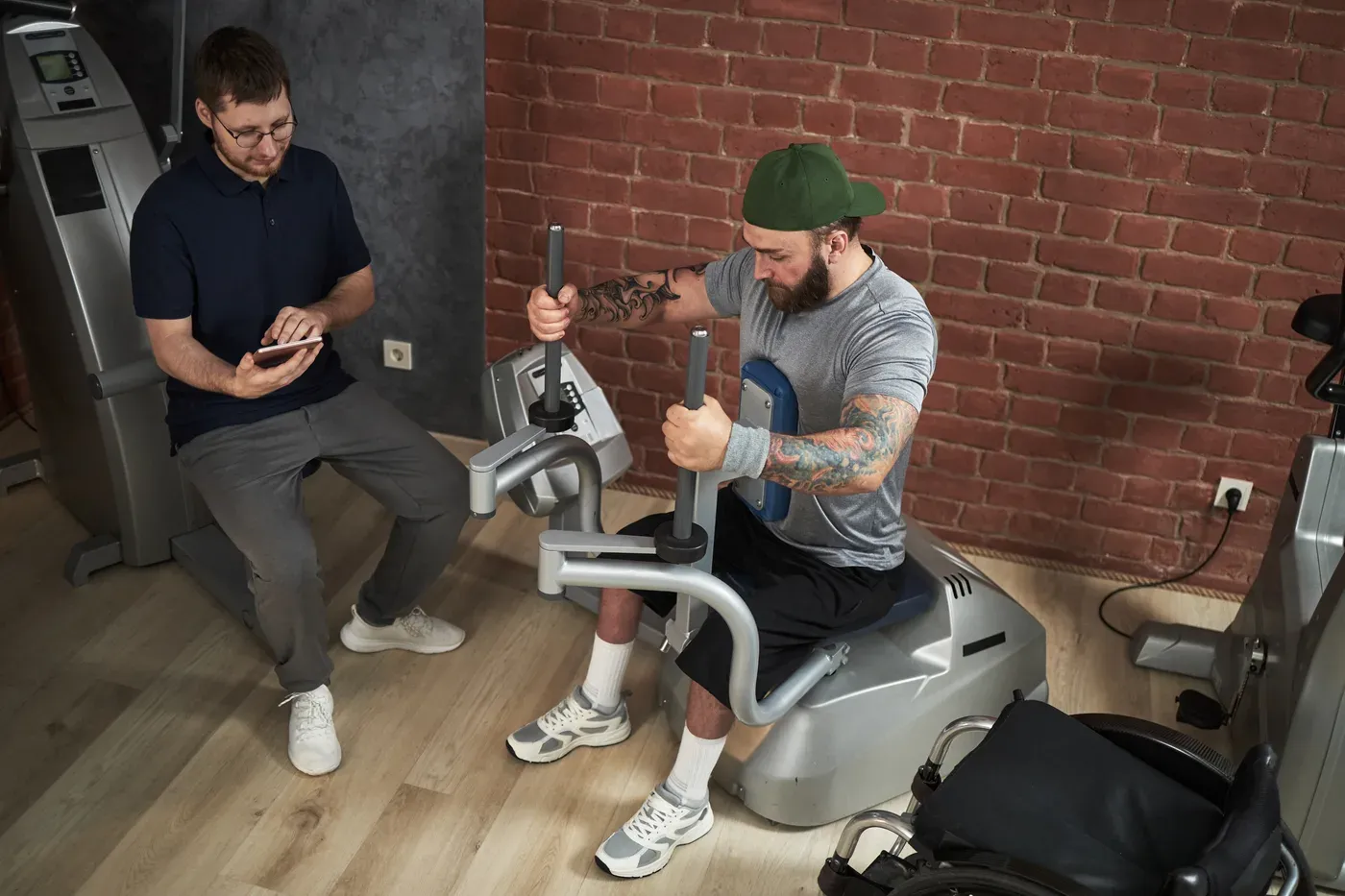
To do a lat pulldown safely over 40, set the thigh pad so your legs are locked in, grip the bar just wider than your shoulders, lean back slightly, and pull the bar down to your upper chest by driving your elbows toward your ribs. Let it rise slowly until your arms are straight. Pull in front of your face, never behind your neck, and keep the weight light enough that your torso doesn’t rock.
What the pulldown builds
The lat pulldown works the lats, the large muscles that give your back its width, along with the rear shoulders, biceps and the muscles between your shoulder blades. It’s the most adjustable way to train a vertical pull: you can set any weight, including far less than your body weight.
That makes it the go-to for men who can’t yet do a pull-up, and for anyone who wants high-rep back work without the elbow stress of hanging from a bar.
Machine setup
- Adjust the knee pad so it presses down on your thighs with your feet flat on the floor. You shouldn’t lift off the seat when the weight pulls up.
- Choose the attachment. A straight bar with a grip just wider than your shoulders is the standard.
- Stand, grab the bar, then sit down with it so your arms are straight overhead.
Pulling technique
- Sit tall with your chest up and a slight lean back from the hips.
- Pull your shoulders down away from your ears before your elbows bend.
- Drive your elbows down and slightly back, as if putting them into your back pockets.
- Bring the bar to your upper chest, just below the collarbones.
- Squeeze your back for a one-count.
- Let the bar rise slowly until your arms are fully straight and you feel a stretch under your armpits.
- Keep your torso angle the same on every rep.
Mistakes worth fixing
- Rocking back to move the weight. Your body becomes the lever. Lighten it and hold a fixed lean.
- Pulling with the arms. If your biceps burn first, think about elbows moving, not hands.
- Shrugging at the top. The shoulders ride up toward your ears and stay there. Reset the shoulder blades down at the start of every rep.
- Cutting the stretch short. Partial reps miss the lengthened position, which is where much of the growth comes from. Straighten your arms each time.
- Behind-the-neck pulling. Unnecessary stress on the front of the shoulder. Always pull in front.
Sets and reps
| Goal | Sets × reps | Rest | Tip |
|---|---|---|---|
| Beginner | 3 × 10–12 | 90 s | Pause at the chest |
| Strength | 4 × 6–8 | 2 min | Heavier, strict form |
| Muscle | 3–4 × 10–15 | 60–90 s | Slow 3-second return |
| Pull-up prep | 3 × 5–8 | 2 min | Work up toward your body weight |
Increase the weight by one stack plate when you can complete all sets at the top of the range with a still torso.
Variations and shoulder-friendly swaps
| Variation | Notes |
|---|---|
| Close neutral-grip handle | Kinder to sore shoulders and elbows |
| Underhand grip | More biceps; similar to a chin-up |
| Single-arm cable pulldown | Fixes side-to-side imbalances; easy to adjust angle |
| Kneeling band pulldown | Home or travel option |
| Assisted or full pull-up | The harder bodyweight version |
If overhead positions hurt your shoulders at all, a seated cable row keeps your back training at a lower arm angle while you work on mobility.
Programs that use it
The lat pulldown is the vertical pull in the beginner gym workout, the upper body workout and the shoulder friendly upper body workout. For the full week’s plan with back work balanced against pressing, see the DIY programs.
Questions people also ask
Should I pull the bar behind my neck?
No. Behind-the-neck pulldowns force the shoulder into a position many men over 40 can't reach comfortably. Pull to the front of your upper chest.
Wide grip or close grip on the pulldown?
A grip slightly wider than your shoulders is the best default. Close neutral-grip handles are often more comfortable for sore shoulders and let you go heavier.
Will lat pulldowns help me do a pull-up?
They build the same muscles, so yes, but they don't teach you to move your own body. Combine them with negatives and assisted pull-ups.
How much should I lean back?
A small lean, around 10 to 20 degrees, is fine. Leaning far back turns it into a row and uses momentum.