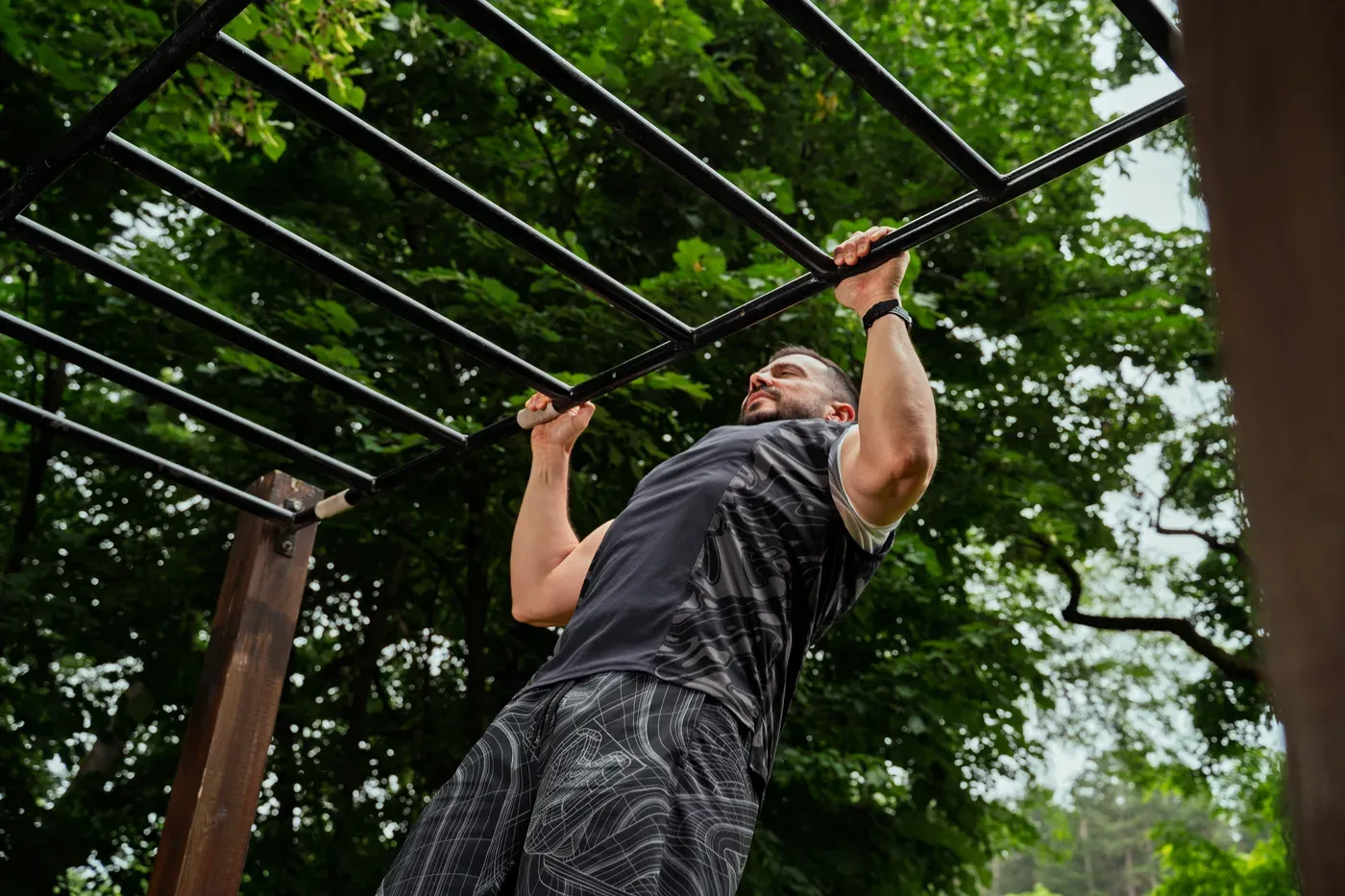
To do your first pull-up safely over 40, build it in stages: hang from the bar, learn to pull your shoulder blades down, lower yourself slowly from the top, then use a band or an assisted machine for full reps until you can do one on your own. Train it two or three times a week, stop before your elbows or shoulders complain, and expect it to take weeks to a few months.
Why one strict pull-up is worth chasing
A pull-up trains the lats, upper back, biceps and grip, and it asks you to move your whole body through space. It also tells you something honest about your strength relative to your weight. Many men who could do ten at 20 now can’t do one, and getting that first rep back is a clear, motivating target.
There’s no shortcut and no trick grip that makes it easy. There’s a sequence of steps that builds the strength without overloading tendons that haven’t hung from anything in years.
The four-stage progression
Stage 1: dead hangs
Grip the bar with palms facing away, hands just outside shoulder width, and hang with feet off the floor. Start with whatever you can hold, building toward three hangs of 30 seconds. This toughens the hands, elbows and shoulders before any pulling.
Stage 2: scapular pulls
From a dead hang, keep your arms straight and pull your shoulders down away from your ears so your body rises a few centimetres. Lower and repeat. Three sets of 8 teaches the first part of every pull-up.
Stage 3: slow negatives
Stand on a box or bench so your chin is above the bar. Step off and lower yourself as slowly as you can, aiming for five seconds, until your arms are straight. Climb back up; don’t jump. Three to five reps per set is enough because these are hard on the elbows.
Stage 4: assisted full reps
Loop a resistance band over the bar and under one knee or foot, or use the gym’s assisted pull-up machine. Do full reps from a dead hang to chin over the bar. Use less help each week.
How to do the full pull-up
- Hang with an overhand grip just wider than your shoulders, thumbs wrapped around the bar.
- Squeeze your glutes and point your toes slightly forward to keep your body still.
- Pull your shoulder blades down first.
- Drive your elbows toward your back pockets and pull your chest toward the bar.
- Stop when your chin is clearly over the bar. No craning your neck.
- Lower all the way down under control until your arms are straight.
Mistakes that stall progress or hurt elbows
- Kipping or swinging. It hides weak spots and stresses shoulders. Keep your body quiet.
- Half reps. Starting with bent elbows or stopping with the chin below the bar trains a partial pull-up. Count full reps only.
- Training it every day. Hanging and pulling daily can irritate the elbows. Leave a day between sessions.
- Ignoring the lowering phase. Dropping fast wastes the part that builds strength fastest.
Sets and reps once you can do one
| Goal | What to do | Rest |
|---|---|---|
| First rep | 2–3 sessions a week of stages 1–4 | 2 min between sets |
| Building to 5 | Several singles across a session, e.g. 6 × 1, adding a rep to one set each week | 90 s–2 min |
| Strength | 4 × 3–5, adding weight on a belt once 3 × 8 is easy | 2–3 min |
| Muscle | 3 × 6–10, band-assisted for the last set if needed | 2 min |
Easier, harder and joint-friendly versions
- Easier: the lat pulldown, inverted rows under a bar or a table, band-assisted pull-ups.
- Harder: weighted pull-ups, pauses at the top, or slower five-second negatives with added weight.
- Elbow or shoulder sensitive: a neutral grip (palms facing each other) on parallel handles, or the underhand chin-up, which many men find easier.
- No bar access: dumbbell rows and band pulldowns keep the back strong in the meantime.
Programs that build toward it
The calisthenics workout and the military workout both include pull-up progressions, and the upper body workout uses pulldowns while you build up. If you’d like a progression that tells you exactly when to move from bands to full reps, look at the DIY programs.
Questions people also ask
How many men over 40 can do a pull-up?
There's no reliable published figure for Canadian men in their forties. What matters more is that the skill is very trainable: most men who follow a steady progression and keep body weight in check can get their first rep.
How long does it take to get your first pull-up?
It depends on your starting strength and body weight. A man who can already do several slow negatives may get there in a few weeks; someone starting from zero hang time may need a few months.
Should I lose weight before working on pull-ups?
You don't need to wait. Train the progression now. Dropping body fat makes every rep easier, so fat loss and pull-up practice work well together.
Are assisted pull-up machines worth using?
Yes. They let you practise the full movement with less than your body weight. Reduce the assistance a little at a time as your reps go up.