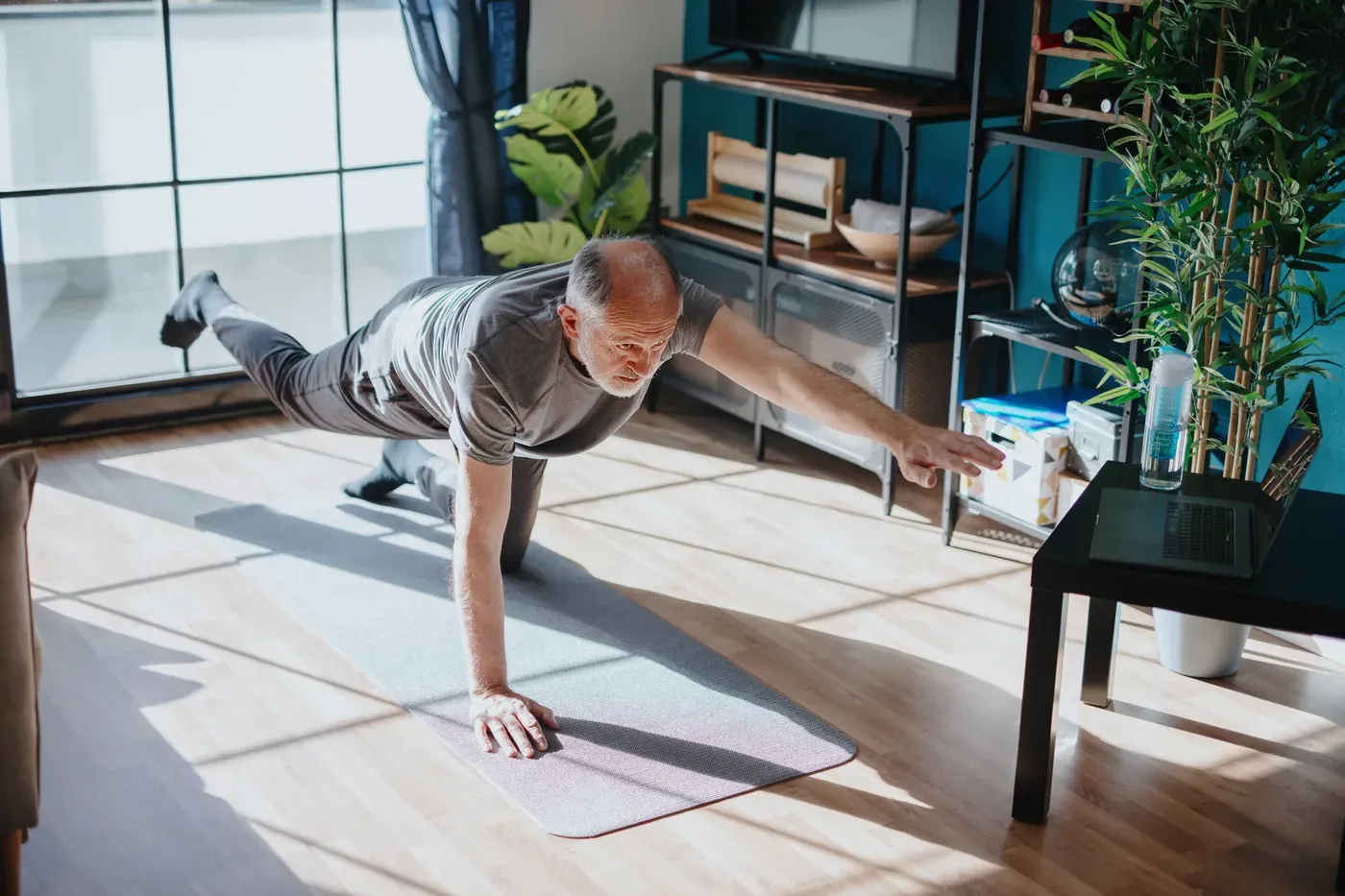
To do a bird dog, kneel on all fours with your hands under your shoulders and knees under your hips, brace your stomach lightly, then slowly reach one arm forward and the opposite leg back until both are level with your body. Hold for a few seconds without your back twisting or sagging, return, and switch sides. The goal is a still spine while your limbs move, so slow and small beats fast and high.
Why it’s worth five minutes
The bird dog teaches your trunk, glutes and back extensors to work together and keep your spine still, which is the same job they do when you lift a box or reach across a car seat. The load is tiny, so it’s a safe place to build that control before you test it under a barbell.
It’s also quick. A few sets fit into a warm-up, a desk break or the morning before work.
Getting into position
Kneel on a mat. Hands go directly under your shoulders, fingers spread. Knees go directly under your hips, hip width apart. Your back is flat like a tabletop, neck long, eyes on the floor just ahead of your hands. Breathe out and gently tighten your abs, enough to stiffen your middle without changing your back’s shape.
Cues
- Slide your right hand forward along the floor, then lift it to shoulder height, thumb pointing up.
- At the same time, slide your left foot back along the floor, then lift it to hip height.
- Reach long through your fingertips and heel, as if being pulled in two directions.
- Hold for five seconds, breathing normally.
- Bring the elbow and knee back under you without touching down, if you can, or return to all fours.
- Repeat on the other side.
A useful test: place a water bottle or foam roller on your lower back. If it rolls or falls, your hips tipped.
Shortcuts that miss the point
Lifting the leg too high. Your lower back arches to get the heel higher. Stop at hip height.
Hips rotating. The hip of the raised leg opens toward the ceiling. Keep both hip bones pointing at the floor.
Speed. Swinging the limbs up and down turns it into a balance game. Move slowly into and out of each hold.
Sinking into the shoulders. The upper back sags between the shoulder blades. Push the floor away with your hands.
Sets and reps
| Level | Version | Sets × reps per side | Hold |
|---|---|---|---|
| Starting out | Arm only, then leg only | 2 × 6 | 3 s |
| Standard | Opposite arm and leg | 3 × 6–8 | 5 s |
| Stronger | Elbow-to-knee touch under the body between reps | 3 × 8 | 5 s |
| Advanced | Light ankle weight or band | 3 × 6 | 5–10 s |
Rest 30 to 45 seconds between sets. Quality is the measure, not fatigue.
Easier, harder and joint-friendly versions
- Easier: move only one limb at a time, or slide the foot along the floor without lifting it.
- Harder: add a band around the wrist and opposite foot, hold a light dumbbell, or do it with your knees hovering a few centimetres off the floor.
- Sore wrists: rest on your fists or on dumbbell handles, or on your forearms.
- Sore knees: put a folded mat or pillow under them.
- Sore shoulders: reach the arm forward only to a comfortable height, or skip the arm and do the leg.
The dead bug is the face-up version of the same idea, and the side plank adds the sides of the trunk. A glute bridge after bird dogs is a good warm-up pair before lower-body lifting.
Programs with bird dogs
Bird dogs are in the mobility routine, the desk posture workout and the core workout. For a full plan with warm-ups built in, see the DIY programs.
Questions people also ask
What is the bird dog exercise good for?
It trains the muscles along your spine, your glutes and your abs to hold your back steady while your arms and legs move. It's a low-load way to build trunk control.
How long should I hold a bird dog?
Five to ten seconds at full extension is plenty. Several short, controlled holds beat one long, shaky one.
Should I do bird dogs before lifting?
They work well in a warm-up to switch on the trunk and glutes before squats or deadlifts.
Is the bird dog good for lower back pain?
It's commonly used in back-friendly programs because it loads the spine lightly. It isn't a treatment; if you have back pain, get it assessed and follow your physiotherapist's plan.