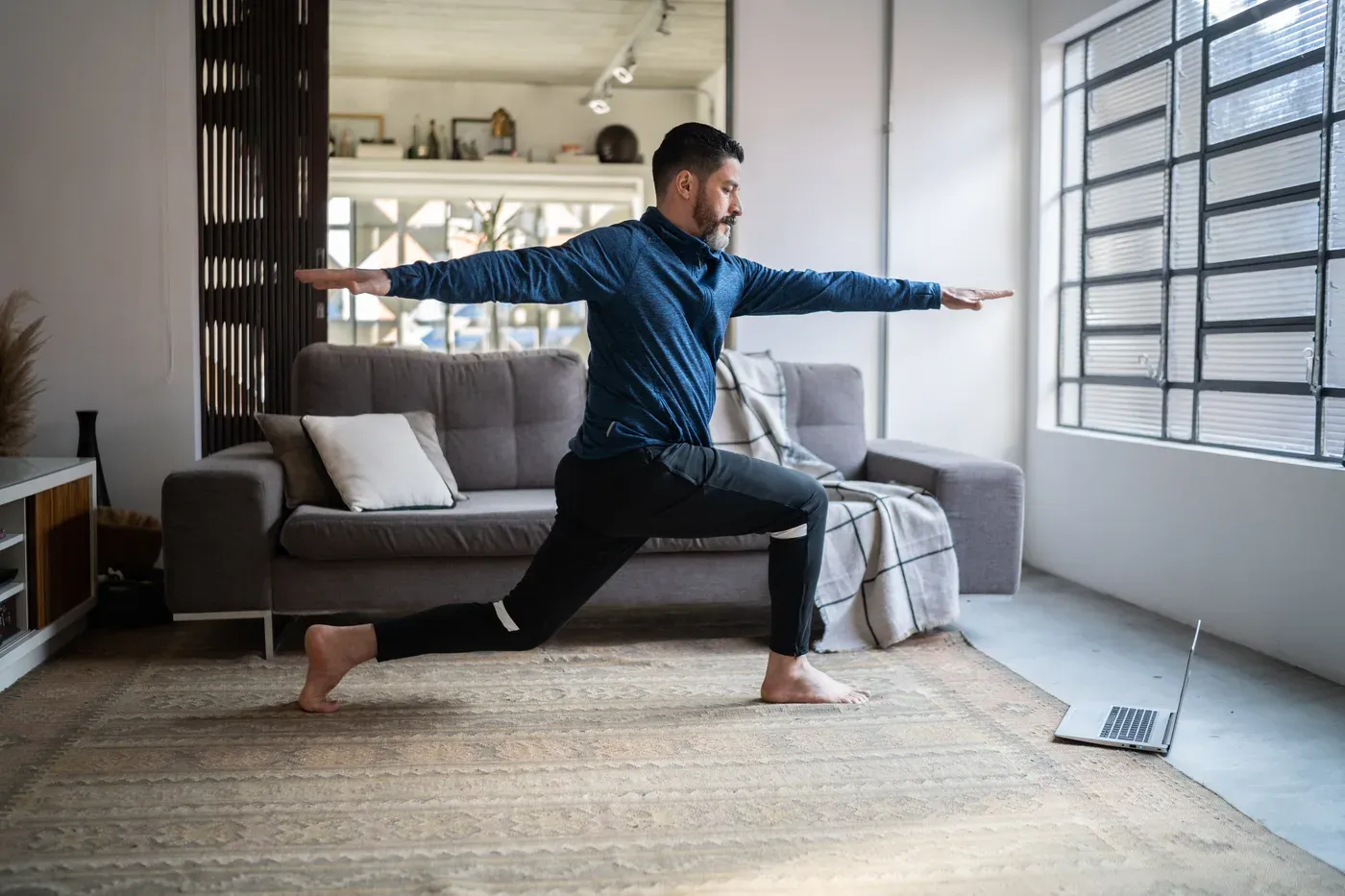
A daily mobility routine for men over 40 works best as two short pieces: about eight minutes in the morning to get moving, and ten to twelve minutes in the evening that builds range and strength in the positions you’ve lost. Add a two-minute break at your desk in the middle of the day if you sit for hours. The morning part is the same every day so it becomes automatic; the evening part rotates through hips, upper back and shoulders, and ankles and knees, and gets a little harder each fortnight over eight weeks.
What a mobility routine can and can’t do
An international expert consensus agreed that stretching improves range of motion and reduces muscle stiffness, but does not build muscle, prevent all injuries, speed recovery after exercise or improve posture. A meta-analysis also found that strength training and stretching produced similar gains in range of motion. So this routine mixes both: gentle movement in the morning and slow, loaded work at end range in the evening.
If you already lift through full ranges two or three times a week, you’re getting some of this already. The routine fills the gaps, especially hips and upper back, which long hours in a chair tend to stiffen.
The morning routine: 8 minutes, every day
Do it before coffee or while it brews. No equipment.
| Order | Movement | Amount | Cue |
|---|---|---|---|
| 1 | Knee-to-chest rocks, lying in bed | 10 | Slow, both knees, rock side to side |
| 2 | Cat-camel on hands and knees | 8 | Move one vertebra at a time |
| 3 | Thread the needle (upper back rotation) | 6 per side | Follow your hand with your eyes |
| 4 | World’s greatest stretch (lunge, elbow to instep, rotate) | 4 per side | Hold each position 2 breaths |
| 5 | Deep squat hold, holding a door frame | 3 × 20 s | Let your hips sink, chest up |
| 6 | Standing wall slides | 10 | Back and forearms on the wall |
| 7 | Standing hip circles | 5 each way per side | Big, slow circles |
| 8 | Calf raises with a slow lower | 15 | Hold a counter |
The desk break: 2 minutes, two or three times a day
Set a reminder for mid-morning and mid-afternoon.
| Movement | Amount |
|---|---|
| Stand, reach overhead, side bend | 3 per side |
| Chair-supported hip flexor stretch (one knee on the chair seat) | 30 s per side |
| Doorway chest opener | 30 s |
| Chin tucks | 10 |
For a strength session aimed at desk workers, see the desk posture workout.
The evening routine: rotate four sessions
Do one per evening, in order: A, B, C, D, then start again. Each takes 10 to 12 minutes. Use a light kettlebell or dumbbell (4 to 12 kg) where listed.
A: hips
| Movement | Sets × reps or time |
|---|---|
| 90/90 hip switches (seated, knees bent, rotate side to side) | 2 × 8 per side |
| Half-kneeling hip flexor stretch with glute squeeze | 2 × 45 s per side |
| Cossack squat (side-to-side, to a comfortable depth) | 2 × 5 per side |
| Goblet squat hold with a light bell, elbows pushing knees out | 3 × 30 s |
B: upper back and shoulders
| Movement | Sets × reps or time |
|---|---|
| Open book rotation (side-lying) | 2 × 8 per side |
| Foam roller thoracic extension | 2 × 8 |
| Band dislocates (wide grip, over and back) | 2 × 10 |
| Prone Y-T-W raises, no weight | 2 × 6 each letter |
| Dead hang from a bar or door-frame pull-up bar | 3 × 15–30 s |
| Half Turkish get-up (to the hand only), very light bell or a shoe on your fist | 2 × 3 per side |
C: ankles, knees and calves
| Movement | Sets × reps or time |
|---|---|
| Knee-to-wall ankle rocks | 2 × 10 per side |
| Elevated-heel squat hold | 2 × 30 s |
| Slow tibialis raises (back against the wall, lift toes) | 2 × 15 |
| Single-leg balance, eyes closed | 3 × 20 s per side |
D: loaded hamstrings and hip hinge
| Movement | Sets × reps or time |
|---|---|
| Standing toe touch with a 3 s lower, light bell in hands | 2 × 8 |
| Light kettlebell Romanian deadlift, 3 s down | 2 × 10 |
| Seated straddle reach | 2 × 30 s |
| Glute bridge with a 5 s hold | 2 × 8 |
| Bird dog with a 5 s reach | 2 × 6 per side |
| Dead bug, slow | 2 × 6 per side |
| Side plank with top arm reaching under and back | 2 × 6 per side |
Eight weeks of progression
The morning routine stays the same; the evening routine gets harder every two weeks.
| Weeks | Evening change | Measure |
|---|---|---|
| 1–2 | As written, bodyweight only for the loaded moves | Note your knee-to-wall distance and how deep your squat hold feels |
| 3–4 | Add the light bell to Cossack squats and RDLs | Deep squat hold: can you stay 30 s with heels down? |
| 5–6 | Add 5 s holds at the bottom of Cossack squats; dead hangs to 30 s | Overhead reach against a wall: thumbs touching? |
| 7–8 | Next bell size up on RDLs and goblet holds; add a third set to A and C | Retest week 1 measures |
There’s no deload in a mobility routine. If you’re sore or short on time, do only the morning part.
Joint-friendly adjustments
| Problem | Adjustment |
|---|---|
| Knees don’t like deep squats | Squat hold onto a low box; skip Cossack squats and do side lunges to a box |
| Lower back stiff in the morning | Spend extra time on knee-to-chest rocks and cat-camel; skip the toe touch until midday |
| Shoulders pinch overhead | Wall slides only to the height that’s comfortable; replace band dislocates with band pull-aparts |
| Hips pinch in the 90/90 | Sit on a folded towel or cushion to raise your hips |
Mobility work should feel like effort or a strong stretch, never a sharp or pinching pain. Persistent joint pain during simple movements is worth a physiotherapist’s assessment.
How you’ll know it’s working
You get out of bed and the car more easily, your squat hold drops lower with heels down, your hands get closer together behind your back, and the morning routine starts to feel like a reset rather than a chore. Keep the week 1 measurements so you can compare honestly. More on why range comes back with effort is in can you regain flexibility after 40, and for stiff hips from long days in a chair, read tight hips from sitting.
Bottom line
Eight minutes every morning, ten or so every evening, and two-minute breaks at the desk. Mobility on its own won’t build muscle or fix your posture, but it keeps your joints moving well enough to train hard and live comfortably. To pair it with a full strength plan, the FITWITHIM programs start at $29.
Questions people also ask
What is the best morning stretch routine for men over 40?
A short sequence that moves every major joint through its range: spine, hips, shoulders and ankles. The 8-minute morning routine on this page does that in bed and on the floor, without long static holds while you're still stiff.
Is mobility the same as stretching?
Not quite. Stretching is one way to improve range of motion. Mobility work also includes moving actively through that range and getting strong at the ends of it, which is why the evening sessions here add light loads.
How long until I notice better mobility?
Most people feel less stiff within a week or two of doing something daily. Measurable range, such as how deep you can squat or how far you can reach overhead, improves more gradually over the eight weeks.
Will mobility work fix my posture?
An expert consensus on stretching found it does not improve posture. Mobility work helps you move more freely and feel less stiff, which is a worthwhile goal on its own.
Sources
- Afonso et al. (2021), Strength training versus stretching for improving range of motion: a systematic review and meta-analysis, Healthcare (Basel)
- Warneke et al. (2025), Practical recommendations on stretching exercise: a Delphi consensus statement of international research experts, J Sport Health Sci