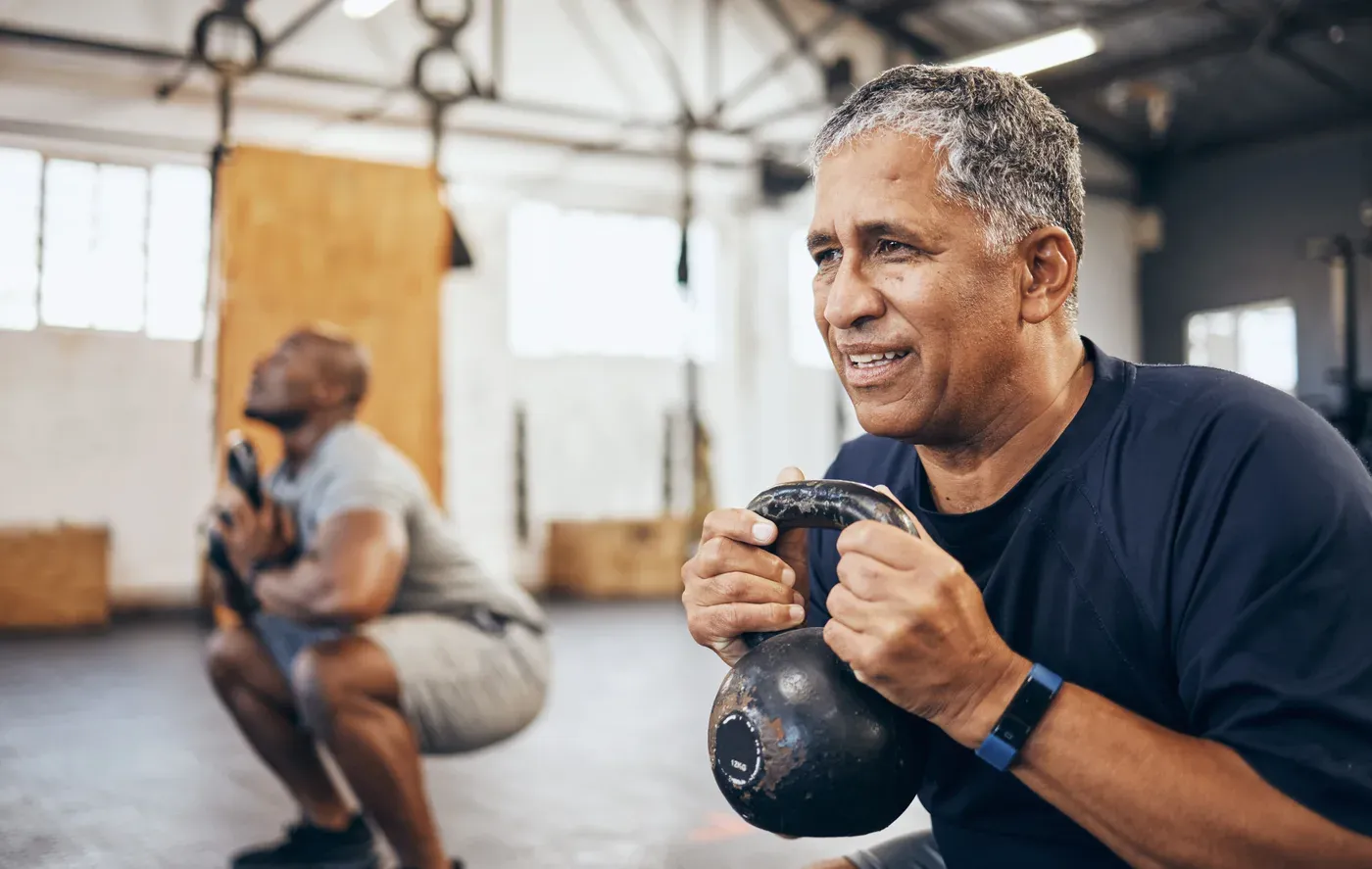
A goblet squat is a squat with one dumbbell or kettlebell held against your chest. To do it safely over 40, hold the weight close at collarbone height, set your feet a little wider than your shoulders with toes slightly out, then sit straight down between your heels, keeping your chest up and your elbows inside your knees. Stand up by pushing the floor away. It’s the best way to learn to squat because the weight in front keeps you upright.
Why start here
The goblet squat trains your quads, glutes and upper back, and it teaches the squat position more reliably than any cue. Holding the weight in front shifts your balance so you can sit deeper with a straighter back. For men coming back to the gym, it’s often the squat that feels best on day one.
It also needs only one dumbbell, so it works at home, in a condo gym or in a crowded commercial gym where the racks are taken.
How to hold the weight
- Kettlebell: grip the two sides of the handle (the horns), bell hanging upside down against your chest.
- Dumbbell: stand it on end and cup the top plate in both palms, like holding a goblet.
- Keep the weight touching your chest throughout. If it drifts forward, your back works harder.
Step by step
- Stand with feet slightly wider than shoulder width, toes turned out a little.
- Brace your midsection and keep your chest tall.
- Bend your knees and hips together and sit straight down between your heels.
- Let your elbows track inside your knees. At the bottom, they can lightly push your knees outward.
- Go as deep as your back stays straight and your heels stay down.
- Drive up through your whole foot and stand tall.
- Keep breathing: in on the way down, out as you finish.
Common mistakes
- Weight drifting away from the chest. Pull it in tight; your forearms stay nearly vertical.
- Rising on the toes. Weight should be across the whole foot. Put small plates under your heels if your ankles are stiff.
- Knees caving at the bottom. Use the elbows-inside-knees trick and slow down out of the hole.
- Folding forward. Lead with your chest. A lighter weight is often the fix, because a heavy one can pull you forward.
Sets and reps for your goal
| Goal | Sets × reps | Rest | Pace |
|---|---|---|---|
| Learning the squat | 3 × 8, plus a 3-second hold at the bottom of the first rep | 60–90 s | Slow down, normal up |
| Strength (within grip limits) | 4 × 6 | 2 min | Heaviest weight you can hold |
| Muscle | 3 × 10–15 | 90 s | 3 seconds down |
A rough start for most men is a 12 to 20 kg (25 to 45 lb) dumbbell. Add weight when every set reaches the top of the range with full depth.
Easier, harder and joint-friendly options
| Option | When to use it |
|---|---|
| Goblet squat to a box or bench | Sore knees, or to set a depth you can trust |
| Heels raised on small plates | Stiff ankles |
| Pause goblet squat (3–5 s) | Harder without more weight |
| Double-kettlebell front squat | Heavier, still upright |
| Barbell back squat | Once the goblet weight gets awkward |
For knees that ache, squat to a box set just above the painful range. For one leg at a time, the split squat is the natural next step.
Where it shows up
The goblet squat is the squat in the beginner gym workout, the dumbbell workout and the 30-minute gym workout. If you want it sequenced into a full week with the rest of your training, the DIY programs do that.
Questions people also ask
Why is the goblet squat good for beginners?
The weight in front of your chest acts as a counterbalance, so it's easier to sit down between your heels with an upright back. It almost teaches itself.
Kettlebell or dumbbell for goblet squats?
Either works. Hold a kettlebell by the horns or a dumbbell vertically by one end. Dumbbells usually go heavier.
When should I switch from goblet squats to barbell squats?
When you can do 3 sets of 10 with good depth using a weight that's becoming awkward to hold, often around 30 to 35 kg (65 to 75 lb) for men. You can also simply keep doing goblet squats with higher reps.
Can the goblet squat build big legs?
It builds plenty of leg muscle for most men's goals. The limit is how heavy you can hold the weight at your chest; once your arms give out before your legs, add a barbell or leg press.