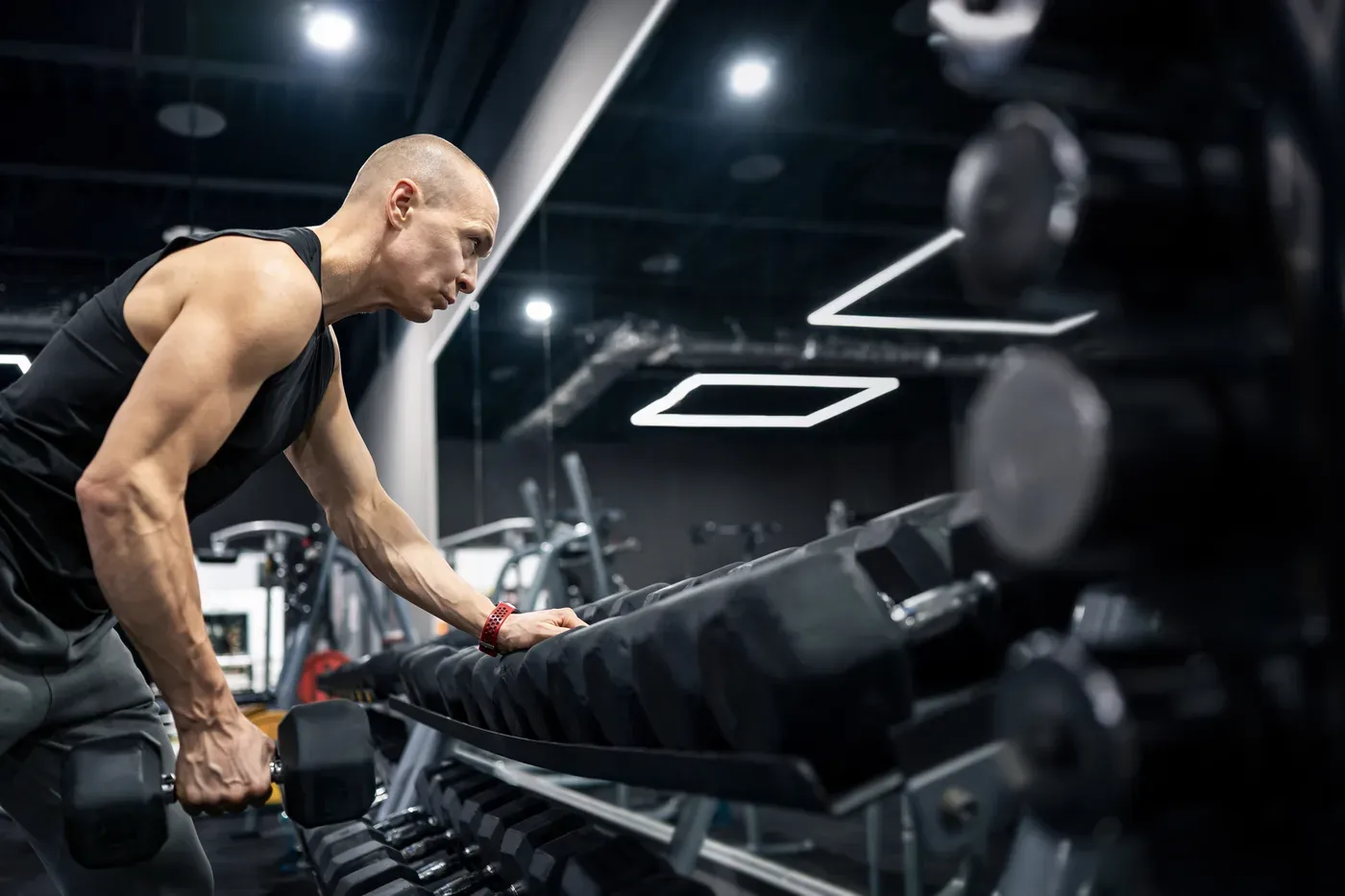
A dumbbell workout for men over 40 can be a complete strength program with one adjustable pair and a bench. This one uses two sessions, A and B, alternated three days a week, so you do A-B-A one week and B-A-B the next. Every exercise has a target rep range, and when the dumbbells get light, you climb a progression ladder (slower lowering, pauses, one-and-a-half reps, single-limb versions) before you need heavier weights. It runs for eight weeks and fits a basement, a condo gym or a hotel with decent dumbbells.
What you need
| Equipment | Why it matters | Workaround if you don’t have it |
|---|---|---|
| Adjustable dumbbells, about 2.5–23 kg (5–50 lb) per hand | Covers every exercise here | Two or three fixed pairs: light, medium, heavy |
| Adjustable bench (flat and incline) | Incline press, chest-supported row, Bulgarian split squat | Floor press; row with one hand on a chair |
| A clear 3 m strip of floor | Carries and lunges | Walk in place carrying for time instead of distance |
For buying advice on a budget, see setting up a home gym.
The weekly pattern
| Monday | Wednesday | Friday | |
|---|---|---|---|
| Odd weeks (1, 3, 5, 7) | A | B | A |
| Even weeks (2, 4, 6, 8) | B | A | B |
Each session takes 45 to 50 minutes with full rests. Effort is reps in reserve (RIR): how many more good reps you could have done.
Session A
| Exercise | Sets × reps | Rest | RIR |
|---|---|---|---|
| Goblet squat (heels on a small plate if needed) | 4 × 8–12 | 2 min | 2 |
| Flat dumbbell bench press | 4 × 8–12 | 2 min | 2 |
| One-arm dumbbell row | 3 × 10–12 per arm | 90 s | 1–2 |
| Dumbbell Romanian deadlift | 3 × 10–12 | 90 s | 2 |
| Dumbbell lateral raise | 3 × 12–15 | 60 s | 1 |
| Suitcase carry | 3 × 30 m per side | 60 s | Heaviest dumbbell |
Session B
| Exercise | Sets × reps | Rest | RIR |
|---|---|---|---|
| Bulgarian split squat (back foot on bench) | 3 × 8–12 per leg | 90 s | 2 |
| Incline dumbbell press | 4 × 8–12 | 2 min | 2 |
| Chest-supported dumbbell row (on incline bench) | 4 × 10–12 | 90 s | 1–2 |
| Dumbbell hip thrust (shoulders on bench) | 3 × 10–15 | 90 s | 2 |
| Half-kneeling one-arm dumbbell press | 3 × 8–10 per arm | 60 s | 2 |
| Dumbbell curl to press-out, superset with floor skull crusher | 2 × 12 each | 60 s | 1 |
The progression ladder
Home dumbbells top out. Research comparing light and heavy loads found that muscle growth can be achieved across a wide spectrum of loads, while maximal strength benefits most from heavy loads. So when a dumbbell gets too light for the rep range, you make the set harder without new equipment. Climb one rung at a time, only when you hit the top of the rep range on every set:
| Rung | Change | Example: goblet squat |
|---|---|---|
| 1 | Add reps up to the top of the range | 4 × 12 at 22 kg |
| 2 | Add weight if you have it, drop to the bottom of the range | 4 × 8 at 24 kg |
| 3 | Slow the lowering to 3 seconds | 4 × 8–12, 3 s down |
| 4 | Add a 2-second pause at the bottom | 4 × 8–10, 3 s down, 2 s pause |
| 5 | One-and-a-half reps (down, halfway up, down, all the way up = 1) | 3 × 6–8 |
| 6 | Switch to a single-limb version | Bulgarian split squat, 3 × 8 per leg |
When you reach rung 6 on the main lower-body lifts, you’ve outgrown home dumbbells for leg strength. A gym membership, a trap bar or heavier dumbbells are the next step.
Eight weeks, week by week
| Week | Sets | Target | Notes |
|---|---|---|---|
| 1 | As written, minus one set on each exercise | RIR 3 | Choose weights; note them |
| 2 | As written | RIR 2–3 | |
| 3 | As written | RIR 2 | Start climbing reps |
| 4 | As written | RIR 2 | First rung changes on any lift at the top of range |
| 5 | 2 sets per exercise | RIR 3–4 | Deload: same weights, fewer sets |
| 6 | As written | RIR 2 | Resume the ladder |
| 7 | As written | RIR 1–2 | |
| 8 | As written, add one set to the first exercise | RIR 1 on the last set | Retest: compare reps with week 3 |
Warm-up with the same dumbbells
- Two minutes of brisk marching, arm swings and torso turns.
- One round, no rest: 10 bodyweight squats, 10 glute bridges, 8 push-ups on the bench, 10 band or light-dumbbell rows.
- One light set of the first exercise at about half your working weight for 8 reps.
Joint-friendly swaps
| Joint | Instead of | Use |
|---|---|---|
| Knees | Bulgarian split squat | Reverse lunge to a low step, or step-up |
| Knees | Goblet squat | Box squat holding one dumbbell, sit to a bench |
| Lower back | Dumbbell RDL | Single-leg hip thrust, or single-leg RDL with a hand on the wall |
| Shoulders | Flat bench press | Floor press with a neutral grip |
| Shoulders | Half-kneeling press | High-incline press (about 60 degrees) |
Joint pain that builds through a set or is worse the next morning means the swap, not more reps. Persistent pain is a reason to see a physiotherapist.
How to tell it’s working
By week 8 you should be one or two rungs higher on most exercises, using a heavier pair on rows and presses, and carrying your heaviest dumbbell farther with less wobble. Compare your week 3 and week 8 reps on goblet squat and bench press: more reps at the same weight is a clear win.
After eight weeks
Keep climbing the ladder until it runs out, then add weight or move to a gym. If you’d like variety at home, a kettlebell workout uses the same space and adds swings and get-ups, and resistance bands are a cheap way to load rows and presses. For a printed program with logs, see the FITWITHIM programs.
Questions people also ask
Can you build muscle with only dumbbells after 40?
Yes. Muscle responds to sets taken close to failure across a wide range of loads, so dumbbells work well as long as each set is genuinely hard. Strength in the heaviest lifts will eventually need heavier loads than most home dumbbells provide.
What weight dumbbells should a man over 40 buy?
Adjustable dumbbells that go from about 2.5 to 23 kg (5 to 50 lb) per hand cover this whole program for most men. If you're already strong, a set that goes to 32 kg (70 lb) lasts longer.
Do I need a bench?
It helps a lot. An adjustable bench adds incline presses, chest-supported rows and split squats with the back foot raised. Without one, use the floor press and a sturdy chair or step.
How is this different from short at-home circuits?
Circuits keep you moving with little rest. This is a strength program: full rests, set-by-set targets, and a planned way to keep progressing for months with the same dumbbells.