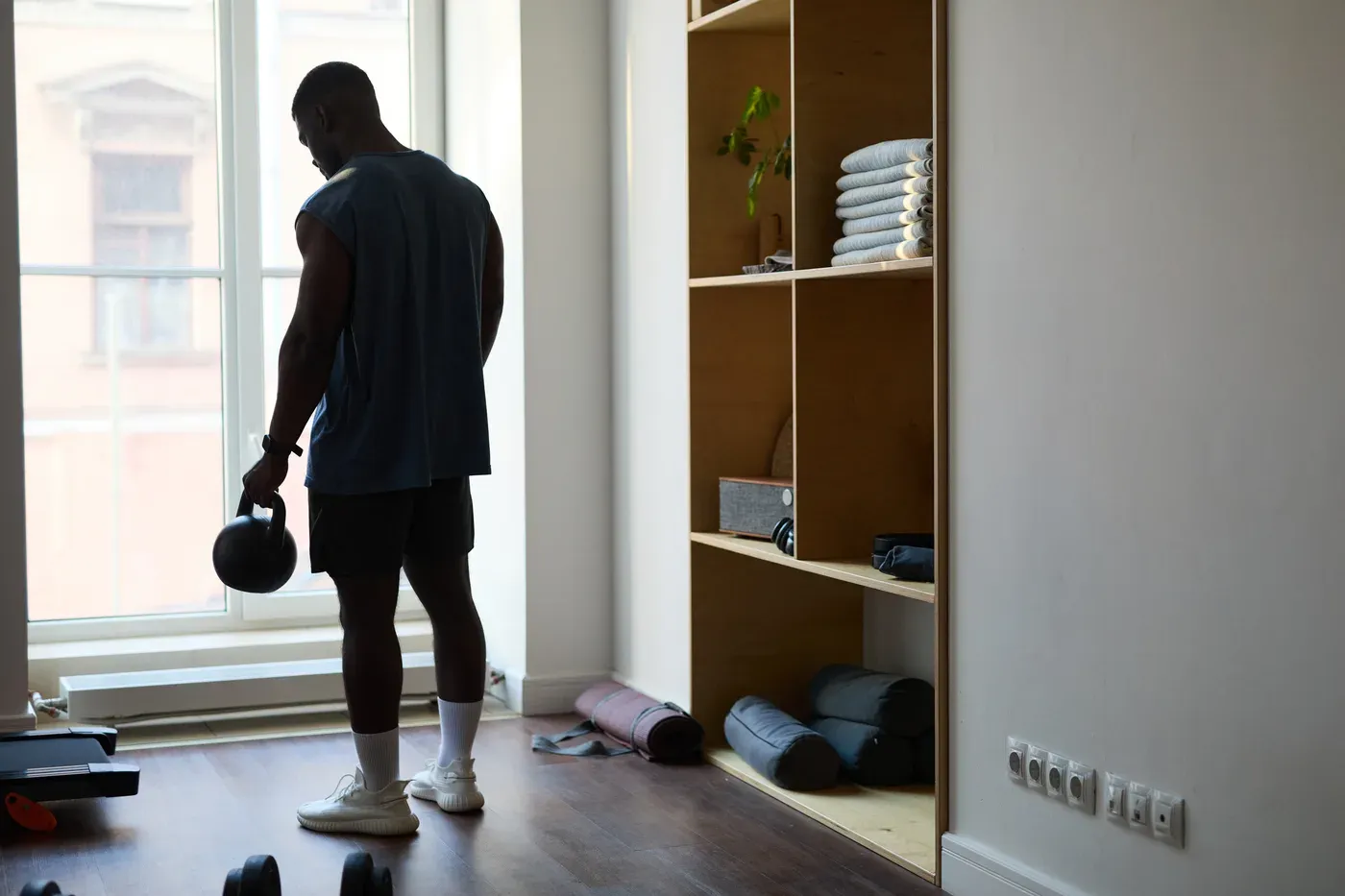
A budget home gym for a man over 40 needs only two things to start: a pair of adjustable dumbbells that go reasonably heavy and an adjustable bench. With those you can train every major muscle group three times a week for months. Add resistance bands, one kettlebell and a doorframe pull-up bar when you’ve outgrown the basics, and a squat rack with a barbell only once you’re sure you’ll keep training at home. Buy the heavy, simple things used; buy anything that protects your joints or floor new.
Stage 1: the two-item gym
| Item | What to look for | Why it comes first |
|---|---|---|
| Adjustable dumbbells | Reach at least 20–25 kg (45–55 lb) per hand; quick, secure adjustment | Replaces a whole rack of fixed dumbbells; you’ll grow into the heavier settings |
| Adjustable bench | Flat to incline; stable, no wobble; rated well above your body weight plus dumbbells | Turns floor exercises into presses, rows and step-ups |
That’s enough for a full program: goblet squats, Romanian deadlifts, bench presses, one-arm rows, split squats, step-ups and farmer’s carries. The dumbbell workout for men over 40 is written for exactly this setup.
Buying used is sensible here. Dumbbells and benches are simple steel; check for cracks, loose welds and sticky adjustment mechanisms, and test the bench by sitting and lying on it before you pay. Online classifieds in the GTA see a steady supply every January and September.
Stage 2: add variety and pulling
After a couple of months, your weakest area will usually be pulling (back and biceps) and anything that needs lighter, controlled work for the shoulders and hips.
| Item | Use | Note |
|---|---|---|
| Resistance bands (light, medium, heavy loops and a handled set) | Face pulls, pull-aparts, assisted pull-ups, warm-ups | Cheap and easy on the joints; replace when they show nicks |
| One kettlebell (16–24 kg) | Swings, goblet squats, carries | One bell is enough; learn the swing properly first |
| Doorframe pull-up bar | Pull-ups, chin-ups, hanging | Check your door frame; assist with a band if you can’t do one yet |
| Rubber floor mats | Protects floor and dumbbells, reduces noise | Thick rubber stall mats from farm-supply stores are a common budget choice |
The resistance band workout uses most of this kit.
Stage 3: the rack and barbell (only if you’re sure)
A squat rack, barbell, plates and a proper bench open up heavy squats, deadlifts and presses. They’re also the most expensive and space-hungry part of a home gym. Wait until you’ve trained consistently at home for at least six months and know you prefer it to a gym.
| Need | Minimum |
|---|---|
| Floor space | About 2.5 m × 2 m for a rack, plus room to load plates |
| Ceiling height | Enough to press overhead inside the rack, or plan to press seated |
| Floor | Concrete or a reinforced floor; rubber flooring on top |
| Safety | Safety arms or straps set just below your lowest position, because you’ll be lifting alone |
Never squat or bench heavy at home without safeties set. There’s no one to spot you.
What not to buy
- Ab machines and gadgets. A plank and a dead bug do the job for free.
- A treadmill before strength equipment. Walk outside or use a city facility; a treadmill takes space and money better spent on dumbbells. If you want indoor cardio for Canadian winters, a used bike or rower takes less room.
- Light fixed dumbbells. You’ll outgrow 5 kg pairs in weeks.
- All-in-one cable machines from no-name sellers. Cheap ones wobble and the cables fray. Bands do the same job at this stage.
Home gym versus a gym membership
A home gym saves travel time, which for a busy man is often the difference between training and not. It costs more up front and limits how heavy you can go. A gym gives more equipment and a different environment, and some men simply train harder there.
For perspective on cost: Toronto’s city-run weight rooms are available through a FitnessTO membership from $177.70 a year for an adult before tax, so a home gym mostly makes financial sense against a private gym membership, or when the commute is what keeps you from going. Many men end up with both: a basic home setup for busy weeks and a gym for heavy days. The guide to choosing a gym in Toronto covers that side.
Make the space easy to use
- Keep it set up. If you have to drag the bench out from behind the boxes, you won’t train.
- Keep it warm enough. A cold garage in January is a reliable way to skip sessions. A basement corner works year-round.
- Put the plan on the wall. A printed program and a log sheet next to the dumbbells remove the “what am I doing today” question.
- Schedule it. Home training is easier to postpone than a gym visit. Fixed times matter even more.
Three 40-minute home sessions a week plus a daily walk meet the Canadian 24-Hour Movement Guidelines for muscle strengthening and, with brisk walking, aerobic activity. For more ideas on getting it done in a small space, see at-home workouts for busy men.
The bottom line
Start with adjustable dumbbells and a bench, add bands, a kettlebell and a pull-up bar as you grow, and buy a rack only once home training has proven itself. The equipment is the easy part; the plan is what makes it work. The DIY programs include week-by-week plans that run on basic equipment, from $29, with no consultation needed.
Questions people also ask
What is the minimum equipment for a home gym?
A pair of adjustable dumbbells and an adjustable bench. With those two you can squat, hinge, press, row and carry, which covers a complete full-body program for the first months.
Is a home gym cheaper than a gym membership?
Over a few years, usually yes, especially if you buy used. But a basic city weight room in Toronto costs $177.70 a year for adults before tax, so a home gym only saves money if you'd otherwise pay for a private gym and you use the equipment.
Can you build muscle with only dumbbells at home?
Yes, as long as the dumbbells go heavy enough to keep progressing. That's why adjustable dumbbells that reach at least 20–25 kg per hand are a better buy than a few fixed light pairs.
Where should I put a home gym in a Canadian house?
A basement corner is ideal: stable temperature, a solid floor and no neighbours below. An unheated garage works in summer but is hard to use in January unless you add a heater.