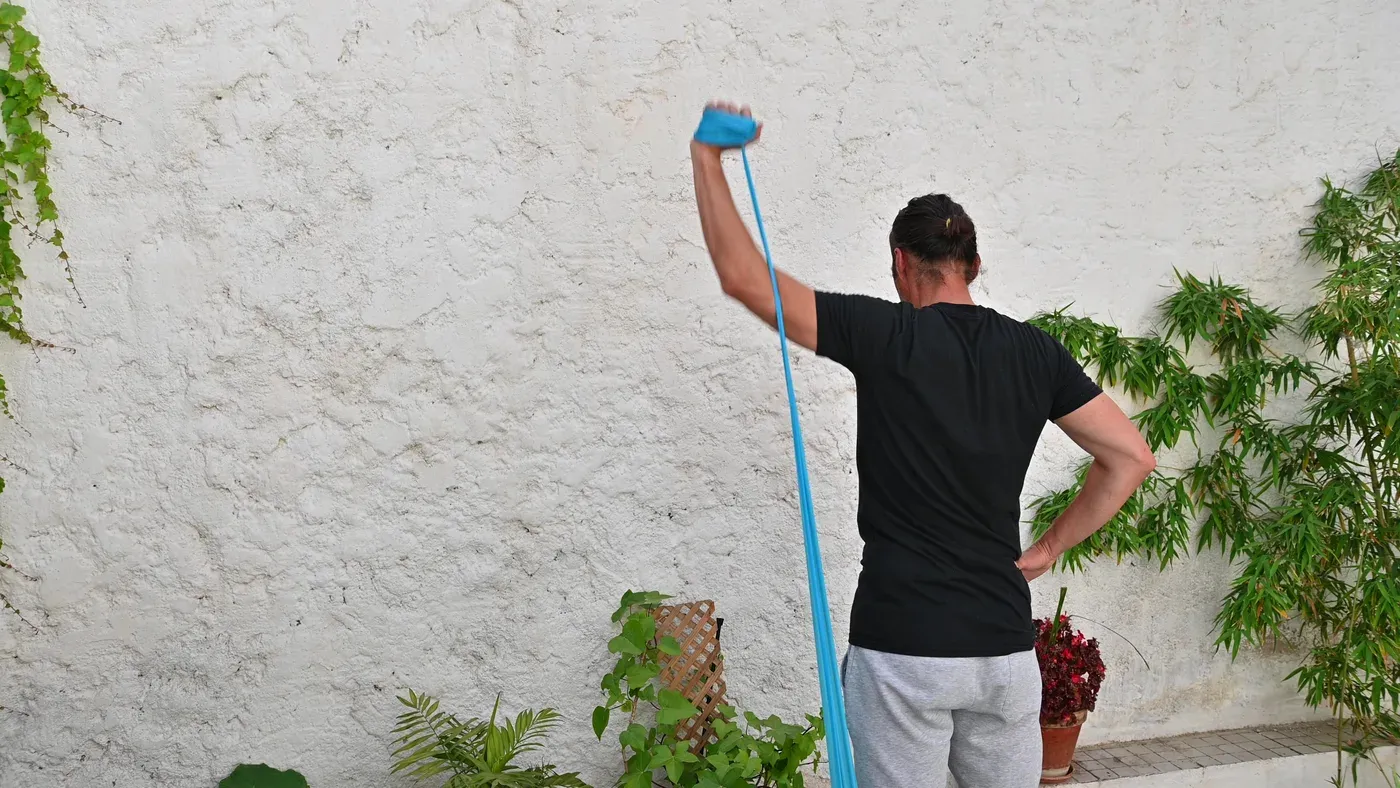
A resistance band workout for men over 40 can be a real strength program if you treat bands like weights: hard sets, a plan for adding resistance, and full-body coverage. This one uses three sessions a week with long loop bands, tube bands with a door anchor and a mini-band. Each session has a strength block with a heavy band and a 2-second hold at the point where the band is tightest, then a lighter “pump” block for time. Resistance rises through holds, stance, doubled bands and stacking over eight weeks, and it all fits in a drawer.
Do bands actually work?
A systematic review and meta-analysis found no difference in strength gains between elastic resistance and conventional resistance for either the upper or lower body. The catch is that bands are easy to under-load. Most men grab a band they can do 30 reps with and wonder why nothing changes. Choose a band that makes 8 to 15 reps hard.
What you need
| Band | Typical use here |
|---|---|
| Long loop bands, 4–5 strengths (light to very heavy) | Squats, deadlifts, presses, pull-aparts, assisted pull-ups |
| Tube bands with handles and a door anchor | Rows, chest press, Pallof press, face pulls |
| Mini-band (short loop) | Lateral walks, glute bridges |
| A sturdy door that opens away from you | Anchor point; close it fully and lock it if you can |
Resistance by colour isn’t standard across brands. Note the brand’s rating on each band and write it in your log, so “next band up” means something.
The weekly layout
| Day | Session |
|---|---|
| Monday | Session A |
| Wednesday | Session B |
| Friday | Session C |
| Other days | Walk 30+ min; mini-band glute work if you like |
How each set works
Strength block: heavy band, 6 to 12 reps, a 2-second hold at the hardest point of each rep (lockout of a press, top of a row, standing tall in a squat). Rest 60 to 90 seconds. Stop with 1 to 2 reps in reserve.
Pump block: lighter band, 40 seconds of continuous reps at a steady tempo, 20 seconds rest, two or three exercises in a row.
Session A
| Block | Exercise | Sets × reps or time |
|---|---|---|
| Strength | Banded squat (band under feet, over shoulders) | 4 × 8–12 |
| Strength | Tube row from the door anchor at chest height | 4 × 10–12 |
| Strength | Banded push-up (band across your back, ends under hands) | 3 × 6–12 |
| Pump | Band pull-apart | 3 × 40 s |
| Pump | Mini-band lateral walk | 3 × 40 s |
| Pump | Banded biceps curl | 3 × 40 s |
Session B
| Block | Exercise | Sets × reps or time |
|---|---|---|
| Strength | Banded deadlift (stand on the band, hinge, stand tall) | 4 × 8–12 |
| Strength | Half-kneeling tube one-arm overhead press | 3 × 8–10 per arm |
| Strength | Band-assisted pull-up, or kneeling straight-arm pulldown from the top of the door | 4 × 6–10 |
| Pump | Pallof press from the anchor | 3 × 40 s per side |
| Pump | Banded glute bridge with mini-band at the knees | 3 × 40 s |
| Pump | Overhead triceps extension, band from under the foot | 3 × 40 s |
Session C
| Block | Exercise | Sets × reps or time |
|---|---|---|
| Strength | Banded reverse lunge (band under front foot, over shoulders) | 3 × 8–10 per leg |
| Strength | Standing tube chest press, split stance, anchor behind you | 4 × 10–12 |
| Strength | Single-arm tube row, split stance | 3 × 10–12 per arm |
| Pump | Banded face pull from the top of the door | 3 × 40 s |
| Pump | Banded good morning (band under feet, around neck and shoulders, light) | 3 × 40 s |
| Pump | Dead bug holding a band anchored behind you | 3 × 40 s |
Eight-week progression
Climb one rung on an exercise when you hit the top of its rep range on every strength set with a clean 2-second hold.
| Rung | Change |
|---|---|
| 1 | More reps, up to the top of the range |
| 2 | Step 15–30 cm further from the anchor, or widen your stance on the band |
| 3 | Double the band (fold it, or choke it shorter) |
| 4 | Next band up |
| 5 | Stack two bands |
| Week | Strength block | Pump block | Notes |
|---|---|---|---|
| 1 | 3 sets each, find a band where 10 reps is hard | 2 rounds, light | Log band ratings |
| 2 | Sets as written | 2 rounds | |
| 3 | Climb rungs where earned | 3 rounds | |
| 4 | Same | 3 rounds, 45 s work | |
| 5 | 2 sets each, same bands | 2 rounds | Lighter week |
| 6 | Sets as written, climb rungs | 3 rounds | |
| 7 | Add a 3 s lowering to every strength rep | 3 rounds, 45 s work | |
| 8 | Same as week 7, with one extra set on the first exercise | 3 rounds | Compare bands used with week 1 |
Warm-up
Two minutes of marching or stair climbing, then one round with your lightest band: 15 pull-aparts, 10 squats, 10 good mornings, 10 overhead dislocates (wide grip, over and back). Then one easy set of the first strength exercise.
Swaps for sore joints
| Joint | Swap | Notes |
|---|---|---|
| Knees | Banded squat → banded box squat to a chair | Control depth |
| Knees | Reverse lunge → banded glute bridge, 3 × 12 | |
| Lower back | Banded deadlift → banded pull-through from a low anchor | Lighter hinge |
| Shoulders | Overhead press → landmine-style angled press (band under the back foot, press up and forward) | Lower arm angle |
| Shoulders | Banded push-up → tube chest press with a lighter band | Shorter range |
| Elbows | Curls and extensions → lighter band, more reps | Bands are often easier on elbows than bars |
Check every band for nicks or tears before each session and replace it if you find one; a snapping band can injure your eyes or face. If a joint hurts during a set, swap the exercise; ongoing pain is worth a physiotherapist’s opinion.
How to tell it’s working
Your log shows you climbing rungs: further from the anchor, doubled bands, then heavier ones. By week 8 most strength exercises should be at least one band heavier than week 1. Push-ups and pull-up assistance give you a clean comparison: more reps with the same band, or less assistance.
Bottom line
Bands are cheap, portable and effective when you use them hard. They pair well with travel; the hotel room workout uses a band as an optional extra. If you’d like to add weights later, the dumbbell workout is the natural step up, and the FITWITHIM programs have printed plans with logs.
Questions people also ask
Can resistance bands build muscle for men over 40?
Yes. A meta-analysis found elastic resistance produced strength gains similar to conventional weights. Bands work best when sets are taken close to failure and you move to heavier bands, or stack them, as you get stronger.
What resistance bands should I buy?
A set of long loop bands in four or five strengths, a pair of tube bands with handles and a door anchor, and a mini-band for hip work. Resistance by colour varies by brand, so check the manufacturer's ratings rather than going by colour.
Are bands easier on the joints than weights?
Many men find them so, because the resistance is lightest where the joint is most stretched and heaviest near lockout. That makes bands useful for training around sore shoulders and elbows.
How do I make band exercises harder?
In order: more reps, a 2-second hold at the hardest point, stepping further from the anchor, doubling the band, then a heavier band or two bands stacked.