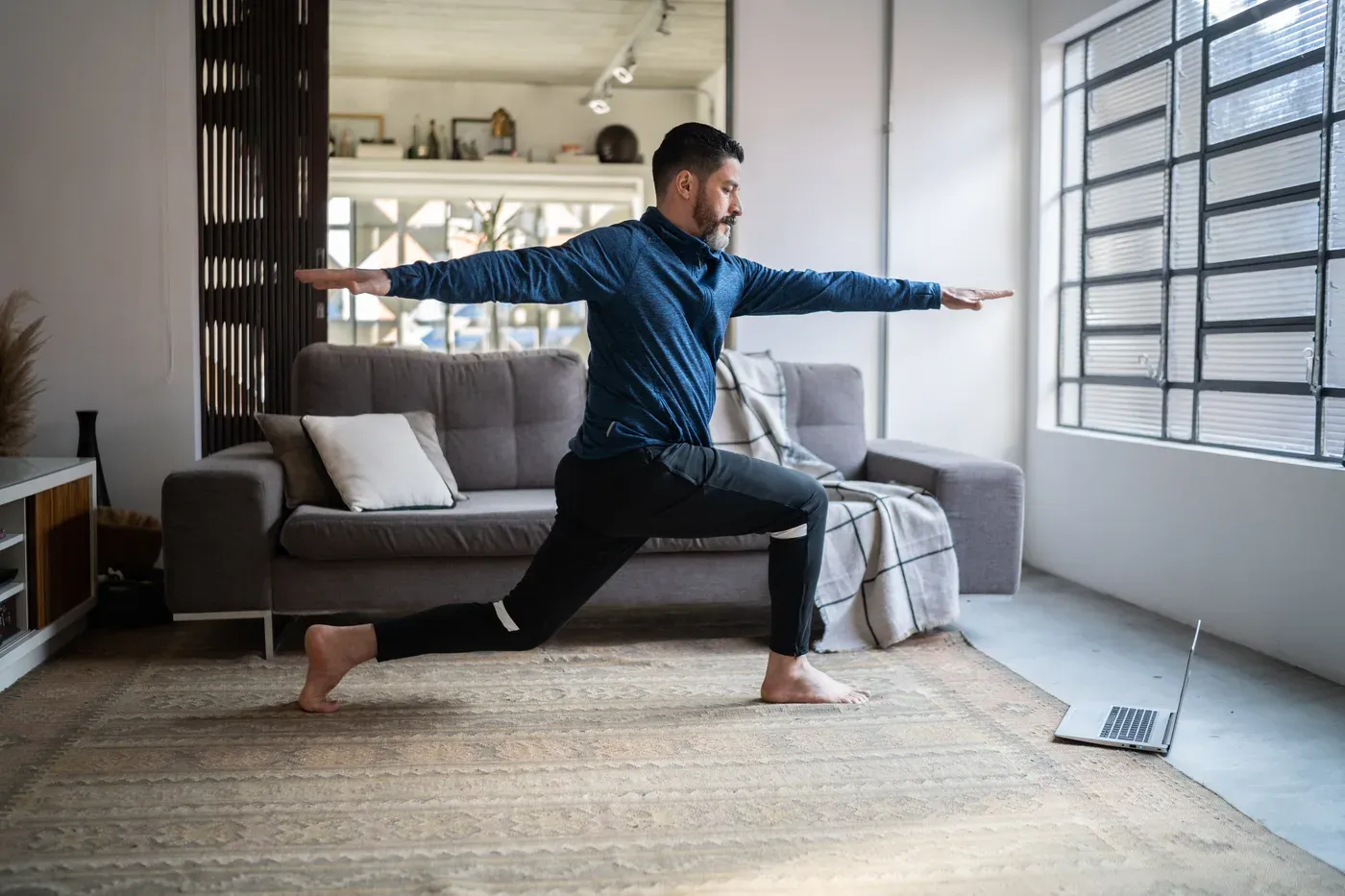
To do a reverse lunge, stand tall with feet hip width apart, take a long step back with one foot, and lower until your back knee is just above the floor with your front shin close to vertical. Then push through your front foot to step back up to standing. It’s kinder to the knees than a forward lunge because the front leg doesn’t have to brake your body moving forward.
What the reverse lunge does
The reverse lunge trains the quads and glutes of the front leg, and it adds a skill the split squat doesn’t: stepping and returning under control. That’s useful for everyday balance, for sports like tennis or hockey, and for keeping your footing on an icy sidewalk.
The backward step loads the front hip more and the front knee less, so many men who find forward lunges painful have no trouble here.
Starting position
Stand with feet hip width apart and hold dumbbells at your sides or keep your hands on your hips. Brace your trunk lightly. Weight sits through the middle of both feet. Pick a spot ahead to look at; it helps balance.
Steps
- Shift your weight onto your left foot.
- Step your right foot straight back, landing on the ball of the foot, about two to three feet (60 to 90 cm) behind you.
- Bend both knees and lower straight down. Your torso can lean forward slightly.
- Stop when your back knee is just above the floor. The front knee stays in line with the second toe.
- Drive through your left heel and midfoot to rise.
- Bring your right foot forward to meet the left and stand tall.
- Repeat on the same side, or alternate.
Mistakes to watch
Stepping back on a tightrope. Your back foot lands behind the front one and you wobble. Keep your feet on two separate tracks.
Pushing up with the back leg. The rear foot is a kickstand. Most of the effort should come from the front leg.
Front knee collapsing inward. Slow the descent and keep the knee tracking over the toes. Lighter weights help.
Slamming the back knee down. Lower with control so the knee hovers or touches lightly.
Sets and reps
| Goal | Sets × reps per leg | Load | Rest |
|---|---|---|---|
| Beginner | 2–3 × 8 | Bodyweight, hand on a rail | 60 s |
| Strength | 4 × 6 | Heavy dumbbells or a barbell | 2 min |
| Muscle | 3 × 10–12 | Moderate dumbbells | 90 s |
| Conditioning | 3 × 40 s alternating | Light | 60 s |
Variations and knee-friendly options
- Easier: hold a rail or post for balance, or use a split squat so your feet don’t move.
- Harder: a deficit reverse lunge with the front foot on a small plate, a goblet-held weight, or a barbell on your back.
- Sore knees: shorten the depth, put a pad under the back knee, and lean forward slightly to shift load to the hip. A step-up on a low box is another option.
- Sore back: hold a single dumbbell in goblet position instead of a barbell.
- Balance problems: go back to the split squat, or hold a kettlebell in the hand opposite the working leg.
If you’re still learning to squat, pair reverse lunges with a goblet squat on the same day.
Workouts that use the reverse lunge
You’ll find reverse lunges in the knee friendly leg workout, the full body workout and the resistance band workout. For a full program with lunges placed and progressed, browse the DIY programs.
Questions people also ask
Are reverse lunges better than forward lunges for bad knees?
For most people, yes. Stepping back keeps your front shin more vertical and you don't have to brake your body weight with the front knee, which is what often irritates knees in forward lunges.
Should I alternate legs on reverse lunges?
Either works. Alternating is easier to balance; doing all reps on one leg first is harder and builds more strength on that side.
How far back should I step?
Far enough that both knees are near 90 degrees at the bottom. Too short and the front knee shoots forward; too long and you strain the hip flexor of the back leg.
Do reverse lunges work the glutes?
Yes. A slight forward lean of the torso and pushing through the front heel shifts more work to the glutes.