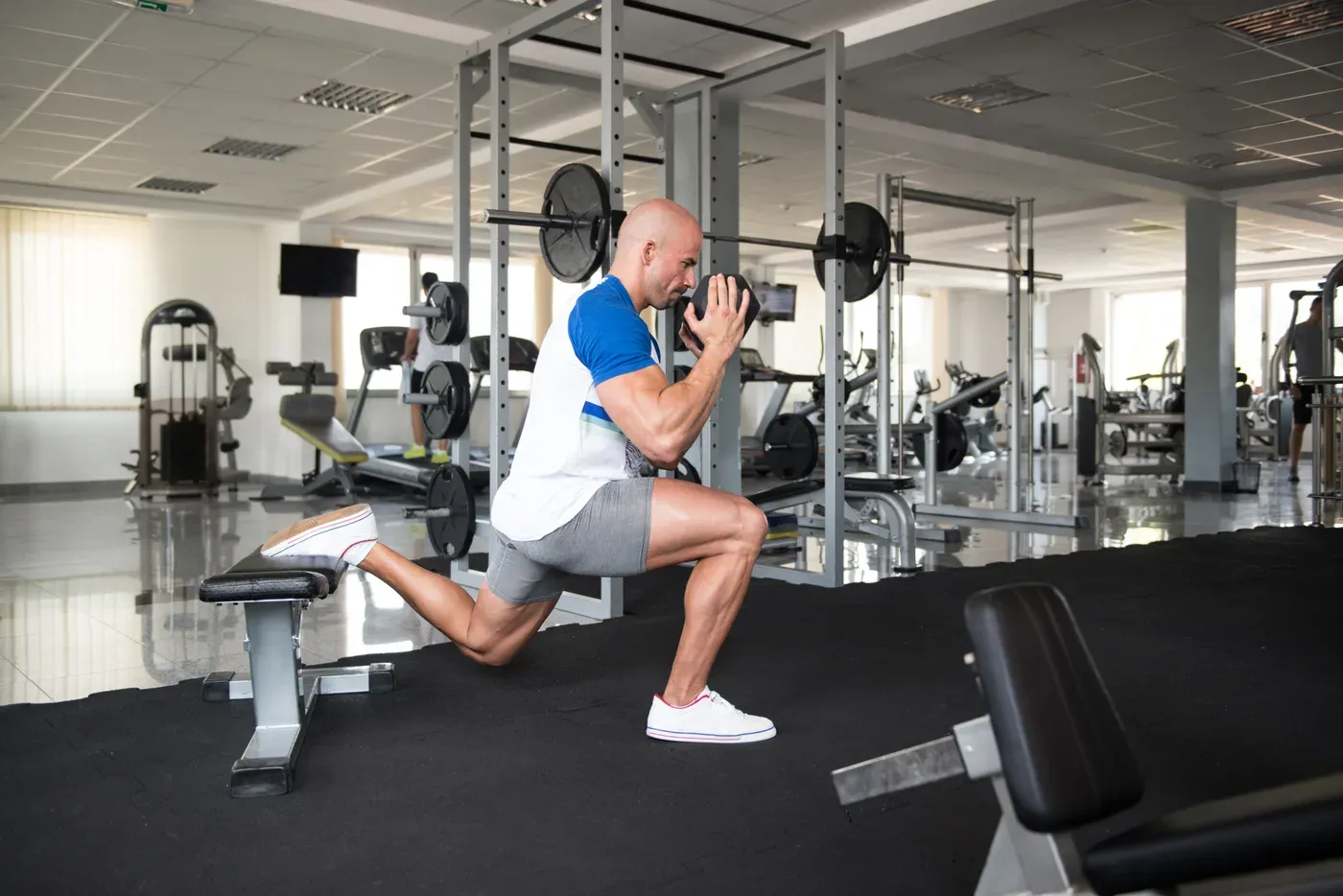
A leg workout with bad knees should still train your legs hard, just through ranges and exercises your knees tolerate. This plan uses two leg sessions a week: one built around squatting to a box at a pain-free height, and one built around the hips and hamstrings, which work hard while the knee stays relatively quiet. Wall-sit holds load the knee gently before the moving exercises, the bike covers your cardio, and an eight-week progression lowers the box and raises the weight only as fast as your knees allow.
When to get your knee checked first
This plan assumes you can walk, climb stairs and bear weight normally, even if it aches. Following NHS guidance on knee pain that needs urgent advice, get seen promptly by your doctor or an urgent care clinic if:
- you can’t move your knee or put weight on it
- it’s badly swollen or has changed shape
- it locks, gives way or clicks painfully (painless clicking is normal)
- it’s red and hot and you have a fever or feel shivery
- the pain is severe
See your doctor or a physiotherapist if ordinary knee pain hasn’t improved within a few weeks.
Why strengthening helps sore knees
For knee osteoarthritis, NICE guidance names therapeutic exercise, such as local muscle strengthening and general aerobic fitness, as a core treatment, and advises that joint pain may increase when you start before regular exercise brings long-term benefit. For general knee pain, the logic is similar: stronger quads, glutes and hamstrings share the load. For more background, see exercising with knee pain and exercising with arthritis.
Find your box height before week 1
Squat depth is the main dial. Find your starting point like this:
- Stack a bench or box with plates or aerobic steps so the top is roughly at knee height.
- Do 5 slow bodyweight squats, touching the box lightly with your hips.
- Rate knee pain from 0 to 10. If it’s 3 or less and doesn’t linger, lower the box by about 5 cm and repeat.
- Stop at the lowest height that stays at 3 or less. That’s your week 1 box.
Write the height down. Lowering it over the weeks is one of your two main measures of progress.
The weekly layout
| Day | Session |
|---|---|
| Monday | Leg session A (knee-tolerant squat focus) |
| Tuesday | Upper body or rest |
| Wednesday | Bike 25–40 min, easy to moderate |
| Thursday | Leg session B (hip and hamstring focus) |
| Friday | Upper body or rest |
| Weekend | Walk, swim or bike; avoid sudden jumps in hiking distance |
If you need upper-body sessions, the shoulder-friendly upper body workout fits the gaps.
Session A: squat focus
| Exercise | Sets × reps or time | Rest | Notes |
|---|---|---|---|
| Bike warm-up | 6 min | — | Seat high, easy resistance |
| Wall sit (or Spanish squat with a band behind the knees) | 4 × 30–45 s | 60 s | Depth where pain is 3/10 or less; a gentle way to load the knee |
| Box squat with a kettlebell or dumbbell | 3 × 8–10 | 90 s | To your box height; 3 s down |
| Step-up to a low step (15–20 cm) | 3 × 8 per leg | 60 s | Drive through the whole foot; lower slowly |
| Leg press, feet high on the platform | 2 × 12 | 90 s | Stop before the knee hurts; short range is fine |
| Leg extension, partial range | 2 × 15 | 60 s | Light; top half of the movement only |
| Calf raise | 3 × 12 | 45 s | Slow, full range |
Session B: hip and hamstring focus
| Exercise | Sets × reps | Rest | Notes |
|---|---|---|---|
| Glute bridge, then hip thrust as it gets easy | 3 × 10–12 | 90 s | Shins vertical at the top |
| Romanian deadlift with dumbbells | 3 × 8–10 | 2 min | Knees soft, hips back; usually very knee-friendly |
| Seated or lying hamstring curl | 3 × 10–12 | 60 s | Controlled |
| Sled push or backward sled drag | 4 × 15–20 m | 90 s | Backward drag is often the most comfortable for the front of the knee |
| Side-lying hip abduction or cable hip abduction | 2 × 15 per side | 45 s | |
| Copenhagen plank, knee on bench | 2 × 15 s per side | 45 s | Short lever only |
The 24-hour check
After each session, rate your knee the next morning against your usual baseline:
- Same or better: progress next session as the table below says.
- A little worse, back to normal by midday: repeat the same session next time.
- Worse all day, or swollen: go back one week in the progression and drop the exercise that bothered it most. If this happens twice in a row, see a physiotherapist.
Eight-week progression
| Week | Box height | Box squat load | Other exercises |
|---|---|---|---|
| 1 | Your test height | Bodyweight or light kettlebell | Learn movements; 3 reps in reserve |
| 2 | Same | +2–4 kg | Add reps to the top of the range |
| 3 | Lower by 2–5 cm if the 24-hour check was “same or better” | Same | Add 2.5–5 kg on RDL and hip thrust |
| 4 | Same as week 3 | +2–4 kg | Add a set of wall sits |
| 5 | Same | Same; lighter week, 2 sets per exercise | All exercises 2 sets |
| 6 | Lower by 2–5 cm if comfortable | +2–4 kg | Step-up height +5 cm if pain-free |
| 7 | Same | +2–4 kg | Leg press range slightly deeper if pain-free |
| 8 | Retest: find your new lowest pain-free height | Hold | Compare to week 1 |
If your knees stay at the same box height for all eight weeks but you’re handling more load, that’s still progress.
Swaps if something still hurts
| If this bothers you | Try this |
|---|---|
| Box squat at any height | Wall sit only for 2 weeks, plus leg press with a shorter range |
| Step-up | Lower step, or step-ups to the side (lateral step-up) |
| Leg extension | Drop it; add a second wall-sit set |
| Kneeling for the Copenhagen plank | Side plank from the feet |
| Walking lunges, jumping, running | Leave them out; bike and sled cover conditioning |
| Step-ups feel easy and pain-free by week 6 | Add a short-stride reverse lunge or a short-range split squat, 2 × 8 per leg, holding a support |
How to tell it’s working
The two numbers to watch are your box height and your loads. By week 8, a lower box, heavier box squats, and stairs that feel easier are all good signs. Fewer mornings with a stiff, cranky knee is another. If pain is creeping up week to week despite following the 24-hour check, stop progressing and get the knee assessed.
Bottom line
Bad knees change how you train legs, not whether you train them. Squat to a box, load your hips, use the bike, and lower the box only when the knee agrees. If you’d prefer a coach to choose your box height, load and progressions each week, and to coordinate with your physiotherapist’s advice, weekly 1:1 coaching starts from $99 a week.
Questions people also ask
Should I still train legs if my knees hurt?
In most cases, yes. Strong thighs and hips take load off the knee, and for knee osteoarthritis, therapeutic exercise is a core recommended treatment. The trick is choosing depth, exercises and loads your knees tolerate today, then building from there.
Are squats bad for your knees?
Not inherently. Squats load the knee, and loading is how tissues adapt. With sore knees, squatting to a box at a height that doesn't provoke pain is usually a better choice than avoiding squats altogether.
Is cycling good for bad knees?
For many men it's one of the most comfortable ways to do cardio, because the load is steady and there's no impact. Set the seat high enough that your knee is only slightly bent at the bottom of the pedal stroke.
Is some knee pain during exercise OK?
Mild discomfort that settles within a day is common when you start strengthening, and osteoarthritis guidance warns that pain may increase at first. Sharp pain, swelling afterward, or pain that's worse the next day means scale back.