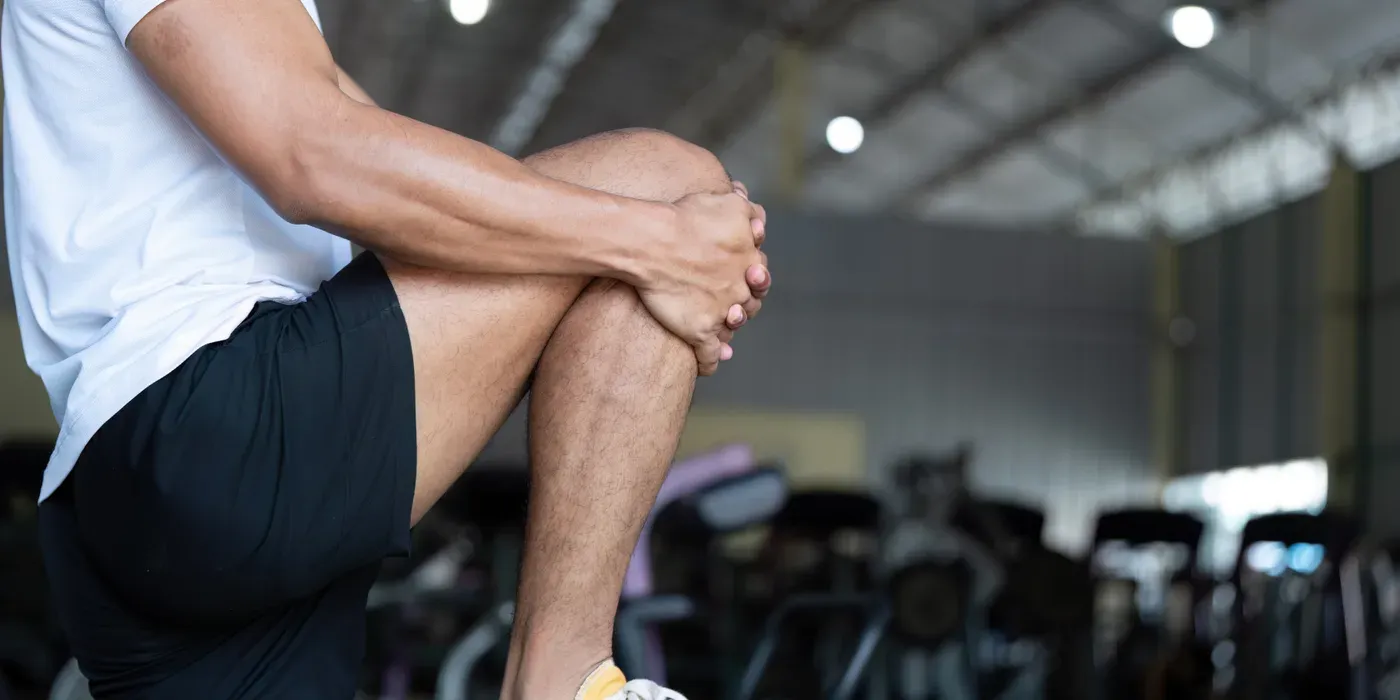
To exercise with knee pain, keep training but change three things on the movements that hurt: how deep you bend, how much weight you use, and how much impact is involved. Squat to a box instead of all the way down, swap running and jumping for cycling or rowing, and use a simple rule: mild discomfort that settles by the next morning is usually acceptable, while pain that sharpens during a set or lingers into the next day means back off. Keep the rest of your training as normal, and get the knee assessed if it isn’t improving within a few weeks.
First: is this one to train around?
Some knee pain needs a professional before it needs a workout. The NHS knee pain guidance advises getting urgent advice if:
- Your knee is very painful, or you can’t move it or put any weight on it.
- It’s badly swollen or has changed shape.
- It locks, gives way, or clicks painfully (painless clicking is normal).
- You have a high temperature or feel hot and shivery, with redness or heat around the knee, which can be a sign of infection.
It suggests seeing a doctor if knee pain hasn’t improved within a few weeks. A twist or pop during sport followed by swelling also needs assessing before you load it.
If none of these apply and it’s the familiar ache of an old knee, a long run, or a bad squat session, read on.
A simple rule for training through knee discomfort
Physiotherapists often use a pain-monitoring approach: you keep training the painful area, but you let your symptoms set the dose. In a trial of people with Achilles tendon pain, those who kept running and jumping within a pain-monitoring model recovered as well as those who stopped those activities for six weeks (Silbernagel et al., 2007). That was the Achilles rather than the knee, but the principle is widely used for managing load on irritated joints and tendons.
A practical version, which your physiotherapist can adjust for you:
| During or after training | What it means | What to do next time |
|---|---|---|
| No pain, or mild discomfort (about 3/10 or less) that settles by next morning | Acceptable load | Keep going; progress slowly |
| Moderate pain (4–5/10), or the knee feels worse next morning | Too much | Reduce depth, load or volume |
| Sharp pain, swelling or limping afterwards | Well over the limit | Stop that exercise; get it assessed |
Knee-friendly swaps
You don’t need to stop training your legs. You need versions your knee tolerates right now.
| If this hurts | Try this instead | Why it’s often easier |
|---|---|---|
| Deep barbell squat | Box squat to a higher box | Controls depth; you can lower the box over weeks |
| Walking lunges | Split squat holding a support, short range | Slower, more stable, adjustable depth |
| Leg extension | Spanish squat or wall sit at a comfortable angle | Many people find held positions easier on an irritated knee |
| Running | Bike, rower, incline walking | Much less impact per step |
| Jumping, plyometrics | Sled push | Leg drive without landing forces |
| Deep leg press | Leg press with shorter range | Keep the knee angle where it’s comfortable |
| Step-ups on a high box | Low step-ups | Less knee bend under load |
Train the hips hard too: Romanian deadlifts, hip thrusts and glute bridges load the posterior chain without asking much of the knee. The knee-friendly leg workout is built from these swaps.
Small changes that make a big difference
- Warm up for longer. Five to ten minutes on a bike before leg work helps most sore knees.
- Slow the lowering. A controlled three-second descent on squats and split squats is usually kinder than dropping fast.
- Let the knees travel naturally. Knees moving forward over the toes in a squat is normal; forcing them back can shift stress to the hips and back.
- Check your footwear. Very soft running shoes can feel unstable under a heavy squat; a flatter shoe is often better for lifting.
- Spread the load across the week. Two moderate leg sessions often feel better than one very heavy one.
Who to see in Ontario
If your knee pain isn’t settling within a few weeks, see a physiotherapist or your doctor. A physiotherapist can assess what’s causing it and give you a specific exercise plan. In Ontario, government-funded physiotherapy is available with a valid health card if you’re 65 or older, 19 or under, after an overnight hospital stay or day surgery within the last 12 months, or receiving Ontario Works or ODSP. Most men aged 35 to 64 pay privately or use workplace benefits.
If your doctor or physiotherapist mentions osteoarthritis, the guide to exercising with knee or hip arthritis covers what the guidelines recommend. If the problem is more general (knees, elbows and shoulders all a bit cranky), read achy joints when training over 40.
A sample week with a sore knee
| Day | Session |
|---|---|
| Monday | Upper body plus hip work (Romanian deadlift, glute bridge); 15 min easy bike |
| Wednesday | Knee-friendly legs: box squat, split squat with support, sled push; upper-body pull |
| Friday | Full body with the swaps above; easy rower |
| Daily | Walk on flat ground, as comfortable |
The bottom line
A sore knee rarely means no training. Lower the depth, load and impact, use the pain rule, train the hips and upper body as normal, and see a physiotherapist if it isn’t improving. No program can promise the pain won’t return, but strong legs and sensible loading give you the best chance of training for years. If you want a coach to build the swaps into your program and adjust them as the knee improves, weekly 1:1 coaching starts from $99 a week, alongside your physiotherapist’s advice.
Questions people also ask
Should I rest my knee completely if it hurts?
Usually not, unless it's a fresh injury or one of the warning signs applies. Complete rest weakens the muscles that support the knee. Reduce the load on the painful movements, keep the rest of your training, and get it assessed if it doesn't settle.
Is squatting bad for your knees?
Not for healthy knees, and squatting is often part of rebuilding a sore one. During a flare, squat to a higher box, use a lighter weight and slow down, then increase depth and load as the knee tolerates it.
What cardio is best with knee pain?
Cycling, rowing, swimming and walking on flat ground are usually better tolerated than running, jumping or stair sprints. Adjust a bike seat high enough that your knee doesn't bend sharply at the top of the stroke.
Should I wear a knee brace or sleeve to lift?
A sleeve can make the knee feel warmer and more comfortable, and some men like that. It doesn't fix the underlying problem. Ask your physiotherapist before relying on a brace for a specific injury.