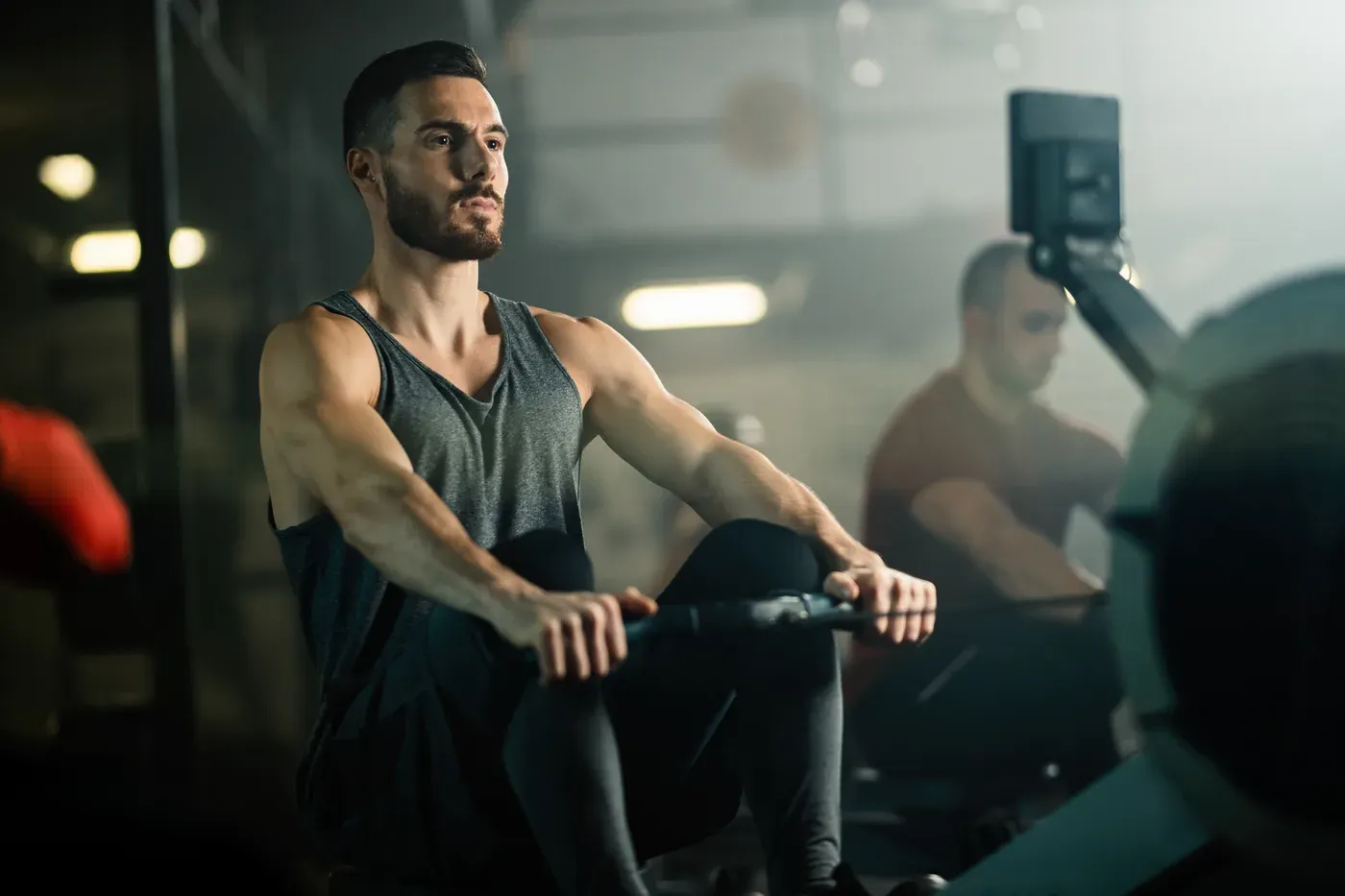
Good rower technique follows one order: legs, then body, then arms on the drive, and arms, then body, then legs on the way back. Push with your legs first while your arms stay straight, swing your torso slightly back, then pull the handle to your lower ribs. Reverse it to return. Set the damper around 3 to 5 and keep your back long at the front of the stroke. Most of the power should come from your legs, not your arms or back.
Why rowing is worth learning properly
The rowing machine trains your legs, hips, back and arms together, and it can push your heart and lungs as hard as you want with no impact. For men over 40 who want conditioning without pounding knees on a treadmill, it’s one of the best options in the gym or a basement.
Bad technique, though, turns it into an arm-and-back exercise that tires you out early and can irritate the lower back. A few minutes spent on the sequence pays off for years.
Machine setup
- Strap your feet in so the strap crosses the widest part of your foot.
- Set the damper (the lever on the fan housing). Concept2 recommends starting at 3 to 5; it’s not a difficulty setting, and higher is not better.
- Sit tall on the seat, holding the handle with a relaxed overhand grip.
The stroke in four parts
- The catch. Shins near vertical, arms straight, torso leaning slightly forward from the hips, back long.
- The drive. Push through your feet with your legs while your arms stay straight. When your legs are nearly flat, swing your torso back slightly, then pull the handle to your lower ribs.
- The finish. Legs straight, torso leaning slightly back, handle just below your chest, elbows past your body.
- The recovery. Arms extend first, then your torso hinges forward from the hips, then your knees bend and you slide back to the catch.
The drive is fast and strong; the recovery is slower, roughly twice as long. Think “push, glide.”
Faults that waste effort
| Fault | Fix |
|---|---|
| Pulling with the arms first | Keep arms straight until your legs finish pushing |
| Rounding the back at the catch | Hinge from the hips; chest proud, back long |
| Knees bending too early on the recovery | Arms and body forward first, then knees |
| Damper on 10 | Drop it to 3–5 and focus on leg drive |
| Shooting the slide (seat moves, handle doesn’t) | Brace your trunk so leg power reaches the handle |
Sample sessions by goal
| Goal | Session | Notes |
|---|---|---|
| Learning | 5 × 2 min easy, 1 min rest | Practise the sequence at 18–20 strokes per minute |
| Aerobic base | 20–30 min steady, able to speak in sentences | Twice a week |
| Intervals | 8 × 250 m hard, 90 s easy rowing between | Once a week, after a good warm-up |
| Short finisher | 5 × 30 s hard, 60 s easy | After strength work |
If you have a heart condition, high blood pressure or chest symptoms with exercise, check with your doctor before hard intervals. To plan your easy and hard pace by heart rate, the heart rate zone calculator helps.
Easier, harder and back-friendly options
- Easier: arms-only and arms-and-body drills, or legs-only rowing at low intensity.
- Harder: longer intervals, lower rest, or a 2,000 m test once your technique is consistent.
- Sore lower back: shorten the lean at the catch and finish, and keep sessions shorter. The assault bike or a sled push are alternatives with no back flexion.
- Stiff hips: if you can’t reach the catch without rounding, shorten the slide. The hip hinge drills help here.
Workouts that use the rower
The rower appears in the joint friendly HIIT workout, the fat loss workout and the 30-minute gym workout as conditioning. For a plan that blends conditioning and strength, the DIY programs are ready to follow.
Questions people also ask
What damper setting should I use on a rowing machine?
Concept2 recommends starting at 3 to 5. Higher settings feel heavier but don't automatically give a better workout; they tire your muscles before your heart and lungs get the benefit.
Is rowing bad for your lower back?
Rowing with good technique is well tolerated by many people. Back trouble usually comes from rounding forward at the catch or yanking with the back early in the drive. If rowing hurts your back, stop and get it assessed.
How long should a beginner row?
Start with 10 to 15 minutes at an easy pace, broken into chunks if needed, two or three times a week. Technique first, then time, then intensity.
What stroke rate should I aim for?
For steady rowing, around 18 to 24 strokes per minute is a common range. Faster isn't better if each stroke is short and weak.