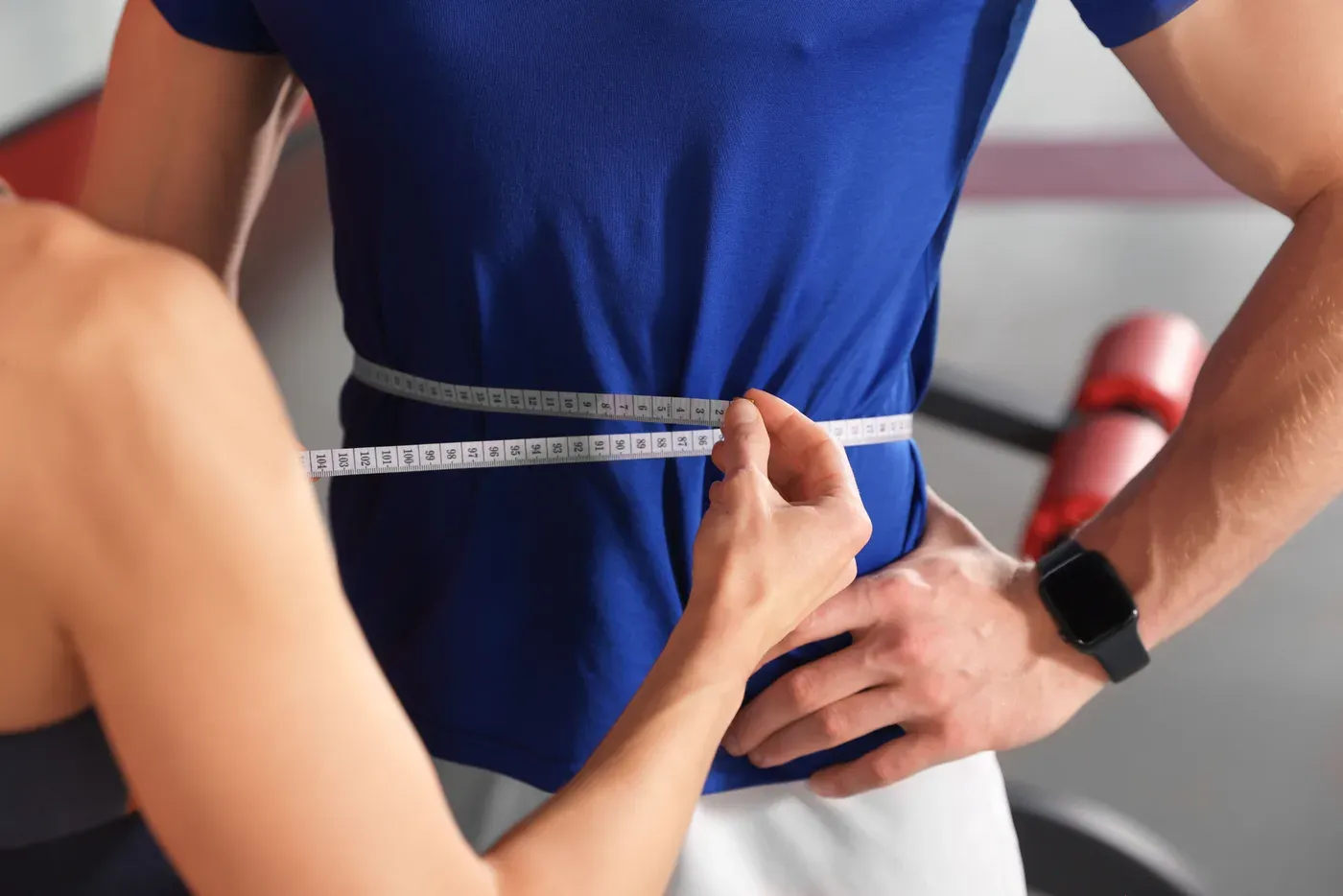
For men aged 40 to 59, the most widely cited research-based ranges put a healthy body fat percentage at roughly 11 to 23%. About 23 to 29% corresponds to overweight, and 29% or more to obesity. For men 60 and older, each band sits about two points higher. So a good body fat percentage for a 50-year-old man is anywhere from the low teens to the low 20s, and lower isn’t automatically healthier. Treat any single number with caution: most measuring methods carry an error of several percentage points.
Healthy body fat ranges by age
These ranges come from Gallagher and colleagues, who measured body fat with reference methods (a 4-compartment model and DEXA) in white, African American and Asian adults, then matched body fat to the standard BMI cut-offs for underweight, overweight and obesity (Gallagher et al., 2000). The table below shows the men’s classification as reproduced in a later peer-reviewed study (Shahab Jahanlou, 2016).
| Age | Under | Healthy | Overweight | Obese |
|---|---|---|---|---|
| 20–39 | under 8% | 8–20.9% | 21–25.9% | 26% or more |
| 40–59 | under 11% | 11–22.9% | 23–28.9% | 29% or more |
| 60 and over | under 13% | 13–24.9% | 25–30.9% | 31% or more |
Two caveats from the original paper. The authors called these ranges provisional, a starting point for guidelines rather than final ones. And their prediction equations had a standard error of roughly 3 to 5 percentage points of body fat, which is a reminder that body fat is an estimate even in research.
What the ranges mean in practice
| Your number (age 40–59) | What it usually means | Sensible focus |
|---|---|---|
| Under 11% | Very lean for your age | Strength and performance; check you’re eating enough |
| 11–16% | Lean and athletic | Maintain; build strength and muscle |
| 17–22.9% | Healthy range | Fine for health; lower only if you want to look leaner |
| 23–28.9% | Overweight range | Gradual fat loss; check your waist and health markers |
| 29% or more | Obese range | Fat loss plan; see your doctor for blood pressure, blood sugar and cholesterol |
The 11–16% and 17–22.9% split is a practical way to read the healthy band, not a medical category.
Your waist matters as much as the percentage. Health Canada notes that even a man with a normal BMI carries some extra risk if his waist is high (Health Canada). Check both; healthy waist size for men has the targets.
How much to trust your number
Different methods give different answers for the same man on the same day:
- Home smart scales and gym impedance machines estimate body water and use prediction equations. They work reasonably in healthy people with stable hydration but should be interpreted with caution for tracking, and less reliably at high BMI (Kyle et al., 2004). A reading taken after a salty dinner or a hard workout can be noticeably off.
- DEXA is more detailed and is one of the reference methods behind the ranges above, but it still has error and machines differ.
- Calipers depend on who’s holding them.
So don’t chase a precise number. Use one method, under the same conditions, and watch the trend over months. How to measure body fat compares the options in detail.
Getting from one range to the next
Moving down a band, say from 26% to 22%, means losing fat without losing muscle. The approach:
- A modest deficit of about 0.5 to 1% of bodyweight a week, the range recommended to protect muscle while dieting (Helms et al., 2014).
- Strength training two to three times a week.
- High protein at every meal.
- Aerobic activity most days, walking included.
If your weight is normal but your body fat is high (the skinny-fat pattern), the answer is more muscle rather than a hard diet; see body recomposition after 40. For a sense of how strong you should be alongside a healthy body fat level, there’s strength standards for men over 40.
Is lower always better?
No. Pushing well below the healthy range at 45 or 55 takes a lot of effort and isn’t needed for health. Very lean levels can be hard to hold with a job, a family and normal social life, and dieting hard for them can cost muscle and energy. A sensible target for most men over 40 is somewhere in the healthy band where you feel strong, sleep well and can hold it without misery.
The bottom line
For men over 40, roughly 11 to 23% body fat is healthy, and the mid-to-high teens is a realistic lean target. Measure it consistently, pair it with your waist, and focus on the trend. If you want a coach to set a body-composition target and work you toward it with measurable check-ins, the 12-Week Body Transformation is built around exactly that.
Questions people also ask
What is a good body fat percentage for a 50-year-old man?
Using the widely cited Gallagher ranges, roughly 11 to 23% is the healthy band for men aged 40 to 59. The low-to-middle teens is lean for that age; the low 20s is still within the healthy range.
What body fat percentage do you need for visible abs?
Usually well below the top of the healthy range, and it varies a lot between men because of genetics and where you store fat. Visible abs aren't a health target and can take a long time to reach after 40.
Is 25% body fat bad for a man over 40?
For men aged 40 to 59, 25% falls in the overweight band of the Gallagher ranges. It's a reason to work on fat loss and check your waist and health markers, not a cause for alarm.
Why does my smart scale say a different body fat than the gym's machine?
Different devices use different methods and prediction equations, and impedance readings shift with hydration. Pick one method, test under the same conditions, and follow its trend.
Sources
- Gallagher et al. (2000), Healthy percentage body fat ranges: an approach for developing guidelines based on body mass index, Am J Clin Nutr
- Shahab Jahanlou (2016), The accuracy of body mass index and Gallagher's classification in detecting obesity among Iranians, Iran J Med Sci (table of Gallagher's ranges)
- Kyle et al. (2004), Bioelectrical impedance analysis part II: utilization in clinical practice, Clin Nutr
- Health Canada — Canadian Guidelines for Body Weight Classification in Adults (Q&A)
- Helms et al. (2014), Evidence-based recommendations for natural bodybuilding contest preparation, J Int Soc Sports Nutr