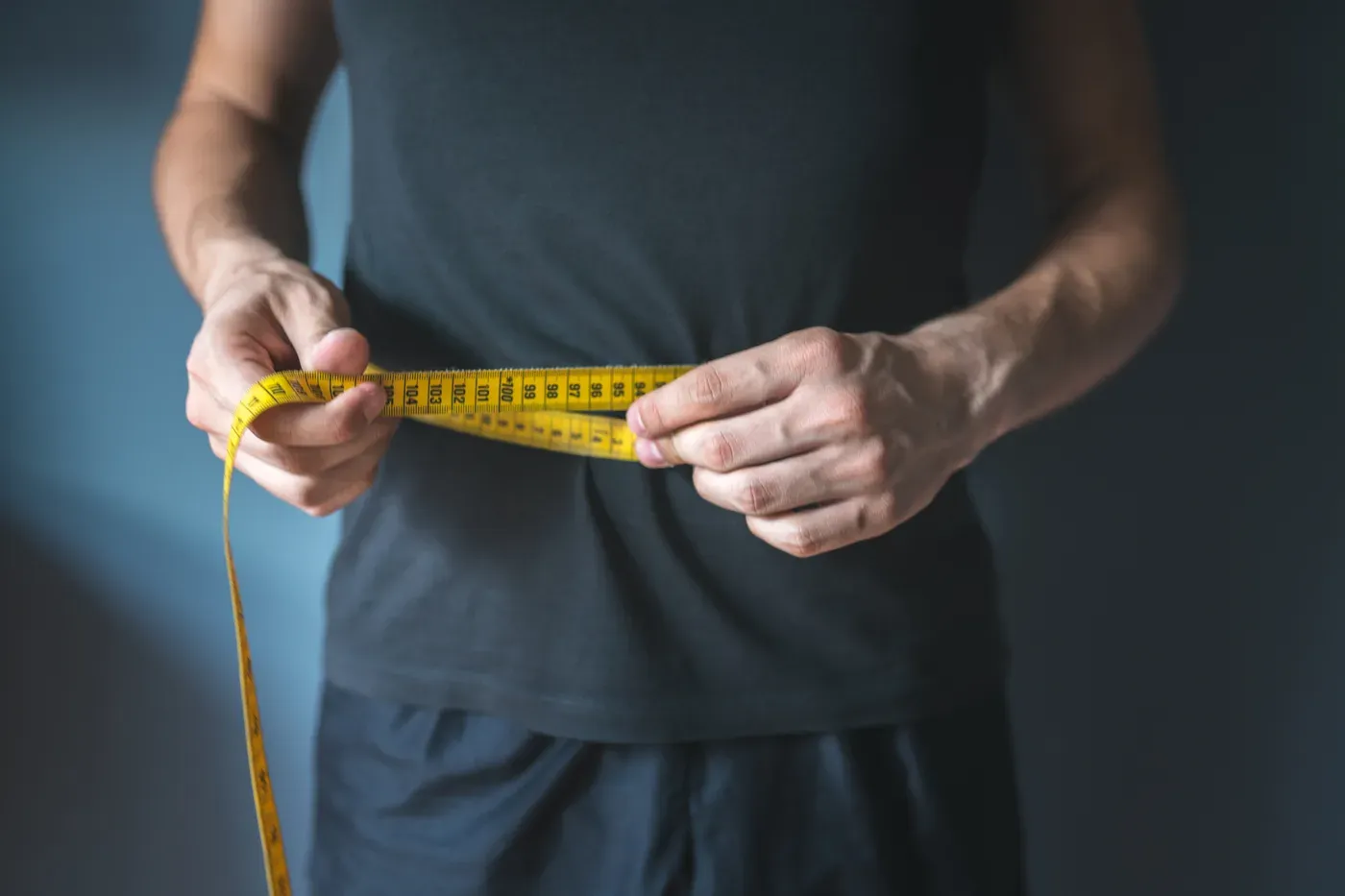
A healthy weight for a 45-year-old man depends on his height. Health Canada’s “normal weight” BMI range of 18.5 to 24.9 works out to about 58 to 79 kg (129 to 174 lb) for a man who is 5’10” and about 62 to 83 kg (136 to 184 lb) at 6’0” (Health Canada). Those ranges are a screening tool, not a verdict. At 45, your waist measurement and how much of your weight is muscle say more about your health than the scale alone.
Weight by height for a 45-year-old man
The table below converts Health Canada’s BMI categories into weights for common heights. The adult categories are the same from 18 to 64, so they apply at 45 as they would at 30.
| Height | “Normal weight” (BMI 18.5–24.9) | “Overweight” (BMI 25–29.9) |
|---|---|---|
| 5’6” (168 cm) | 52–70 kg (115–154 lb) | 70–84 kg (155–185 lb) |
| 5’8” (173 cm) | 55–74 kg (122–164 lb) | 75–89 kg (164–197 lb) |
| 5’10” (178 cm) | 58–79 kg (129–174 lb) | 79–95 kg (174–208 lb) |
| 6’0” (183 cm) | 62–83 kg (136–184 lb) | 84–100 kg (184–220 lb) |
| 6’2” (188 cm) | 65–88 kg (144–194 lb) | 88–106 kg (195–233 lb) |
Calculated from BMI = weight (kg) ÷ height (m)². Health Canada classifies a BMI of 30 or more as obese, in three classes with rising risk.
Health Canada describes the risk of health problems as “least” in the normal range and “increased” in the overweight range. It’s a population-level guide; the same page says weight classification is only one part of a fuller health assessment for any individual.
Why BMI can mislead at 45
BMI only knows your height and weight. It can’t tell 90 kg of a former rugby player who still lifts from 90 kg of a man who hasn’t trained since university. Health Canada specifically warns that it may under- or overestimate risk in highly muscular adults, adults with a very lean build, and certain ethnic and racial groups.
Two patterns are common in men in their mid-40s:
- Normal BMI, but a growing belly. Muscle loss and fat gain can cancel out on the scale. Inactive adults lose about 3% to 8% of their muscle per decade (Westcott, 2012), so the same weight at 45 as at 25 can mean noticeably more fat.
- “Overweight” BMI, but lean and strong. Men who lift seriously often land at a BMI of 26 or 27 with a modest waist. For them, the BMI label overstates the risk.
Background matters too. NICE in the UK advises using lower BMI thresholds for people of South Asian, Chinese, other Asian, Middle Eastern, Black African or African-Caribbean background, because cardiometabolic risk appears at lower BMI (NICE).
Your waist: the better second number
Where you carry fat matters more than what you weigh. Health Canada flags a waist of 102 cm (40 in) or more in men as increased risk for type 2 diabetes, heart disease and high blood pressure, and says that a large waist raises the risk level at every BMI category up to 35.
Waist-to-height ratio is a stricter, height-adjusted version. A meta-analysis of studies covering more than 300,000 adults found it outperformed both waist circumference and BMI at identifying cardiometabolic risk factors (Ashwell et al., 2012). NICE suggests keeping your waist to less than half your height:
| Height | Waist at half your height |
|---|---|
| 5’6” (168 cm) | 84 cm (33 in) |
| 5’8” (173 cm) | 86 cm (34 in) |
| 5’10” (178 cm) | 89 cm (35 in) |
| 6’0” (183 cm) | 91 cm (36 in) |
| 6’2” (188 cm) | 94 cm (37 in) |
Measure correctly: Health Canada’s method is midway between your lowest rib and the top of your hip bone, with the tape snug but not compressing the skin. That’s usually around the belly button, not where your belt sits. The waist-to-height calculator does the maths, and the healthy waist size guide goes deeper on what the result means.
Putting the numbers together
Use the two measurements side by side rather than chasing a single target weight:
| BMI | Waist under half your height | Waist over half your height |
|---|---|---|
| Under 25 | Probably in a good place; focus on strength and fitness | “Normal weight” but carrying fat centrally; fat loss and lifting both help |
| 25–29.9 | Possibly muscular; check strength and body fat | Most men here benefit from losing fat around the middle |
| 30 or more | Talk to your doctor about your overall risk picture | Talk to your doctor; a structured fat-loss plan is worth considering |
If you want a more direct read on how much of your weight is fat, the body fat percentage guide explains the measurement options and their accuracy.
What to do with your number
If your weight and waist are both in range, keep training and measure twice a year. If either is high, aim for slow fat loss while lifting so the weight you lose is fat rather than muscle. A realistic first goal is a few centimetres off your waist, not a number on the scale you last saw in your 20s.
Book a checkup with your family doctor if you haven’t had one recently, especially if your waist is over 102 cm. If you’d like a coach to plan the training, eating and tracking over several months, the 6-Month Full Reset includes a body-composition strategy built around exactly these measurements. For the wider context of what shifts at this age, see what happens to a man’s body at 40.
Questions people also ask
What is a healthy weight for a 45-year-old man who is 6 feet tall?
Health Canada's 'normal weight' BMI range of 18.5 to 24.9 works out to about 62 to 83 kg (136 to 184 lb) at 6 feet. A man with a lot of muscle may sit above that range and still be healthy, which is why waist size matters too.
Is BMI accurate for men over 40?
BMI is a reasonable first screen but not a measure of body fat. Health Canada notes it can misjudge risk for very muscular men and some ethnic groups, and recommends using it alongside waist circumference and a fuller health assessment.
Should a 45-year-old man weigh more than a 25-year-old?
The Canadian BMI ranges for adults don't change between 18 and 64. Many men do gain weight between 25 and 45, but that usually reflects added fat rather than a healthier body, so the same ranges apply.
What waist size is healthy for a man?
Health Canada flags a waist of 102 cm (40 in) or more as increased risk for men. NICE in the UK suggests keeping your waist under half your height, which is a stricter test for shorter men.
Sources
- Health Canada — Canadian Guidelines for Body Weight Classification in Adults: quick reference tool
- NICE (UK) — Overweight and obesity management: identifying and assessing overweight, obesity and central adiposity
- Ashwell et al. (2012), Waist-to-height ratio is a better screening tool than waist circumference and BMI for adult cardiometabolic risk factors, Obes Rev
- Westcott (2012), Resistance training is medicine: effects of strength training on health, Curr Sports Med Rep