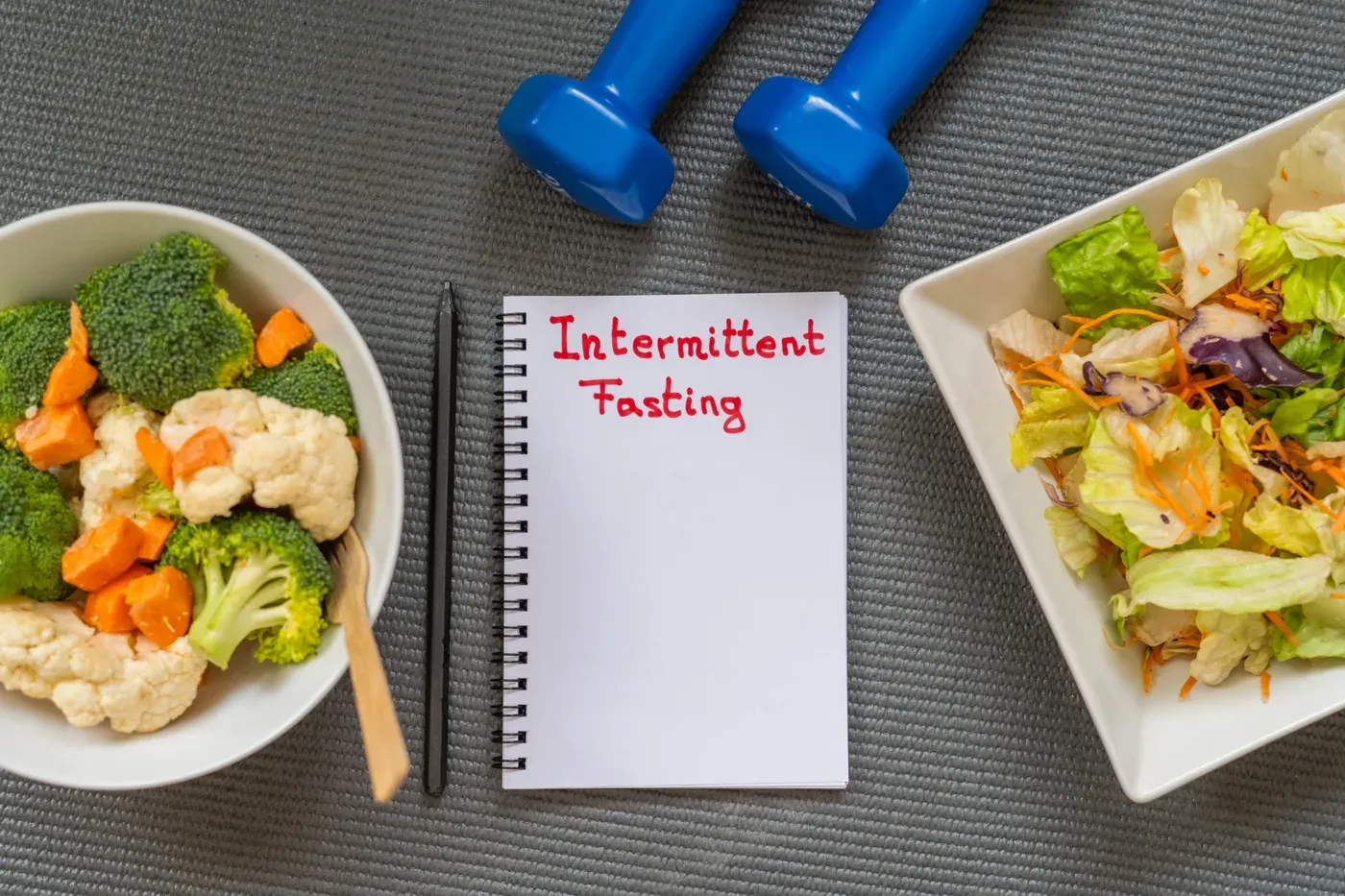
Intermittent fasting works for men over 40 when it helps you eat less, and not otherwise. In randomized trials, people who restricted their eating to an 8-hour window lost no more weight than people who ate the same way across the whole day. If skipping breakfast makes your calories easier to control, it’s a useful tool. If it leaves you starving at 9 p.m. and short on protein, it’s the wrong one.
What the trials actually show
Two well-run trials answer the main question, and both included middle-aged men:
- TREAT (2020): 116 adults, average age about 46 and 60% men, were assigned either to 16:8 eating (noon to 8 p.m.) or to three regular meals for 12 weeks. The fasting group lost a little weight, but there was no significant difference between the groups. In the subgroup that had body scans, the fasting group lost more lean mass (Lowe et al., 2020).
- Liu et al. (2022): 139 adults with obesity followed the same calorie target (1,500 to 1,800 a day for men) for a year, with or without an 8 a.m. to 4 p.m. eating window. Weight loss was 8.0 kg with the window and 6.3 kg without, and the difference wasn’t statistically significant. Body fat, waist and blood markers also didn’t differ (Liu et al., 2022).
The conclusion is consistent: when calories are matched, the clock doesn’t add fat loss. Fasting is a way of structuring a calorie deficit, not a separate mechanism.
The muscle question for men over 40
The lean-mass signal in TREAT matters more to a 45-year-old than a 25-year-old, because you start with less muscle to spare. The likely cause is simple: fewer meals often means less total protein, and less frequent protein.
The ISSN protein position stand recommends spreading protein in doses of 20 to 40 grams (or about 0.25 g/kg) every three to four hours. An 8-hour window gives you room for only two or three feedings. That works if each one is large. For a 90 kg man aiming for 150 g a day:
| Window | Meals | Protein per meal |
|---|---|---|
| 12:00 to 20:00 (16:8) | 3 meals: noon, 4 p.m., 7:30 p.m. | About 50 g each |
| 10:00 to 20:00 (14:10) | 3 meals and a snack | About 40 g each, plus a 25 g snack |
| Ordinary day | 3 meals and a snack | About 35 to 40 g each, plus a snack |
If you can’t eat 50 grams of protein at lunch and again at dinner, a 16:8 window will probably leave you short. A 14:10 window is a gentler version that most men find easier.
Who fasting suits, and who it doesn’t
Fasting tends to work for men who:
- aren’t hungry in the morning anyway and were already forcing breakfast down;
- prefer two larger meals to four smaller ones;
- tend to graze all evening and need a hard stop. A firm kitchen-closed time can help with late-night snacking.
It tends to backfire for men who:
- get ravenous by mid-afternoon and overeat at dinner;
- train hard early and feel weak without food afterward;
- take medication for diabetes or blood pressure (talk to your doctor first);
- have any history of binge eating. Long fasts can feed a restrict-then-binge cycle.
How to set it up if you want to try it
If fasting fits your temperament, start conservatively:
- Begin at 12:12. Stop eating at 8 p.m. and start at 8 a.m. Most men already do something close to this.
- Shrink to 14:10 after a week by pushing breakfast to 10 a.m.
- Plan your first meal around 40 grams of protein. Eggs and egg whites, Greek yogurt, or leftovers from dinner.
- Keep the same calorie target. The window is a container, not a licence to eat freely inside it.
- Judge it after four weeks on weekly average weight and how your lifts are moving. If strength is dropping, widen the window.
Black coffee, tea and water are fine during the fast. Training fasted in the morning works for many men; just make the next meal a big protein one.
Fasting compared with other approaches
The ISSN’s review of diet types concluded that a wide range of approaches can improve body composition similarly when the calorie deficit is the same (Aragon et al., 2017). Fasting sits alongside keto, Mediterranean and plain calorie counting as one way to get there. The best diet comparison lays out how to choose between them.
Should you try an eating window?
Try intermittent fasting if it makes eating less feel easier, keep protein at around 1.6 g per kg of body weight in fewer, larger meals, and drop it if your strength slides or your evenings turn into a free-for-all. If you want help deciding whether an eating window fits your schedule and training, and someone checking the results each month, that’s part of monthly 1:1 coaching.
Questions people also ask
Is 16:8 fasting good for men over 40?
It's fine if you're naturally not hungry in the morning and can fit enough protein into eight hours. It doesn't burn more fat than eating the same calories across the day, so don't force it if mornings are when you're hungriest.
Can I drink coffee while fasting?
Black coffee, tea and water don't break a fast in any meaningful way. Milk, cream and sugar add calories, so if you take them, count your first coffee as the start of your eating window.
Does intermittent fasting lower testosterone or muscle?
The two main trials on this page didn't report testosterone, so they can't answer that part. One did find a small extra loss of lean mass in the fasting group. That's a reason to keep protein high and keep lifting, not proof that fasting destroys muscle.
Should I train fasted?
You can. Many men lift well first thing on an empty stomach. If you train fasted, make your first meal afterward a large protein one, around 40 g.
Sources
- Lowe et al. (2020), Effects of time-restricted eating on weight loss and other metabolic parameters (TREAT trial), JAMA Intern Med
- Liu et al. (2022), Calorie restriction with or without time-restricted eating in weight loss, N Engl J Med
- Jäger et al. (2017), ISSN position stand: protein and exercise, J Int Soc Sports Nutr
- Aragon et al. (2017), ISSN position stand: diets and body composition, J Int Soc Sports Nutr