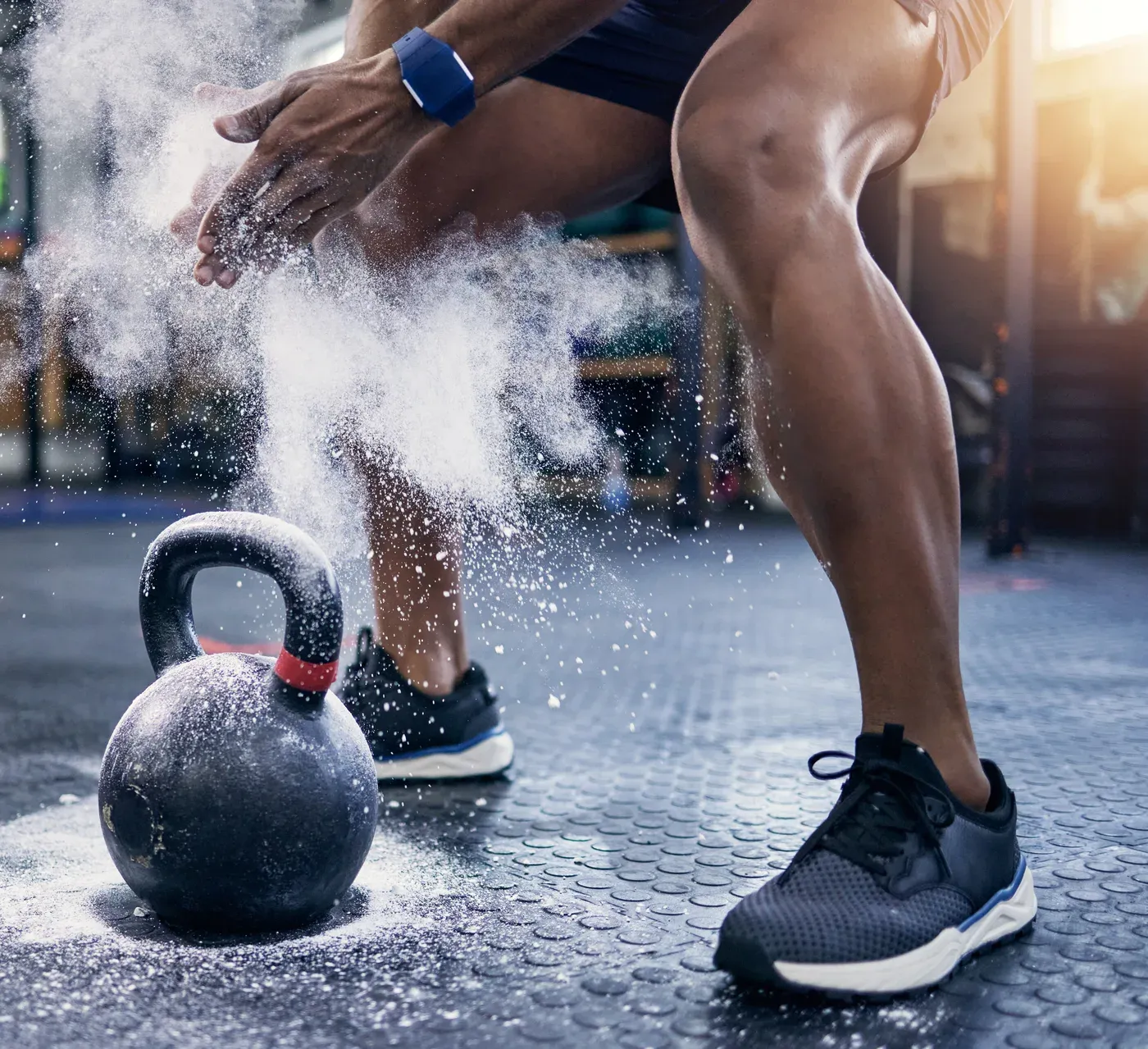
Grip strength in men peaks at a median of about 51 kg between the ages of roughly 29 and 39, then declines slowly: about 50 kg at 40, 49 kg at 45, 48 kg at 50 and 45 kg at 60, measured with a hand dynamometer. Grip matters beyond your hands because it’s a strong marker of overall strength and health, and weaker grip is linked to higher risk of death and heart disease. You can raise it at any age with carries, hangs and heavy pulling.
Grip strength norms for men by age
These centiles come from more than 49,000 people in 12 British studies, measured on hand dynamometers (Dodds et al., 2014). Values in kilograms.
| Age | 10th | 25th | 50th (median) | 75th | 90th |
|---|---|---|---|---|---|
| 35 | 39 | 45 | 51 | 58 | 64 |
| 40 | 38 | 44 | 50 | 57 | 63 |
| 45 | 36 | 42 | 49 | 56 | 61 |
| 50 | 35 | 41 | 48 | 54 | 60 |
| 55 | 34 | 40 | 47 | 53 | 59 |
| 60 | 33 | 39 | 45 | 51 | 56 |
| 65 | 31 | 37 | 43 | 48 | 53 |
How to read it: a 45-year-old man squeezing 56 kg is stronger than about three quarters of men his age. One squeezing 42 kg is in the bottom quarter.
The European sarcopenia consensus uses grip below 27 kg in men as a cut-off for low muscle strength in older adults (Cruz-Jentoft et al., 2019). A man in his 40s should be nowhere near that, but it shows how far grip can fall without training.
Why grip strength predicts health
The PURE study followed 139,691 adults in 17 countries for a median of four years. Each 5 kg lower grip strength was associated with a 16% higher risk of death from any cause and a 17% higher risk of cardiovascular death. Grip strength predicted death from any cause and from heart disease more strongly than systolic blood pressure (Leong et al., 2015).
That doesn’t mean squeezing a gripper will make you live longer. Grip reflects your overall muscle strength and activity level. The useful takeaway is that grip is a cheap, quick test that tells you something real about your strength as you age.
How to test your grip
- Use a hand dynamometer, adjusted so the second knuckles sit at the bend of the handle.
- Stand or sit the same way every time, elbow bent at about 90 degrees and close to your side.
- Squeeze as hard as you can for about three seconds.
- Do two or three attempts per hand, resting between, and record your best.
- Retest every three months under the same conditions.
If you don’t have a dynamometer, track dead-hang time and the weight you can carry for 30 metres. Both move when grip improves.
How to improve grip strength after 40
Grip responds fast because the forearm muscles are small and get little direct training in most programs. Add two of these at the end of two or three sessions a week:
| Exercise | Sets × duration or reps | Focus |
|---|---|---|
| Farmer’s carry | 3 × 30–40 m | Crushing grip and whole-body strength |
| Suitcase carry | 3 × 30 m per side | Grip plus trunk stability |
| Dead hang from a bar | 3 × 20–45 s | Grip endurance and shoulder range |
| Plate pinch | 3 × 15–30 s | Pinch grip (thumb strength) |
| Wrist roller or reverse curl | 2 × 30–60 s or 12–15 reps | Forearm extensors, elbow balance |
Heavy pulling also builds grip: deadlifts, rows and pull-ups done without straps. Use straps only for the final heavy sets if grip is what stops a lift.
An eight-week grip progression
| Weeks | Farmer’s carry load (total, both hands) | Dead hang |
|---|---|---|
| 1–2 | About half your body weight | 3 × 20 s |
| 3–4 | About 60% of body weight | 3 × 30 s |
| 5–6 | About 75% of body weight | 3 × 40 s |
| 7–8 | Approaching body weight | 3 × 45–60 s |
If elbow pain flares with grip work, reduce the load and see the guide to elbow pain from lifting.
Where grip fits with other fitness markers
Grip is one of three easy-to-measure markers worth tracking after 40, alongside push-ups and aerobic fitness. The fitness standards for 40-year-old men show all three together. And because grip falls along with overall muscle, the plan in preventing muscle loss after 40 does more for your long-term grip than any single forearm exercise.
The bottom line
Know your number, compare it with your age group, and train it with carries and hangs alongside a full-body strength program. A rising grip score is one of the quickest signs your training is working. If you’d like a coach to test your strength markers and build a program around the weakest one, weekly 1:1 coaching starts from $99 a week.
Questions people also ask
What is a good grip strength for a 50-year-old man?
In large British norms, the median for men at 50 was 48 kg and the 75th centile 54 kg. Anything above 48 kg is at or above average; 54 kg or more is strong for that age.
Can you improve grip strength after 40?
Yes. Grip responds well to carries, hangs and heavy pulling done two or three times a week. Retest every few months to see the change.
Does improving grip strength make you live longer?
Nobody has proven that. Grip is a marker of overall strength and health. Training it directly helps your hands, but the health benefit comes from the whole-body strength training that raises it.
Where can I test my grip strength?
Some physiotherapists, kinesiologists and gyms have a hand dynamometer, and personal ones are inexpensive online. Test both hands, standing or seated the same way each time, and use your best score.
Sources
- Dodds et al. (2014), Grip strength across the life course: normative data from twelve British studies, PLoS One
- Leong et al. (2015), Prognostic value of grip strength: findings from the Prospective Urban Rural Epidemiology (PURE) study, Lancet
- Cruz-Jentoft et al. (2019), Sarcopenia: revised European consensus on definition and diagnosis, Age Ageing