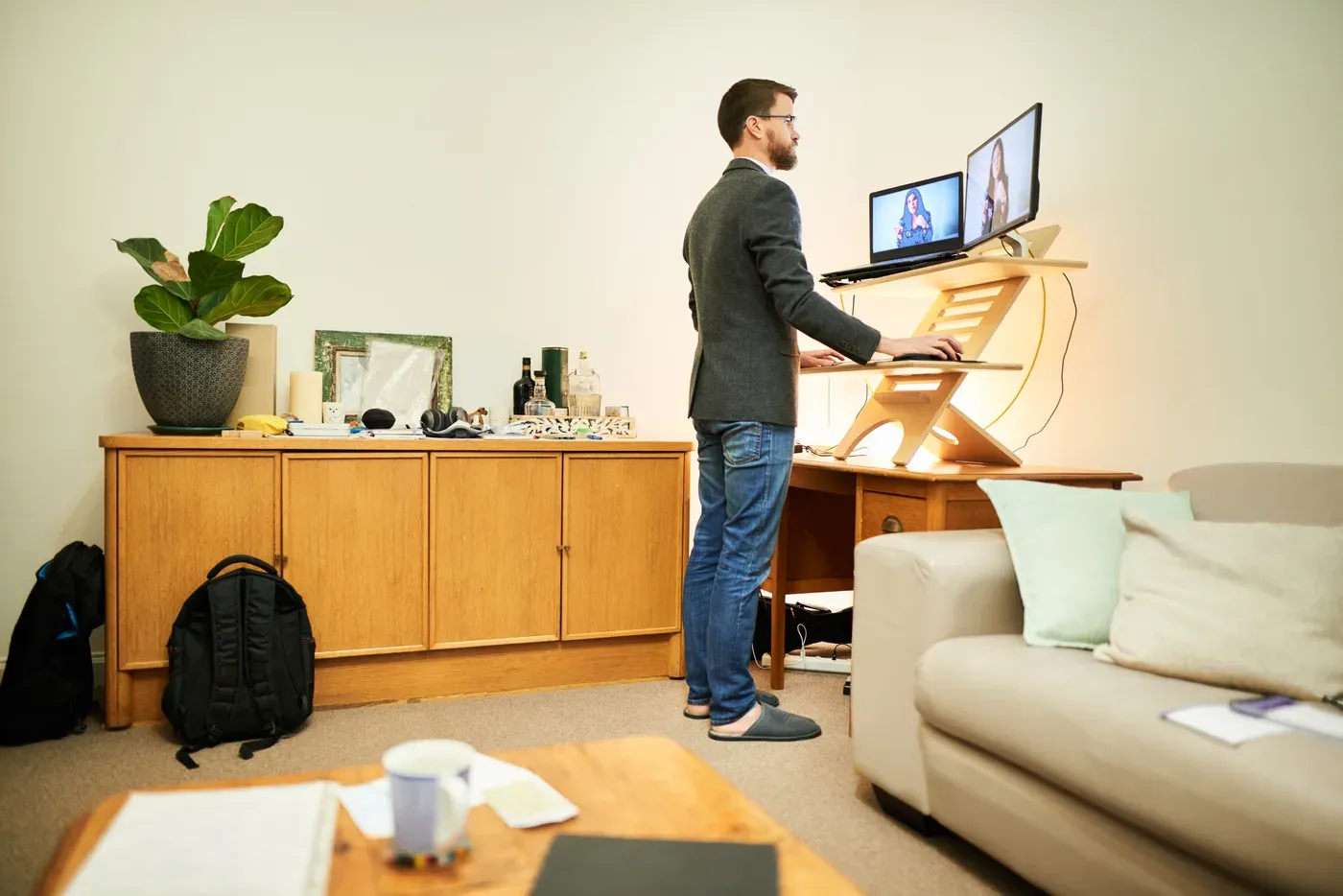
To lose weight with a desk job, you need the same thing as anyone else, a modest calorie deficit, plus a plan that replaces the movement your job removes. In practice that means getting up every 30 to 60 minutes, adding 2,000 to 4,000 steps around your workday, lifting weights two or three times a week, and fixing the two weak points of office eating: the skipped breakfast and the 3 p.m. snack. None of it needs more than 45 minutes of extra time on any day.
Why a desk job makes weight loss harder
A desk job doesn’t stop fat loss; it lowers how much you burn without exercise. Researchers call that daily, non-workout movement NEAT (non-exercise activity thermogenesis): walking, standing, fidgeting, carrying things. In a well-known overfeeding study, changes in NEAT explained most of the difference in how much fat people gained when they all ate 1,000 extra calories a day (Levine et al., 1999). The people who moved more without thinking about it gained less.
An office day removes most of that movement: you drive or ride to work, sit for meetings, sit for lunch and sit on the way home. Canada’s 24-hour movement guidelines recommend limiting sedentary time to 8 hours or less a day and breaking up long periods of sitting as often as possible. A full workday plus a commute and an evening on the couch usually blows well past that.
Sitting also affects how your body handles a meal. In a small trial of overweight adults aged 45 to 65, interrupting sitting with 2-minute walks every 20 minutes lowered blood sugar and insulin after a meal compared with sitting straight through (Dunstan et al., 2012). Short breaks matter, not only workouts.
The desk-worker’s week
This structure assumes a typical 9-to-5 in an office, a commute, and evenings at home. Move the pieces around your calendar, but keep the totals.
| Day | Before work | Workday | After work |
|---|---|---|---|
| Monday | Strength session, 40 min | Walking 1:1s or phone calls; up every 45 min | 20-min walk after dinner |
| Tuesday | — | 15-min walk at lunch; stairs only | Normal evening |
| Wednesday | Strength session, 40 min | Up every 45 min | 20-min walk after dinner |
| Thursday | — | 15-min walk at lunch | Optional: 30 min easy bike or walk |
| Friday | Strength session, 40 min | Up every 45 min | Planned dinner out (see below) |
| Saturday | — | — | Long walk, hike or sport, 60+ min |
| Sunday | — | — | Prep lunches for Mon–Wed; 20-min walk |
That’s about two hours of strength training and several hours of walking a week, enough to meet the CSEP recommendation of at least 150 minutes of moderate-to-vigorous activity and two muscle-strengthening sessions. A program like the 30-minute gym workout fits the morning slots.
Swap mornings for lunch hours if your building has a gym, or for evenings if you’re not a morning person. The point is that each session has a fixed slot, not “when I get a chance.”
Moving more during the workday
These add up to a few thousand steps without taking time from work:
- Set a 45-minute timer. When it goes, stand, refill water, walk to the farthest washroom. Two minutes is enough.
- Walk the one-on-ones. Many 1:1 meetings work better walking, and phone calls never need a chair.
- Take the stairs for anything under four floors. In a downtown tower, ride the elevator part way and walk the last few flights.
- Leave the building at lunch. Fifteen minutes out and back, even in February. Downtown, the PATH counts.
- Change the commute. Get off transit a stop early or park at the far end of the lot.
Track daily steps with your phone for a week first. Then aim to raise the average by about 2,000 a day. The guide on how many steps a day to lose weight explains how to set a target from your own baseline.
Fixing office eating
For most desk workers, the calories don’t come from dinner; they come from the hours in between.
| Office problem | What usually happens | Fix |
|---|---|---|
| Skipped breakfast | Coffee only, then an oversized lunch | 30 g protein before 9 a.m. |
| Takeout lunch | 900+ calories from a food court | Bring lunch 3 days; plan the other 2 |
| 3 p.m. slump | Vending machine, muffins, the meeting-room cookies | A planned snack: Greek yogurt, fruit, a cheese string and an apple |
| Celebrations and catering | Cake twice a week | Pick one a week; skip the rest without explaining |
| Evening at home | Grazing after a long day | Dinner by a set time; kitchen closed after |
Bringing lunch is the single biggest lever. Our list of high-protein lunch ideas for work has options that survive a morning in a bag. If you’re unsure how big your deficit should be, start at a 300 to 500 calorie reduction below maintenance and judge it by two to three weeks of weigh-ins, not by the scale on a single day.
What to expect in the first month
Expect the scale to move slowly and unevenly for the first two weeks. Water and food volume change daily, so weigh yourself several mornings a week and watch the weekly average. By week four, a man eating in a modest deficit and following a structure like the one above should see the average trending down and his waist measurement starting to follow. Strength in the gym should be going up at the same time.
If you work from home some or all of the week, the risks shift: less commuting, more kitchen. The remote work fitness routine covers that version.
This week
Pick three things and do them for seven days: a 45-minute stand-up timer, lunch brought from home three days, and three strength sessions in the calendar as recurring meetings. If you’d like a coach to build the plan around your actual meetings, commute and travel, and to check in each week, coaching for busy professionals is built for exactly that kind of schedule.
Questions people also ask
Can you lose weight if you sit all day?
Yes. Weight loss depends mainly on eating fewer calories than you burn, and that's achievable at any job. Sitting all day makes it harder because you burn less through daily movement, so the plan has to add movement back deliberately and keep food in check.
Does a standing desk help with weight loss?
Only a little on its own. Standing burns slightly more than sitting, but the bigger value is that it makes you more likely to move, pace and take breaks. Treat it as a nudge, not a fat-loss tool.
How many steps should I aim for with an office job?
Start from your current average and add about 2,000 a day for a few weeks, then add more. Most desk workers find their workday count is lower than they guessed, so a steady rise over a month is a meaningful change.
Should I work out before or after work?
Whichever time you can protect. Mornings are less likely to be cancelled by late meetings; evenings suit people who aren't functional at 6 a.m. Consistency matters more than the hour.
Sources
- CSEP — Canadian 24-Hour Movement Guidelines for Adults 18–64
- Levine, Eberhardt and Jensen (1999), Role of nonexercise activity thermogenesis in resistance to fat gain in humans, Science
- Dunstan et al. (2012), Breaking up prolonged sitting reduces postprandial glucose and insulin responses, Diabetes Care